
 E-Paper



Doval champions regional security at NSA-level meet of Colombo Security Conclave
India's national security adviser, Ajit Doval, underscored the Colombo Security Conclave's (CSC) crucial role in guaranteeing regional security and stability.

 Prefer HTon Google


The 6th NSA-level meeting of the Colombo Security Conclave (CSC) witnessed the convergence of top-level officials from India, Mauritius, and Sri Lanka, along with delegates from Seychelles and Bangladesh, as they convened today in Mauritius to bolster regional security cooperation.
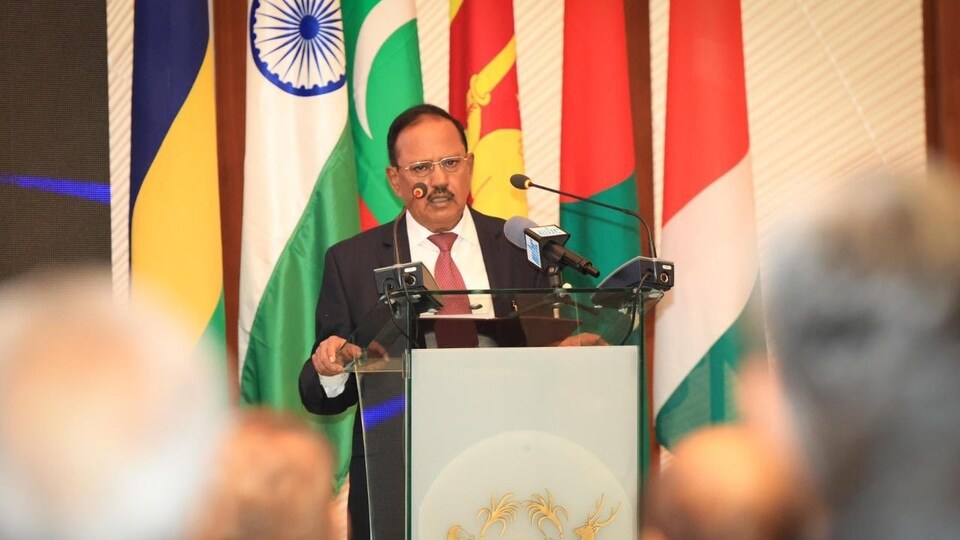
National Security Adviser Ajit Doval emphasized the CSC's pivotal role in ensuring regional security and stability. Highlighting the significance of sustained engagement across the diverse pillars of cooperation, Doval stressed the importance of collective efforts in addressing traditional, non-traditional, and emerging hybrid challenges in the Indian Ocean Region.
During his visit to Mauritius, NSA Doval also paid a courtesy call on Mauritius Prime Minister Pravind Kumar Jugnauth.
The Colombo Security Conclave, established in 2020 through the collaboration of India, Sri Lanka, and the Maldives, expanded its reach and influence when Mauritius joined during the 5th NSA-level meeting in March 2022, held in Male, Maldives. The CSC, focusing on maritime safety and security, countering terrorism, combating transnational crime, cyber security, and humanitarian assistance, has since evolved into a pivotal alliance.
Member States, including observers Bangladesh and Seychelles, reviewed the progress made since the 5th NSA-level Meeting and collaboratively outlined a comprehensive Roadmap of Activities for 2024, reinforcing their commitment to regional security.
Over the past year, member and observer states actively participated in a myriad of activities spanning marine pollution, maritime law, coastal security, oceanography, hydrography, countering financing of terrorism, investigation of terrorism cases, narcotics trafficking, cyber-crime, and cyber security.
Under the maritime safety and security pillar, the CSC celebrated the launch of the Ocean Information Services portal, a tangible outcome of the first Oceanographers and Hydrographers Conference held in November 2022 in Goa and Hyderabad, India. The conference resulted in an array of deliverables, including institutional linkages, joint expeditions, scientific research collaboration, and environmental impact assessments related to maritime incidents.
In an effort to address coastal security concerns, the CSC Coastal Security Conference, initiated in December 2022 in Chennai, brought together Coast Guard leaders and senior officials from Member and Observer States. The conference fostered continuous information sharing and engagement, with plans underway for the next edition in the last quarter of 2024.
Training and capacity-building activities have been a cornerstone of CSC's initiatives, with police officers, counter-terrorism experts, drug law enforcement officers, and cyber security experts engaging in regular exchanges. Joint Working Groups on Countering Terrorism and Radicalization, and on Cyber Security and Protection of Critical Infrastructure have been established to deepen cooperation in specific priority areas. Joint Working Groups on Combating Trafficking and Transnational Organized Crime and Humanitarian Assistance and Disaster Relief are also under discussion between Member States.
In addition to NSA-level meetings, the Colombo Security Conclave convenes at the Deputy NSA level to oversee the implementation of decisions and directions. The next NSA-level meeting is scheduled to be held in India in 2024.


