
 E-Paper



Iranian Airline Favored by the Regime Is Defying Sanctions and Expanding
Mahan Air, accused of ferrying weapons and military personnel, has kept its aging jets flying despite U.S. efforts to ground it.


 Prefer HTon Google


An Iranian airline accused of ferrying cash, weapons and personnel for the regime’s powerful Revolutionary Guard is expanding its footprint, despite more than a decade under U.S. sanctions and a recent push by the Trump administration to ground it.
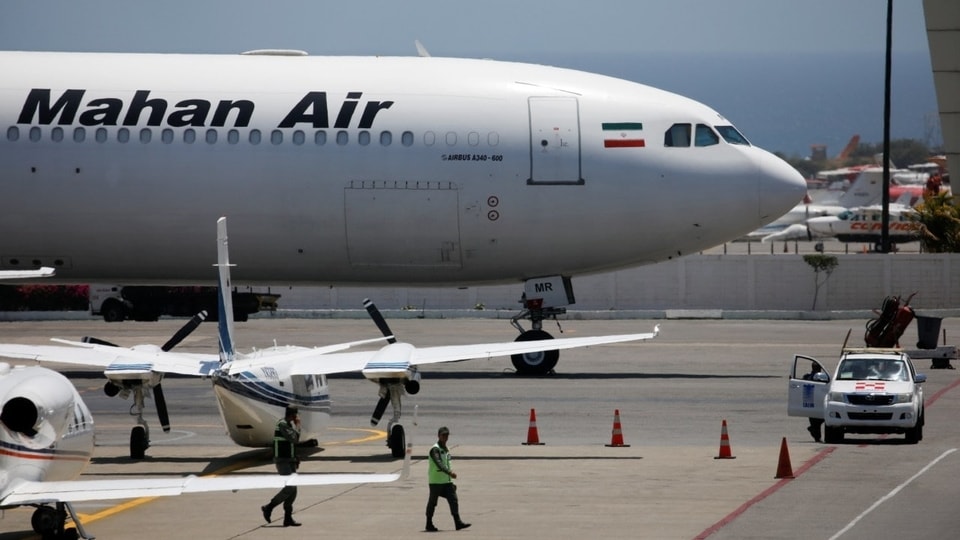
The U.S. and other governments allege Mahan, ostensibly a private civilian carrier, grew into a key conduit for the Islamic Revolutionary Guard Corps to support its allies and advance its activities in the region and beyond.
Mahan’s three dozen planes tend to be aging, secondhand Boeing and Airbus aircraft, some in service for as long as 35 years. Passengers who post about their trips on social media say there is no onboard entertainment or alcohol, and tickets have to be purchased in cash instead of international credit or debit cards.
Despite the lack of amenities, and the sanctions scrutiny, Mahan has been adding new destinations for passenger and cargo services during the war between the U.S. and Iran.
On Aug. 30, six days after Treasury Secretary Scott Bessent launched his campaign of economic pressure on Iran, the airline started flights to Hanoi and Ho Chi Minh City following an agreement between the Iranian and Vietnamese authorities early last month to expand travel and trade.
In July, Mahan launched a weekly flight from Tehran to the Thai tourist resort of Phuket. It now lists regular flights to 20 destinations. The carrier flies five times a week from Tehran to Moscow and every day to Istanbul, Muscat and Guangzhou, a top South China trade hub.
Meanwhile, the airline continues to make appearances at key moments for Iran and its regional militias. Yemen’s Saudi-backed government struck the runway at San’a International Airport this summer to stop a Mahan Air flight bringing Houthi officials who had attended the funeral for Supreme Leader Ali Khamenei from landing. The attack sparked a new conflict between the Iran-backed militants and Saudi Arabia after a long truce.
Last year, Lebanese authorities searched passengers on a Mahan Air flight that touched down in Beirut, after a Saudi news station reported the plane was being used to bring in funds to Hezbollah, the Lebanese militia backed by Tehran. Iran denied the flight was used to fund the group.
“Due to Mahan’s continued use to transfer weapons, the regime is going to look to find ways to keep the airline operating,” said Behnam Ben Taleblu, senior director of the Iran program at the Foundation for Defense of Democracies. “Sanctioning doesn’t mean that Mahan has been grounded but raises the cost to Tehran for continuing operating this airline.”
Mahan didn’t return requests for comment.
The Treasury sanctioned Mahan in 2011 for transporting weapons and personnel for the Revolutionary Guard, then banned transactions with the airline’s service providers and sales agents in multiple jurisdictions as recently as July 30.
More recently, the Treasury has warned half a dozen countries, including Oman, not to allow the airline to use their airports, people familiar with the matter said. The new push is designed to complement steps by the U.S. Navy to shut down seaborne traffic through Iranian ports through its blockade.
Mahan Air was founded in 1991 by politician Hossein Marashi as an airline aimed at developing his native province of Kerman in eastern Iran. The name Mahan refers to a town in that province.
At the time, Iran was rebuilding and opening its economy after a devastating war with Iraq. Mahan quickly expanded its roster of international flights and says it has flown over 100 million people.
But after the election of hard-liner Mahmoud Ahmadinejad as president in 2005, the Islamic Republic took a more aggressive stand against the West, backing radical allies in the region. The airline came under the influence of the Revolutionary Guard and its overseas branch, the Quds Force.
Mahan flew Quds personnel to Syria during that country’s civil war and to Iraq by bypassing normal security procedures, the U.S. Treasury alleged in 2011. Treasury said Mahan transported arms on behalf of Hezbollah and last year alleged it had expanded its weapon deliveries to Venezuela.
The European Union blacklisted the airline in 2024 for allegedly sending drones to Russia, effectively stopping all its flights to the 27-nation bloc. Saudi Arabia also banned the airline in 2016 after cutting diplomatic ties with Iran and hasn’t allowed its flights since despite a rapprochement.
In a 2022 interview with The Wall Street Journal after he had stepped down from the company, Marashi said Mahan had little choice but to transport weapons and Revolutionary Guard officers if asked.
“If the army or Sepah ask Iranian companies, they should help them,” he said, using the Iranian shorthand for the Revolutionary Guard. “We will transport it if they pay money. We have to obey. It’s a patriotic obligation.”
Efforts to reach Marashi for comment for this article weren’t successful.
Write to Benoit Faucon at benoit.faucon@wsj.com


