
 E-Paper



How Donald Rumsfeld, who died aged 88, helped India-Pakistan keep peace after Parliament attack
Donald Rumsfeld, the two-time defence secretary, met his Indian counterpart, George Fernandes, in January 2002 when India and Pakistan were on the brink of another war.


Former US secretary of defence Donald Rumsfeld, who died Tuesday at the age of 88, played an active role in averting a probable war between India and Pakistan following the December 2001 Parliament attack carried out by the Jaish-e-Mohammed (JeM) and Lashkar-e-Taiba (LeT).
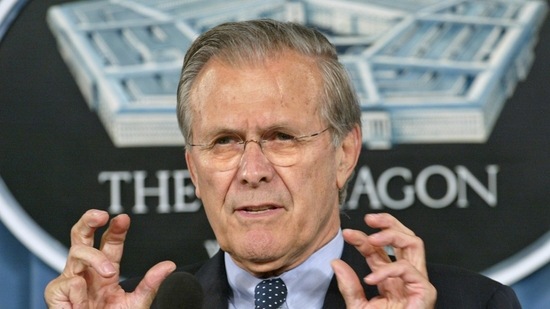
Rumsfeld visited India in June 2002 when Indian and Pakistani armed forces were in a stand-off at the Line of Control (LoC) due to Operation Parakram, sanctioned by then Prime Minister Atal Bihari Vajpayee in the aftermath of the Parliament attack.
But before visiting India, Rumsfeld, the two-time defence secretary and one-time presidential candidate, met his Indian counterpart, George Fernandes, in Washington in January 2002 when India and Pakistan were on the brink of another war. Rumsfeld told a joint news conference that they discussed the “crisis and the tension in the region between India and Pakistan.”
Citing Pakistan's then-president Parvez Musharraf’s speech, Rumsfeld said that Islamabad was taking certain actions and the United States was “certainly hopeful [it] will go a long way towards lowering tensions and promoting a constructive dialogue between India and Pakistan.”
When asked whether Musharraf’s oral assurance was a reason enough for India to dismantle its military build-up, the defence secretary said, “India and Pakistan have to make these decisions. It's not the United States that makes these decisions. It's not any other country.”
Also Read | US pushed for military cooperation with India after 9/11 attacks, says document
During Fernandes’ visit to Washington, reports had emerged that the United States had pressured Israel to not transfer the Airborne Warning and Control System (AWACS) and other weapons to India. “Well, I do not think that the United States had put any pressure on Israel as far as I am aware,” Fernandes had told the press conference, saying there was no substance as far as he was concerned.
Amid efforts from the international community to avert a crisis in the region, the situation seemed to have gone out of control after the Kaluchak terrorist attack in Jammu and Kashmir in May 2002. Ahead of Rumsfeld visit, however, Indian warships had started moving away from waters close to Pakistan, signalling a greater restraint.
Rumsfeld visited New Delhi in June where he met Vajpayee, Fernandes, external affairs minister Jaswant Singh, and national security advisor Brajesh Mishra. "We feel that there are steps being taken which are constructive, and we must say that the leadership here in India has demonstrated their concern and their interest in seeing that things are resolved in an appropriate way," Rumsfeld said after meeting Singh and Mishra.
The stand-off finally ended in October 2002 after months of diplomatic efforts from the international community.


