
 E-Paper



India calls for focus on technology in UN peacekeeping operations
At a meeting hosted by India and chaired by external affairs minister S Jaishankar, the UNSC adopted a first-ever technology-related presidential statement in regard to peacekeeping.


India on Wednesday said the UN peacekeeping operations “must be anchored in a strong ecosystem of technology and innovation” to adapt to changing conflict dynamics and proposed a four-point framework at the Security Council that called, most importantly, for greater focus on “operationally proven, cost-effective, widely available, reliable and field-serviceable technologies”.
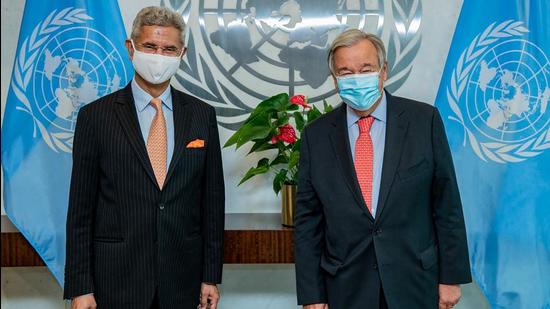
At a meeting hosted by India, which holds the rotational presidency of the UN Security Council for August, and chaired by external affairs minister S Jaishankar, the body adopted a first-ever technology-related presidential statement in regard to peacekeeping - “Technology for Peacekeeping” - that called for recognising “technology has the potential to act as a force multiplier”.
FOCUS ON ACCOUNTABILITY
The top UN body also adopted a resolution drafted by India - “Accountability of Crimes against UN Peacekeepers” - to protect peacekeepers from violence by calling upon member states that host them to take all appropriate measures, to “bring to justice perpetrators of the killing of, and all acts of violence against United Nations personnel”, to “promote accountability” and urged the secretary general to ensure member states did that by every means possible. The resolution was co-sponsored by all 15 members of the Security Council and was the first to be adopted unanimously, and it has also been supported by 80 members of the UN General Assembly.
The meeting on peacekeeping is the second signature event India is hosting as UNSC president. The first was on maritime security which was chaired by Prime Minister Narendra Modi, who became the first Indian prime minister to chair a UNSC debate. The third is scheduled for Thursday, and it will be on counter-terrorism, to be chaired, once again, by Jaishankar.
PEACEKEEPING IN 21ST CENTURY
“Twenty-first century peacekeeping must be anchored in a strong ecosystem of technology and innovation that can facilitate UN peacekeeping operations in implementing their mandates in complex environments,” Jaishankar said. “After all, it helps them to adapt to changing conflict dynamics and take advantage of increased efficiencies.”
Recalling the leading role played by India in UN peacekeeping operations as the country that has made the most sacrifices while participating in these missions and whose men and women are currently deployed in nine missions around the world, Jaishankar said, “To execute their mandates, peacekeeping missions must be able to move fast to acquire and validate, information from a wide range of openly available sources to enhance situational awareness, augment security, aid operational planning, and support decision-making.”
The external affairs minister went on to announce a four-point point framework for securing UN peacekeepers to meet contemporary threats. “We must focus on operationally proven, cost-effective, widely available, reliable and field-serviceable technologies,” the minister said, adding, “These must also prioritise mobility, both in the sense of agile manoeuverability of mission assets and in the sense of use of mobile digital/IT platforms.”
A sound information and intelligence foundation, he said, is the second point of his framework. And in this regard, he announced that India is supporting the UN in the roll-out of the UNITE Aware Platform across select peacekeeping missions. “This initiative is based on the expectation that an entire peacekeeping operation can be visualised, coordinated, and monitored on a real time basis,” the minister said, adding, “ We should ensure that any attack on a peacekeeper or a civilian is predictable, preventable, or responded to immediately.”
It is being rolled out in four missions that are currently under way.
Thirdly, the minister said, efforts must be made to ensure “technological improvements are continuous and are available on the ground, in the gear peacekeepers carry”; and fourthly, more attention should be paid to “consistent training and capacity building of peacekeepers in the realm of technology”.
The minister had laid a wreath at the Peacekeepers Memorial on Wednesday morning along with UN secretary-general Antonio Guterres.
CHALLENGES FOR UN
Guterres also attended the meeting and briefed the member on the challenges and steps UN is taking. “UN peacekeeping was conceived in an analog world. It is now essential that it fully embraces … world in which we live, to improve the world’s agility, anticipation and responsiveness to conflicts, and to be able to address the challenges of today and tomorrow,” said Guterres, adding, “A shift in peacekeeping culture, as well as a systemic change are required for this new weapon.”
Recalling the work done by peacekeepers in “world’s most severe circumstances, Linda Thomas-Greenfield, the US permanent representative to the UN, said, “They deserve the most advanced cutting edge technology to help them do this difficult job better, The right technology helps keep peacekeepers safe, and it helps them keep the communities they serve safe too. So it is our duty to ensure they have the technology and use it appropriately. After all, we all share responsibility for ensuring the safety and security of peacekeepers, as they in turn protect civilians.”
In the Presidential Statement on “Technology for Peacekeeping”, which speaks for the Security Council, the top UN body called for recognising “technology has the potential to act as a force multiplier by enhancing performance, saving resources, simplifying work processes, and allowing peacekeeping missions to have a deeper understanding of the environments they operate in, through improved collection, analysis and dissemination of data”.
The council “stresses the need to leverage the technological tools available to support greater situational awareness of peacekeeping missions and their front-line peacekeepers”, said the statement.
The council “encourages better integration of existing and new technologies, especially digital technology … (and) continued efforts to enhance peacekeepers’ operational readiness and performance in the use of standardised technologies and services”.
The statement urged the secretary-general to “continue to work with member states in exploring available and future technologies and best practices that can contribute towards the safety and security of peacekeepers and protection of civilians”.
PROTECTING PEACEKEEPERS
Underscoring the importance of peacekeeping, the council adopted a resolution - “Accountability of Crimes against UN Peacekeepers” - condemned in “”the strongest terms” the killing of, and all acts of violence against United Nations personnel serving in peacekeeping operations, and their detention and abduction; and expressed “serious concerns regarding challenges in bringing to justice perpetrators saying “the rate of prosecution of such crimes has remained very low, which has further contributed to an environment of impunity, and undermined the safety and security of such personnel”.
The resolution called upon member states that host peacekeepers to take all appropriate measures, to bring to justice perpetrators of the killing of, and all acts of violence against United Nations personnel; “promote accountability” for this violence; and urged the secretary general to ensure this accountability among member states. It also requested the top UN official to “establish a comprehensive online database” in this regard; and, finally, notify the relevant national authorities immediately upon receiving reports of the killing of, and all acts of violence against United Nations personnel.
The resolution also suggested that every UN peacekeeping mission must have “a focal point for all issues related to the prevention, investigation and prosecution of violence against peacekeepers”.


