
 E-Paper



Japan hit by 6.7 magnitude earthquake, tsunami warning issued
The Japan Meteorological Agency has also warned that tsunami waves of up to one metre (three feet) could hit the northern Pacific coastline.

 Prefer HTon Google


A 6.7-magnitude earthquake struck northern Japan on Friday, days after a powerful 7.5-magnitude quake in the same region injured at least 50 people, as per the Japan Meteorological Agency (JMA). The agency has also warned that tsunami waves of up to one metre (3 feet) could hit the northern Pacific coastline.
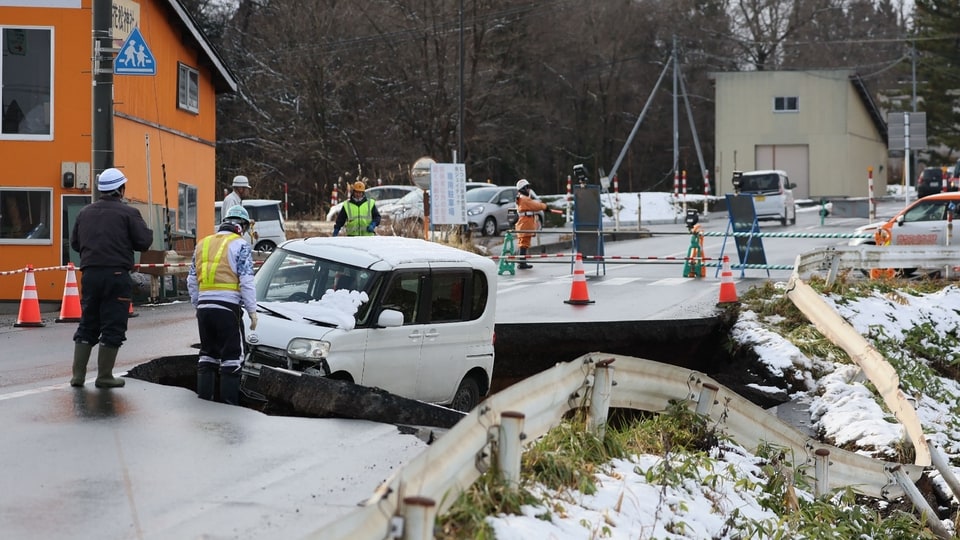
The United States Geological Survey (USGS) also said the quake had a magnitude of 6.7 and was centred 130 kilometres, or 81 miles, from the city of Kuji in Iwate prefecture on Honshu.
Japan earthquake: Tsunami warning issued
Waves of up to 1 metre are possible in areas under the advisory, according to the Japan Meteorological Agency.
A tsunami advisory, a level lower than a tsunami warning, urges those in the area to stay away from the ocean. Evacuation is not required under an advisory.
Japan’s NHK reported that the shaking was weaker than the larger tremor on Monday night, which sent items falling from shelves, damaged roads, broke windows and set off tsunami waves reaching 70 centimetres.
The earthquake measured 4 on Japan’s seismic intensity scale, which ranges from 1–7.
Friday’s quake comes after a 7.5-magnitude earthquake earlier in the week led to injuries, minor damage and initially a tsunami warning along communities on the Pacific coast. At least 50 people were hurt in that earlier quake on Monday, which struck off the coast of Aomori, the northernmost prefecture on Japan’s main Honshu island, NHK reported.
After Monday’s earthquake, the Japanese government had issued a special advisory for residents, including those from Hokkaido in the north to Chiba, to stay alert for an increased chance of a powerful earthquake striking again within a week.
Why is Japan so prone to earthquakes?
Notably, Japan sits on top of four major tectonic plates on the western side of the Pacific "Ring of Fire" and is among the world's most earthquake-prone countries.
The country, which has a population of about 125 million, records around 1,500 tremors each year.
Most of these are mild, though the impact can differ depending on where they occur and how deep they are beneath the Earth's surface.


