Javier Milei is making a habit of beating expectations. When he announced a presidential run, people laughed. After he won, they said protests would scupper his reforms. When he scored early successes, they played them down. Now, after a bumpy year, the irascible libertarian has surprised the world again with a big win in legislative midterms. He must use it to revitalise his programme of radical reform.
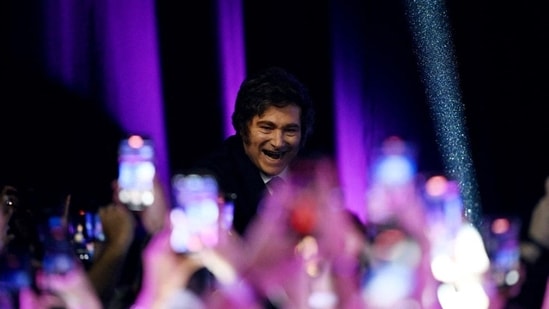
Argentina's President Javier Milei greets supporters in Buenos Aires on Sunday.
Mr Milei’s spending cuts are perhaps the deepest and fastest ever imposed on a country through broad democratic consent. When he won the presidency, promising intense austerity, voters had not yet felt his chainsaw. Now they have: cuts so vicious that the only comparison is post-crisis Greece, where a troika of international institutions imposed austerity in the face of popular outrage. And yet the voters have backed him again. Because only some seats were contested, Mr Milei was never going to gain a majority in Congress. But he now has enough deputies both to block any attempts to restore public spending and to build a coalition to pass further reforms.
This matters beyond the Rio de la Plata. Many rich-world governments are struggling with fiscal deficits and soaring debt. Their problems are not at Argentine levels, but rich-country leaders can still learn from Mr Milei. His success shows the power of tough-but-coherent economic messages that are proclaimed with clarity and conviction. True, blunt fiscal realism may play better with Argentines than with Europeans or Americans, who have no direct experience of the miseries of repeated bouts of hyperinflation and labyrinthine price controls. But until Mr Milei, sceptical pundits held that Argentine voters could never be persuaded to back deep cuts.
The president now has a welcome opportunity to launch a second tranche of reforms. The urgent task is to complete Argentina’s transition to macroeconomic normality. That starts with fully floating the peso. Mr Milei came to rely too heavily on an artificially strong currency to curb inflation, which hampered growth and hindered the accumulation of foreign reserves. His victory makes an orderly float possible, but the clock is ticking. After a brief post-election rally, the peso has again fallen toward the weaker limit of the band within which it is currently permitted to range.
Alongside removing the band—or at least widening it—the government needs a clear monetary policy that uses interest rates to anchor inflation. It also needs to accumulate foreign reserves. Do this, and Argentina could regain access to global capital markets, allowing it to roll over some of its debt. Roughly $20bn of this will come due next year.
Mr Milei also needs to create the conditions for growth. Liberalising labour markets and simplifying the tax system would be a good start. This would reinforce the financial reforms, boosting the economy and Mr Milei’s popularity, paving the way to dealing with tougher policies like pension reform. The president needs a coalition to pass laws in Congress, as well as the support of provincial governors. Investors want legal certainty and stability. The government’s aggression, sometimes aimed against independent institutions, must not undermine that. A cabinet reshuffle would help.
Mr Milei has a chance to improve Argentina in a way that will last long after he leaves office, by transforming the terms of political debate. Every election year markets gyrate at the prospect of a victory for the wild-spending Peronists. Argentina will not become a normal country until it has an opposition that also believes in fiscal discipline. If Mr Milei’s reforms make Argentina a more prosperous and stable place, it could force the Peronists to embrace fiscal rationality.
The path is littered with obstacles. Hubris and a bludgeoning political style may trip Mr Milei up. Yet his journey already holds lessons for the world—and it may soon offer more.
Get the latest headlines from US news and global updates from Pakistan, Nepal, UK, Bangladesh, Russia and US Iran war Live, get all the latest headlines in one place on Hindustan Times.
Home/World News/Javier Milei’s Chance To Transform Argentina And Teach The World

 E-Paper