E-Paper



L.A. Protests Provide Trump With Opening for a Show of Force
Civil unrest is allowing Trump to portray Democratic opponents as weak on crime, but his actions risk being viewed as norm-breaking, authoritarian overreach.


For a man who understands the power of images, the sometimes violent protests in Los Angeles over immigration enforcement have presented President Trump with the ingredients to once again burnish his tough-on-crime message.
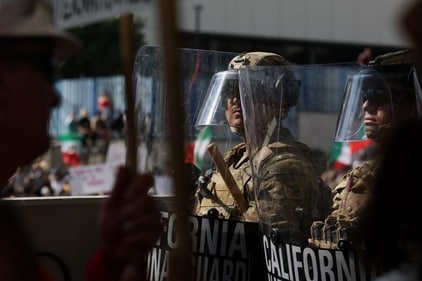
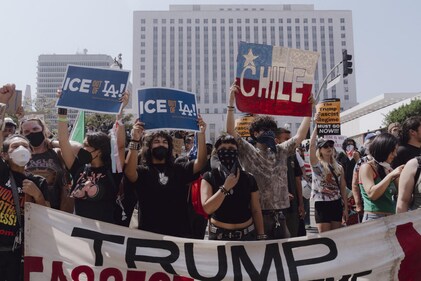
Video of demonstrators protesting Trump’s deportation orders, some burning cars or lining up face-to-face against newly federalized National Guard troops, creates a set of political foils the president is gambling are advantageous to him.
“As is so often the case, Donald Trump’s opponents are playing into his hands,” said Republican pollster Whit Ayres. “This is exactly the kind of fight that Donald Trump loves, with his opponents carrying Mexican flags past burning cars.”
The Republican Party’s House campaign arm summed up Trump’s argument in a single line Monday: “One word to describe the Democrat Party: Lawlessness.”
Democrats counter that Trump’s decision to initially send 2,000 members of the National Guard into the nation’s second-most populous city over the weekend only inflamed the situation, while raising legal issues about states’ rights. The administration on Monday also deployed about 700 Marines to Los Angeles to protect federal property and personnel and authorized an additional 2,000 National Guard members to be sent to California.
One thing that is certain: Los Angeles has helped Trump change the narrative from his messy buddy breakup late last week with billionaire Elon Musk, as well as from the debate over Medicaid cuts in the tax and spending bill he is urging Congress to approve.
“Every day that Donald Trump is talking about immigration, and not talking about kicking 13 million people off insurance and Medicaid, he knows he is winning,” said Chuck Rocha, a Democratic strategist. “He wants to see people standing on top of burning cars, waving the Mexican flag—that’s the exact imagery that can help him overperform in the midterm elections.”
While polling shows most voters oppose deporting longtime residents here illegally but without criminal records, it also shows voters trust Trump’s party more than Democrats when it comes to crime and policing. Trump’s illegal immigration crackdown also remains popular, particularly efforts to deport criminals.
Trump’s actions come with risk, with some potentially viewing them as norm-breaking, authoritarian overreach. By federalizing National Guard troops over the objection of California Gov. Gavin Newsom and local officials, Trump took a step that hadn’t been deployed since President Lyndon Johnson in 1965 chose to override a segregationist governor in the Civil Rights Era.
Trump floated deploying troops during his first term when unrest erupted around the country following the murder of George Floyd. But his defense secretary at the time, Mark Esper, rebuffed his idea and said active-duty military troops should rarely be deployed on American streets to quell protests.
On Monday, Trump said that if protesters spit on National Guard troops, they would respond. “If they spit, we will hit,” he posted on his social-media platform.
Nearly five months into his second term, Trump has surrounded himself with aides and cabinet officials largely in lockstep with his combative approach to the presidency. While the team he had during his first White House tour often provided guardrails for him, the loyalists he has around him now are eager to implement his political instincts.
Trump told reporters Monday he was open to the arrest of Newsom—as Tom Homan, Trump’s border czar, suggested over the weekend for anyone who obstructs the immigration enforcement effort—and said those causing the problem in Los Angeles are professional “agitators” and “insurrectionists” who should be jailed.
Asked later in the day what crime Newsom had committed, Trump said: “I think his primary crime is running for governor because he’s done such a bad job.”
Responding to the suggestion he should be arrested, Newsom said in a statement: “I don’t care if you’re a Democrat or a Republican this is a line we cannot cross as a nation—this is an unmistakable step toward authoritarianism.”
California Attorney General Rob Bonta said on Monday that his state is suing the Trump administration over its decision to send in National Guard troops, arguing the president had acted beyond his authority.
The president has long argued that Democratic leaders were too passive in addressing the unrest in Minneapolis and elsewhere after the killing of Floyd by police in May 2020 and that former President Joe Biden was ineffective in confronting the campus unrest sparked by the Hamas attack on Israel.
Cities such as Los Angeles, San Francisco and Chicago have long been political targets for Trump. He often paints many of the nation’s biggest cities as hellscapes that exhibit what he describes as a decline of lawfulness and weakness of Democrats who run them.
Rob Stutzman, a California-based Republican consultant, said the situation in Los Angeles has created material for both Trump and Newsom, a likely 2028 Democratic presidential candidate, to use to boost their standing among core supporters. “Everyone gets to play hero for their base in a divided country,” he said.
Ayres said immigration is the issue where Trump has received his strongest grades from voters so far in 2025. Still, he said, the administration needs to be careful not to overreach on the issue.
“There is overwhelming opposition to deporting illegal immigrants who have lived here for years without committing any crimes, have American citizen children or those brought here as children,” Ayres said.
While it hasn’t always delivered political victories for him, Trump has a history of amplifying confrontations between protests and police.
During the summer before the 2020 presidential election, he traveled to Wisconsin’s Kenosha County—a politically divided area in a key battleground state—just days after the shooting of a Black man by police triggered protests, looting and fatal violence.
Democratic local and state officials had asked him to stay away, expressing concern that his visit could further inflame tensions. But the then-president, facing a challenging re-election bid amid a troubled economy and a pandemic, ignored them.
In Kenosha, he labeled what happened there following the police shooting “domestic terror” and called for greater support for law enforcement. The Wisconsin violence was just part of a summer filled with racial unrest following the murder of Floyd by a Minneapolis police officer.
Critics say Trump deploys his law-and-order push selectively, noting that he acted quickly once taking office this year to pardon nearly all of the 1,500 people charged in connection with the Jan. 6, 2021, attack on the Capitol, despite cautions from some Republicans who opposed pardons for anyone who had assaulted police. Roughly 140 officers were injured in the attack.
Trump, who lobbied for a military parade happening Saturday in Washington, has long viewed the armed forces as a tool for law and order. In 2022, Esper said Trump had asked about shooting protesters amid the unrest that took place after Floyd’s murder.
“‘Can’t you just shoot them, just shoot them in the legs or something?’” Esper told National Public Radio, recounting a conversation between Trump and military officials. “It was a suggestion and a formal question. And we were just all taken aback at that moment as this issue just hung very heavily in the air.”
Write to John McCormick at mccormick.john@wsj.com and Aaron Zitner at aaron.zitner@wsj.com