
 E-Paper



‘Mega’ tsunami of Greenland in 2023 echoed for 9 days, shook sensors worldwide: NASA
A landslide, which occurred in mid-Sept 2023, sent over 880 mn cubic feet of rock and ice plunging into the Greenland's Dickson Fjord, generating a tsunami.

 Prefer HTon Google


A massive rockslide in Greenland in 2023 triggered a rare and persistent ‘mega' tsunami of sorts that ricocheted within the steep walls of a remote fjord for nine days, according to new satellite data released by NASA and international researchers.
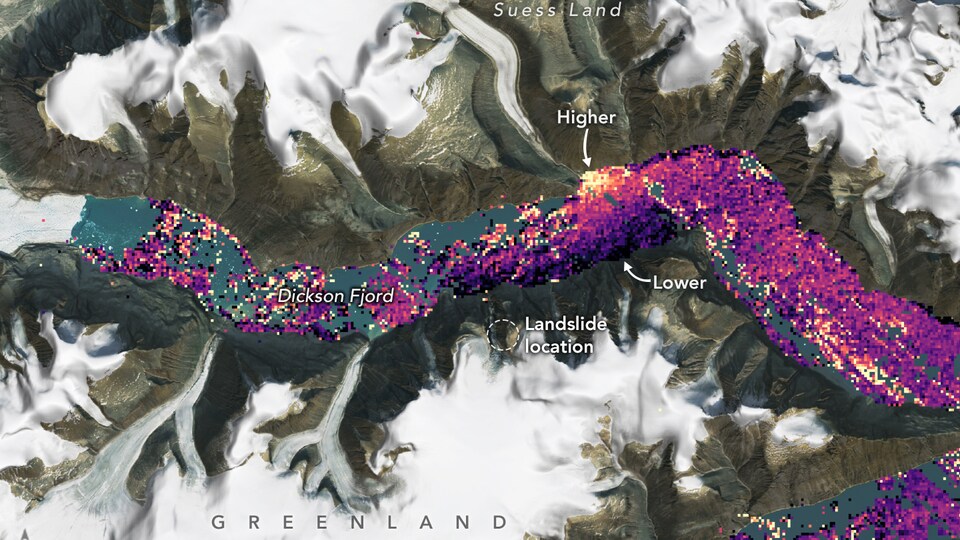
The international Surface Water and Ocean Topography (SWOT) satellite mission, a collaboration between NASA and France’s CNES (Centre National d’Études Spatiales), detected the tsunami's contours.
The event, which unfolded in the Dickson Fjord in eastern Greenland, was captured by the Surface Water and Ocean Topography (SWOT) satellite — a joint mission between NASA and France’s CNES — revealing never-before-seen details of how water surged and tilted inside the fjord after the impact.
Every 90 seconds for nine days
The landslide, which occurred in mid-September 2023, sent over 880 million cubic feet (25 million cubic meters) of rock and ice plunging into the Dickson Fjord, generating a tsunami that lacked space to dissipate. Instead, it bounced back and forth within the confined waterway — rising and falling every 90 seconds.
The impact was so powerful that seismic sensors around the world detected the tremors.
“Far from the open ocean, in a confined space, the energy of the tsunami’s motion had limited opportunity to dissipate, so the wave moved back and forth about every 90 seconds for nine days. It caused tremors recorded on seismic instruments thousands of miles away,” the article read.
Using its high-resolution Ka-band Radar Interferometer (KaRIn), the SWOT satellite measured changes in water elevation from its orbit 560 miles (900 kilometers) above Earth. A flyover on September 17 — just a day after the landslide — showed dramatic tilting in water levels, with the north side of the fjord standing up to 4 feet (1.2 meters) higher than the south. These results were compared with baseline measurements taken weeks earlier, on August 6.
“SWOT happened to fly over at a time when the water had piled up pretty high against the north wall of the fjord,” the article quoted Josh Willis, a sea level researcher at NASA’s Jet Propulsion Laboratory in Southern California.
The Dickson Fjord, about 1.7 miles (2.7 kilometers) wide and 1,772 feet (540 meters) deep, lies along a remote network of channels on Greenland’s rugged east coast. Its towering walls — more than 6,000 feet (1,830 meters) high — helped trap the ‘mega’ tsunami’s energy and keep it churning for more than a week.


