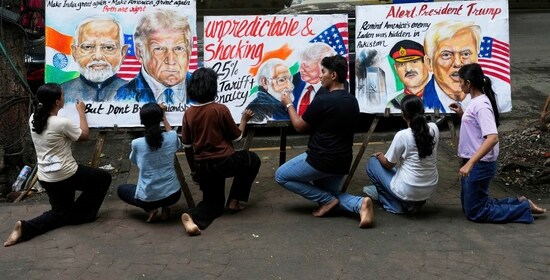
On August 4th Donald Trump took to Truth Social, his social-media platform, to berate India: because the country’s “massive” oil purchases fund “the Russian War Machine”, he said, it would suffer substantially steeper tariffs than the 25% the president slapped on the country last week. Two days later he added a further 25% from August 27th—pushing the total tariff rate to 50%. In some ways the president is not wrong: Russia supplied a negligible 0.2% of India’s oil imports before the war in Ukraine. Since then, it has become India’s biggest supplier, providing between 35% and 40%. But Mr Trump’s vendetta also marks an ugly end to his bromance with Narendra Modi, India’s prime minister.
Few in India seem in the mood for compromise. (AP)
Months-long negotiations between the two countries towards a “mini-deal” have yielded a final tariff rate that is virtually double the original threat of 26% tariffs on Indian exports to America. Previously, Mr Trump has complained about the total bilateral trade of $212bn, that India hoped would be a sign of closer ties. In Mr Trump’s view, though, America runs a “MASSIVE TRADE DEFICIT WITH INDIA!!!”
Chart
Few in India seem in the mood for compromise. In a defiant public address on August 2nd Mr Modi avoided name-checking the American president but urged economic self-reliance at a time of global uncertainty. Anonymous Indian officials are briefing international media on India’s right to Russian oil. America’s negotiating team is expected in Delhi, as planned, for the sixth round of talks starting on August 25th. Even so, Ajit Doval, the national security adviser, was warmly received in Moscow on August 6th. Subrahmanyam Jaishankar, India’s foreign minister, will reportedly follow later this month.
This marks a striking change from Mr Trump’s first term, when the American president and Indian prime minister filled stadiums from Texas to Gujarat in celebration of a blossoming bond between the two countries. India clinched deals for defence equipment and tech usually reserved for NATO allies and some exemptions from sanctions on its dealings with Russia. A mutual disquiet about China’s rise lent the relationship urgency. As a result, India welcomed Mr Trump’s comeback. According to a poll in 2024 by the European Council on Foreign Relations, a think-tank, 84% of Indians believed Mr Trump was good news for their own country—the highest among all 24 countries polled.
But despite Mr Modi’s outwardly friendly reception at the White House in February, one journalist briefed on the visit describes Indian diplomats as “stunned” by the “lack of respect” America’s president showed India’s prime minister behind closed doors. Mr Trump has demanded that India buy more American weapons. He used a military plane to deport illegal Indian migrants in handcuffs. Trade disputes between the two countries in Mr Trump’s first term look like “an early sign of the madness that was to come”, concedes one former Indian ambassador.
Economic assessments of the fallout from MAGA tariffs are shaky. Indian manufacturers—of textiles and garments, for example—will find themselves at a huge disadvantage compared with regional competitors such as Bangladesh, Indonesia and Vietnam. These countries have emerged from Mr Trump’s executive-order blitz facing tariff rates on their American exports less than half of India’s. At least, to India’s relief, existing exemptions for pharmaceuticals and electronics seem to have survived. India is the world’s biggest exporter of generic drugs and is also experiencing an electronics-export boom. Trade experts assume that Apple will keep making most of its American-sold iPhones in India. However, other companies may be wooed by lower tariffs elsewhere.
Even India’s few reliably pro-American voices are losing faith. Mr Jaishankar, known for his patient decades-long campaign to corral sceptical compatriots into American arms, has mounted no recent defence of Mr Trump. Instead, on August 4th he said that: “We live in complicated and uncertain times. Our collective desire is to see a fair and representative global order, not one dominated by a few.” A hawkish foreign-policy analyst now uses a term usually reserved for China, saying that India should “de-risk” from America. India’s small club of free-market economists has stopped arguing for India to unilaterally lower its tariffs. One foreign-affairs insider describes how, under previous administrations, the view was that “America cannot be trusted”. Now that Mr Trump has alienated Mr Modi’s government, India “will go back to thinking that way,” she says.
Get the latest headlines from US news and global updates from Pakistan, Nepal, UK, Bangladesh, Russia and US Iran war Live, get all the latest headlines in one place on Hindustan Times.
Home/World News/Narendra Modi And Donald Trump Go Head-to-head

 E-Paper