
 E-Paper



Premium Conversation | Raja Krishnamoorthy on Indo-US ties & the China challenge
Congressman Raja Krishnamoorthi, the elected representative from Illinois’s 8th district in the House of Representatives spoke to HT about India-US relations, China, the state of democracy, and the politics of Indian-Americans


Washington: Congressman Raja Krishnamoorthi, the elected representative from Illinois’s 8th district in the House of Representatives, is a member of the House Permanent Select Committee on Intelligence, the select subcommittee on the coronavirus caucus, and an assistant whip of the Democratic caucus.
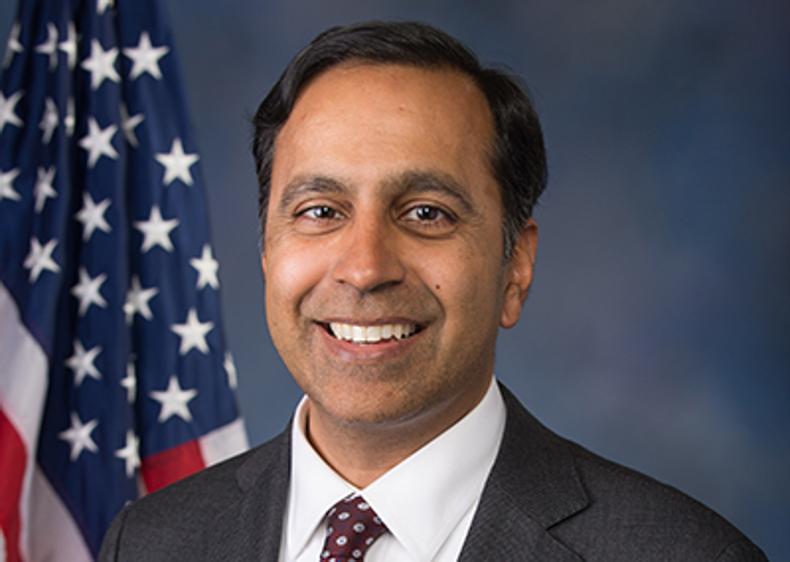
Born in 1973 in Delhi, he is a part of the cohort of Indian-American political leaders – along with Pramila Jayapal, Amy Bera and Ro Khanna – who have, in quick time, risen up in the US Congress and become important voices on debates in domestic policy and national security. Krishnamoorthy went to Princeton and Harvard, before becoming active in Chicago politics. All four are Democrats.
In a wide-ranging conversation, Krishnamoorthi spoke to Hindustan Times on Tuesday about India-US ties in the wake of the Russian invasion, the China challenge, the state of democracy in India and the US, and the rise and politics of Indian-Americans.
Where do India-US ties stand in the wake of Russia's invasion of Ukraine and the differences in position of Delhi and Washington on the issue?
I think it remains strong. Obviously, different countries have different opinions with regard to different subjects, but the fundamentals remain extremely strong and that's why the United States and India continue to cooperate on a range of issues, from security matters as part of the Quad initiative to economic matters, trade matters, and of course, people to people and cultural ties. As you know, there are more than four million Indian-Americans in the United States and they form a very sturdy and long-lasting bridge to India. And I think that also helps to always keep the relationship close.
Are you worried that these differences, despite the underlying strengths of the relationship, will lead to a degree of distrust and strategic divergence?
No. I think everybody understands the long-term trajectory of the relationship. I think that everyone understands that what we share in common far, far outweighs anything that we may disagree about. The most important challenge in the Indo-Pacific region is containing the Chinese Communist Party and Chinese communist aggression. And I think that if we take the eye off that ball, we lose an opportunity to really stabilise the region and create a rules-based international order, which is what I think all democratic countries desire.
The strategic relationship
Since the US is so focused on the European theatre and the Russia challenge, is there a risk it will takes its eyes off the ball from the Indo-Pacific theatre and the China challenge?
Absolutely not. In fact, I am going to the Indo-Pacific region shortly to meet with some of our allies and partners to highlight the importance of our ties to the region and to underscore the need to remember that we need a common approach to our common regional challenges.
In the context of the Russian invasion, how do you read what China’s current position?
I think the Chinese Communist Party decided to back Vladimir Putin a 100%. And I think that they are having misgivings about that. They are not even willing to kind of call out the the situation in any kind of objective fashion. And, in fact, the Chinese Communist Party is, as usual, fabricating misinformation about what is happening in Europe. They are also trying to brainwash their population about the United States and its role in the world. I think that Xi Jinping is riding a dangerous tiger in the sense that the more that he builds his leadership on a house of cards, in a sense of misinformation, propaganda, falsehoods and fabrication, the more brittle it becomes and the more the Chinese population understands the reality of the situation. I think, medium to long term, I think that's something that he should be concerned about in terms of his own leadership. I think democracies based on the fundamental principle of equality under the law, liberty and freedom for people, protection of minorities, all the shared values of the United States and India have in common, will ultimately prevail. That is what we see in history.
The administration has been saying is that it is willing to help India offset its defence dependence on Russia with deeper cooperation. In Delhi, the sense is that issues such as pricing, technology sharing, and willingness to co-manufacture in India inhibit these deeper ties. Are you willing to champion deeper India-US defence ties, with the US accommodating some of India's concerns?
Sure. And I think that that is really the conversation that we should be having. We should increasingly talk about what is the manufacturing and technology supply chain on the defence side, how do we make sure that our mutual defences are strong, and how do we make sure that India has the capability that it requires to defend itself without being so dependent on Russian imports and, at the same time, have access to the most modern technology. So I think all of those issues should be on the table. In general, I think that what we have learned also about supply chains is that you have to be very careful about where you source components, where you source materials. For instance, if we are all going to depend on semiconductor chips coming out of Taiwan, then we have another security challenge that we have to deal with. So we have to look at everything in a holistic fashion.
What do you think about the health of Indian democracy at the moment?
I think, like American democracy, it's being challenged. I think that all democracies around the world are facing pressures. I believe minority rights are very important in any democracy. I think that they are under pressure in India. I think they are under pressure here in the United States. As an Indian-American myself. I am a member of an ethnic, religious, racial minority, and I am an immigrant, and I have got 29 letters in my name. And I feel the pinch of pressure on minorities in the United States when it happens, whether it's on the immigration front -- my office had one of the biggest immigration caseloads of any in the country, we have not only Indian-Americans, but 30% of my constituency is foreign-born. And these people have gone through hell in the last six years, especially during the (Donald) Trump presidency, as immigrants. But for that matter, if you are a minority, if you are Hindu, if you are a Muslim, if you are Sikh, if you are Jew, you have probably seen and felt certain pressures that you didn't think you would. And that's something that I think about a lot.
I lived through January 6. On that day, a bomb was placed 200 feet from my office window. And it turns out that a lot of people in America believe in political violence. One study by Professor Robert Pape of University of Chicago suggests that upwards of 10% of American adults, mostly white men, believe in political violence as a tool to get their way. And you know what motivates or animates them their belief is something called the great replacement theory that Democrats are actively trying to replace White people with non-white people from around the world, including India and other countries. So that is what we are up against here. And I can see it happening in every other country at this point. And we have got fight very hard against those pressures.
Indian-Americans, their rise, and their politics
Indian-Americans have really risen to key positions in American political structures. What do you attribute this to?
I think Indian-Americans have fully embraced their roles in society in every field, from journalism to now government, and, of course, business and medicine and finance and so forth. The fact that they embraced their role in these fields, plus the fact that, quite frankly, Indian-American parents did a heck of a job in instilling in their children a real desire for education and excellence has manifested itself in this type of leadership in different areas. So I give the credit to the parents for sure.
Lots of Indian parents will relate to that and be happy to hear it.
(Laughs) I am an Indian-American parent now, so I am on the other side of this. But, seriously, what you can say for sure is that the first generation of Indian-American immigrants who obviously are our parents sacrificed so much in coming to the United States from India. And I believe they passed along that desire to make that venture count, make that journey and their sacrifice count. I think it inspires countless Indian-American children who now have kind of come into their own in different ways.
Two questions on the political preferences of Indian-Americans. The first is with regard to their role in US politics. Indian-Americans were largely seen as Democrats. Do you think there is a shift of at least a segment of the demographic towards the Republicans?
I think, increasingly, their political preferences resemble the places where they live. And so as Indian-Americans have increasingly moved south and west, they are, you know, more likely to be members of another party or have independent affiliation. But I still think that a lot of them, even among Republicans, help to provide some ballast and steady some of the direction of the party so that it doesn't become an anti-immigrant party, and it still keeps with the best traditions of what it means to be an American. I think they help to provide that kind of direction.
Indian politics is sharply polarised as well. Have those divisions back in India manifested itself strongly within diaspora here?
I think the vast majority of people are much more interested right now in making sure that their own families and their own communities and their own country are moving in the right direction, given the incredible turbulence of the past few years. They still want to stand up for the very best principles that they believe make India great, whether its standing up for a secular democracy, standing up for all communities, and making sure that…just as they would want America to be its best self, they would believe the same for India. It's almost like rooting for your home team. And I think there is always going to have that incredible tie to their home countries.
As midterms come up, why does it seem like your party is in trouble?
Well, that's a simple question with a long answer. The short answer is that I am still hopeful about our fortunes. Historically, in America, the party in the White House tends to have a tough time, tougher time during a midterm election…That being said, we are still in the middle innings of this election cycle. And we have a lot of innings to go and we need to do everything we can to succeed in November.
 ABOUT THE AUTHORPrashant Jha
Prashant Jha is the Washington DC-based US correspondent of Hindustan Times. He is also the editor of HT Premium. Jha has earlier served as editor-views and national political editor/bureau chief of the paper. He is the author of How the BJP Wins: Inside India's Greatest Election Machine and Battles of the New Republic: A Contemporary History of Nepal.Read More


