
 E-Paper



RCEP deal that India didn’t join stands signed now. What’s next?
China has been taking the lead on RCEP for 8 years now since the Obama administration made plans for a TPP excluding China.

 Prefer HTon Google


The Regional Comprehensive Economic Partnership, or RCEP, was signed virtually on Sunday during the annual summit of the 10-nation Association of Southeast Asian Nations (ASEAN).
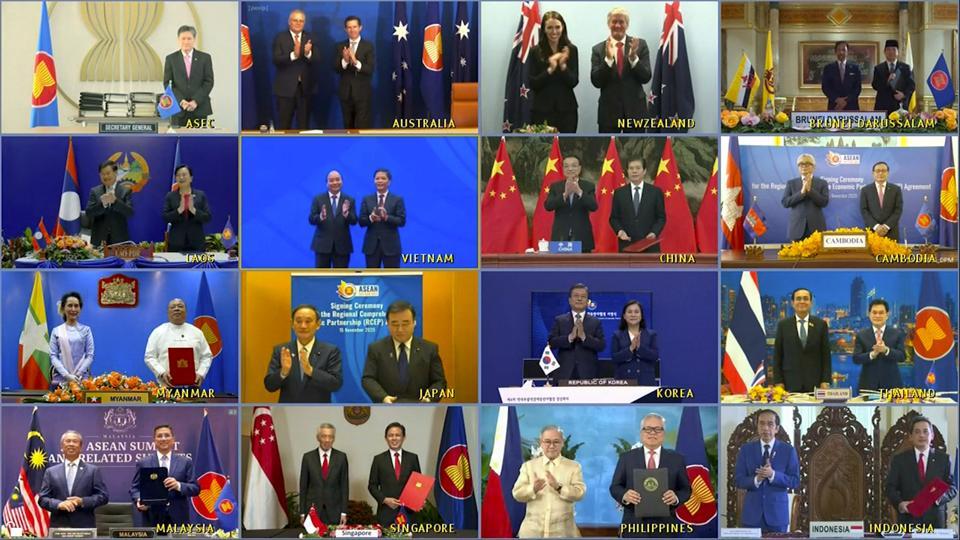
The signing of the pact was an unusual ceremony since all the member countries were connected by video.The trade ministers of each country took turns to sign separate copies of the pact and later held it up for the cameras, accompanied by their respective head of the state.
14 countries under the tutelage of China have formally agreed to form the world’s largest free trade bloc, encompassing nearly a third of all economic activity. After 8 long years of negotiations, the deal was finally sealed as leaders world over are keen to nudge their pandemic-hit economies back on track.
Why did India not take part?
India was part of the negotiations up until last year but withdrew from talks after severe domestic protests. The Indian pharmaceutical industry was all in favour of the RCEP because they wanted to import generic drugs to China, but textile, agriculture, and dairy sectors were worried about cheap imports flooding the domestic market. The dairy sector in particular was worried about products from New Zealand and Australia inundating the domestic market.
China also rebuffed India’s demands for a more ambitious pact that would have gone further in tying together the region’s economies and would have included trade in services as well as trade in goods.
India already faces a mammoth trade deficit with China, and sought power to increase tariffs if imports surged. It also wanted to be able to reduce tariffs for low-end, labour-intensive industrial goods, all points which China refused to include in the pact.
“As far as India is concerned, we did not join R.C.E.P. as it does not address the outstanding issues and concerns of India,” Riva Ganguly Das, the secretary for Eastern relations at India’s Ministry of External Affairs, said at a news briefing on Thursday.
What changes after the pact comes into force?
The most crucial aspect of the pact, for now, is that it opens up trade liaisons between Japan and South Korea. Earlier, Japan due to its controversial role in the wartime occupation of the Korean peninsula was not able to establish friendly relations with South Korea. Last year, at the face of an escalating diplomatic dispute, removed South Korea from its ‘white list’ of trusted trade partners, a move South Korea criticized as a violation of the “spirit” of RCEP. Now, under a comprehensive multilateral trade pact, the two countries are expected to develop better trade relations which they were unable to foster bilaterally.
The RCEP also has a rules of origin clause, which will set common standards for how much of a product must be produced within a particular region for the final it to qualify as duty-free. These rules could make it simpler for companies to set up supply chains across several countries.
It does not cover environmental protection laws, intellectual property, and labour protection laws, all three laws have been a particular contention for China from time to time with the United States and Europe. It does not put restrictions on state-subsidy of business either, something which the Trans-Pacific Partnership(TPP) brought about by the Obama administration to counter China’s influence in Asia, explicitly dealt with.
Experts opine that RCEP is the formalisation of bilateral trade agreements that already existed within different countries into a uniform multilateral trade deal, it does not attempt to remake.
China has been taking the lead on RCEP for 8 years now since the Obama administration made plans for a TPP excluding China. When Donald Trump took office he withdrew US from the TPP, choosing to put “America First”, but since last year even Trump has been trying to counter China’s influence, with Joe Biden giving no indication of easing up on China the Communist Parties anxieties are well placed. With the UK’s criticism of its activities in Hong Kong, European Union coming down on China’s Ughyur repression, and America banning Chinese government linked technology companies China is doing its best to hold fort against the global storm that is coming.


