
 E-Paper



S Jaishankar says Quad a ‘new mode’ of partnership for like-minded countries
S Jaishankar pointed out that India and the US were largely on the same page on “principal level” on Afghanistan but agreed less on others, such as “some neighbours” of Afghanistan.


Indian external affairs minister S Jaishankar on Thursday said the Quad (Quadrilateral Security Dialogue) offered a “very new model of cooperation among like minded countries” and added that no one, especially those attempting to portray it in a negative such as China, which he did not name, had the “veto on our choices”.
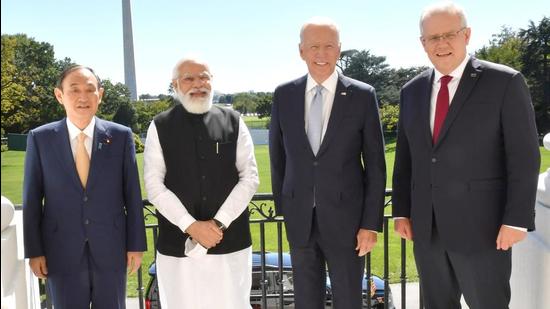
S Jaishankar also pointed out that India and the US were largely on the same page on “principal level” on Afghanistan but agreed less on others, such as “some neighbours” of Afghanistan, whom he did not name but meant Pakistan as he explained India’s position as a victim of cross-border terrorism.
The minster spoke on a wide range of foreign policy issues but focused mainly on the bilateral relationship with the United States and the Quad in a virtual discussion hosted by the US-India Strategic Partnership Forum (USISPF) as part of its annual leadership summit.
Asked to define the Quad, which held its first in-person summit during Prime Minister Narendra Modi’s visit to the United States last week, S Jaishankar said, the group is made of four countries of the Indo-Pacific region who “have a lot of shared interests, who have a very common … values and beliefs, who as a consequence of all this have a high degree of comfort and working together on the immediate, and more than immediate concerns of the whole region”. “I actually see it very frankly as a very new model of cooperation among like-minded countries,” he added.
Asked if it was about China, a question that comes up at every discussion about the Quad, S Jaishankar said, repeating himself and perhaps every other member of the group, it was not aimed against anything or any other country.
He went on cite the joint statement to bolster his argument, saying, “we are for rule of law, we are for freedom of overflight, we are for peaceful resolution of disputes we are for democratic (rights), we are for territorial integrity of states”.
S Jaishankar went on to sharply condemn attempts to give it a negative slant saying “which actually is not from, you know, our, our script, it is somebody else’s script, and I don’t think we should fall for that. I think we need to be positive, you know, all of us have a fundamental right to cooperate with partners, I think it’s important that others should not have a veto on our choices”.
Beijing has tried to frame the Quad as China-centric. A Chinese foreign ministry spokesperson said this of the in-person summit: “For some time, these countries have been keen on insinuating China with the so-called ‘rules-based order’, playing up and inciting the so-called ‘China threat’ theory, and driving a wedge between regional countries and China. China is firmly opposed to this.”
S Jaishankar, who has been critical of the US decision to pull out of Afghanistan calling it a move driven by political expediency, was blunt in his assessment of differences in the views of India and the United State though, he noted at the outset “we are on similar page at the principal level, on many of these issues” such as terrorism.
But there are differences. “There would be issues on which we would agree more, there would be issues on which we would agree less. We have been victims of cross-border terrorism ourselves from that region.”
And that, he added, has shaped, in many ways, “our view of some of the neighbours of Afghanistan”.
S Jaishankar noted that domestic discussions in the United States were also beginning to focus on Pakistan.
Top US generals have in recent congressional hearings pointed to Pakistan’s sanctuary to Afghan figures from the US and international forces as one of the reasons for America losing the Afghan war.


