The battle for blue skies over Beijing leaves farmers cold
Villagers across northern China have long burned coal as a cheap source of warmth. But that thickened a hazardous smog, which cloaked Beijing every winter.
Residents of Hebei, a province of some 74m people which surrounds Beijing, sometimes suffer for being so close to the capital. During the covid-19 pandemic, Hebei enforced extra-tough controls over people’s movements to stop infections spreading into Beijing (state-run media praised the province for acting as a “moat” against the virus, though Hebei residents were not asked for permission). Then, after torrential rains in 2023, the government diverted floodwaters into Hebei’s cities to avoid submerging areas of Beijing, outraging locals. Now Hebei folk have another reason to be upset. The side effects of efforts to clean up Beijing’s air have left some unable to heat their homes.
Smog shrouds residential high-rises and railway tracks as air pollution reduces visibility in the city, in Beijing, China, Thursday, Dec. 18, 2025. (PTI Photo) (PTI)
Chart.
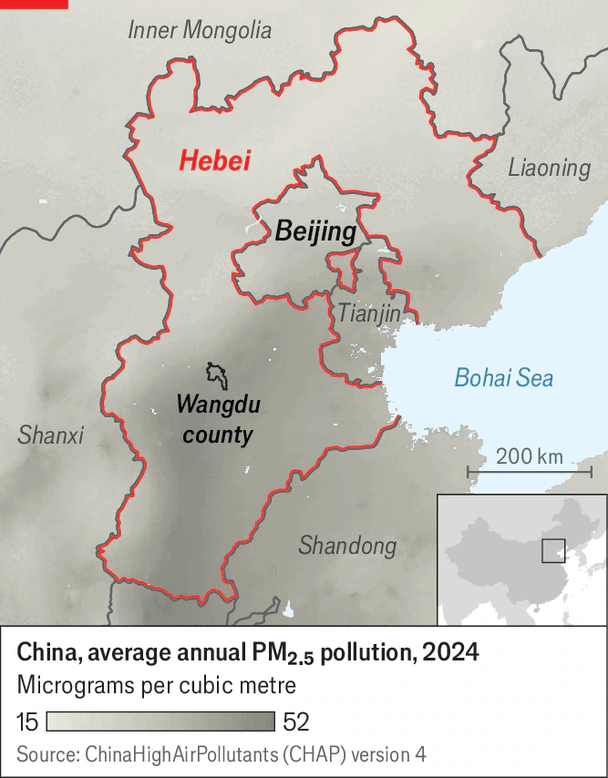
Villagers across northern China have long burned coal as a cheap source of warmth. But that thickened a hazardous smog, which cloaked Beijing every winter. In 2017 the government banned coal burning and started installing gas heaters instead. The plan (combined with other measures, such as forcing factories to move away) worked. Beijing’s peasoupers are now, largely, a thing of the past (see map). On January 4th environmental officials said the capital had seen only one “heavily” polluted day last year, going by the government’s standards. Annual average concentrations of PM2.5, an especially dangerous type of pollutant made of tiny specks of dust and ash, are less than a third of what they were around a decade ago.
But heating with gas is much more expensive than with coal. And although at first government subsidies helped to make up the difference, they have tapered off in recent years. As a result, some Hebei villagers could face bills of more than 6,000 yuan ($860) for a winter’s worth of heating, which is more than the average annual pension in rural areas. To make matters worse, gas prices in Hebei have also risen faster than they have in Beijing and are now about 20% higher. That is partly because heating companies in the capital can negotiate better deals for gas and residents there enjoy subsidised central heating. Some farmers are sneakily going back to burning coal, according to a handful of news reports. To stop this, officials occasionally send drones to look for suspicious smoke trails. Rule-breakers are then fined. More law-abiding villagers are huddling under extra blankets instead.
Videos of shivering rural elderly have made a splash on Chinese social media. Many consider it unfair for Hebei to freeze in order for Beijing to have clean air. “Everyone who benefits from blue skies should bear the cost of them,” said one commenter on Weibo, a social-media platform. Perhaps, some mutter, China’s officials should talk less about America’s social concerns (one of their favourite topics) and more about problems closer to home.
In fact some state-run media, which normally run only glowing coverage of domestic affairs, have been surprisingly critical. “A solution for Hebei farmers’ heating problems can no longer be delayed!” thundered a recent commentary from the Farmers’ Daily. It was later taken off the newspaper’s website, though it still remains available on other official platforms. Several sympathetic articles on the problems of Hebei farmers have been removed from social media, too. Although internet censors are allowing some discussion of the issue, they seem uneasy in case things get out of hand.
The big freeze
In one dusty village in Wangdu county, in central Hebei, gas pipes snake around the low brick houses, but many residents choose not to use them because of the cost, despite the patches of ice on the ground. “It’s not easy for us ordinary folk to earn money, so we just try to weather the cold if we can,” says one woman. “People with small kids have no choice but to pay,” she adds. Another local says he supports efforts to clean the air. But he claims not to have received any subsidies in recent years to help make the switch to gas affordable. “Staying warm shouldn’t be incompatible with government policies,“ he believes. “It’s hard to bear.” It is hardly the first time that the people of Hebei have had to grit their chattering teeth.
Subscribers can sign up toDrum Tower, our new weekly newsletter, to understand what the world makes of China—and what China makes of the world.
Get the latest headlines from US news and global updates from Pakistan, Nepal, UK, Bangladesh, Russia and US Iran war Live, get all the latest headlines in one place on Hindustan Times.
Home/World News/The Battle For Blue Skies Over Beijing Leaves Farmers Cold

 E-Paper