
 E-Paper



The Bond Market Issues World Leaders a Failing Grade
Nothing in this week’s G-20 suggested an end to the deficits, inflation and geopolitical disruptions that are roiling investors.


 Prefer HTon Google


If you’re a global bond investor, you’ve had a lot to fret about lately. Government deficits are out of control, inflation is stubborn, and geopolitics, from trade wars to actual wars, threaten to make both worse.
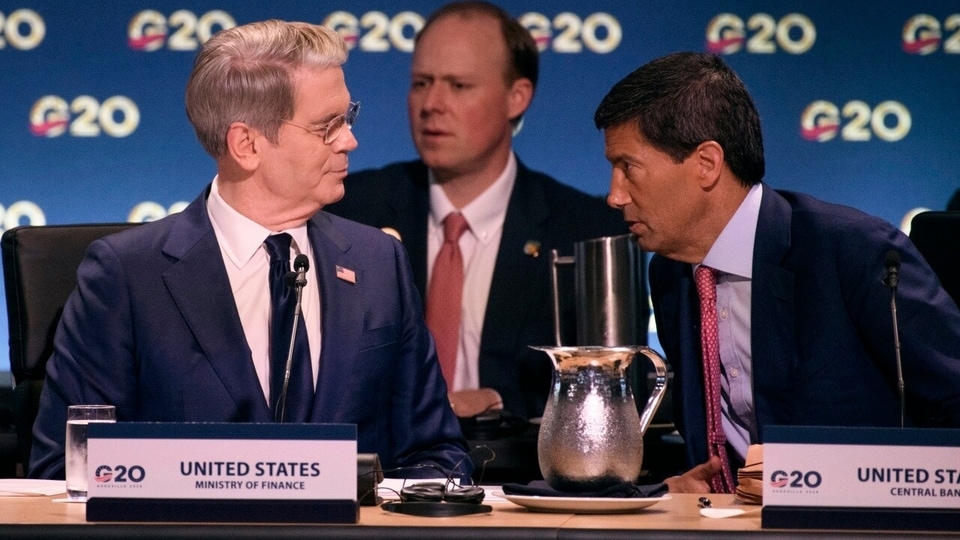
You probably noticed that the government officials who can presumably do something about these things got together this week for the G-20 summit. You might have hoped they would do something, anything, to put your mind at rest.
Judging by the rise in bond yields this week, you’ve been disappointed.
It’s not (just) the U.S.
Deep Dive

The preponderance of attention has been on U.S. Treasury yields, which hit 4.8%, the highest of President Trump’s presidency, this week. But this is not only—or even mostly—a U.S. story. Yields have actually risen more in Japan, where the 10-year yield hit 3% for the first time in 30 years, and just as much in Europe. France’s 10-year yield, at 4.21%, is up 0.65 percentage points this year. Britain’s, at 5.15%, is up 0.67 points.
All, like the U.S., are struggling with energy-induced inflation and gargantuan debts, without the benefit of American tech-led growth. France’s minority government is barely capable of passing a budget. Japan’s Prime Minister is using her massive majority to spend more, not less.
Nonetheless, all eyes naturally turn to the U.S. for leadership at moments like this. It has the largest and most important bond market, the most influential central bank, and the reserve currency. It started the war with Iran, and can presumably end it. It also hosted this year’s G-20.
Treasury Secretary Scott Bessent and his fellow central bankers and finance ministers in Asheville, N.C., aren’t personally responsible for rising bond yields. But their proceedings displayed a certain lack of seriousness about tackling the ultimate cause.
“The world is awash in debt…and the only way for us to get out of this is to grow our way out of this,” Bessent said at the start of the summit.

This is not a credible solution. First, growth hasn’t come to the rescue yet. U.S. GDP is up 2.1% in the past 12 months, in line with Joe Biden’s last year in office. The federal deficit is likely to top 6% of GDP this fiscal year, in line with or higher than in Biden’s last full fiscal year.
Second, an AI boom isn’t enough. In a recent paper, economists Doug Elmendorf, Karen Dynan and Louise Sheiner examined scenarios in which AI sustainably boosted annual productivity growth by a half to a full percentage point, with differing impacts on employment. In all scenarios, the debt keeps rising as a share of GDP, albeit more slowly than now.
Third, better growth naturally leads to higher interest rates, which raises the interest bill on the debt. Indeed, that may be one factor at work now. Heady visions of AI’s potential have uncorked a tidal wave of AI-linked borrowing.
Many on Wall Street applauded Bessent’s early advocacy of a 3% of GDP deficit target, but neither Trump nor Congress signed on. Unable to change the fundamentals, Bessent is tinkering with the symptoms: a surprise boost to bond buybacks, which he characterized this week as an effort to influence the speed of yields’ movement rather than their destination, or intervening to support the yen, whose drop he feared would roil the bond market. At a meeting with the Bank of Japan’s governor, he reiterated support for a stronger yen.
Bessent offered little prospect of relief on those sources of inflation for which the administration is at least partly responsible. As the U.S. resumed bombing Iran, driving up the price of oil, he predicted the Strait of Hormuz would be a “worthless piece of water” in two years. He might be right, but consumers want lower gas prices today. Asked about a trade war with Canada, another potential source of disruption, he ridiculed the idea that Canada was even big enough to wage such a war.
Good and bad bond news
In fairness, headlines about yields hitting new highs were not something that should panic global leaders. The actual level of U.S. yields is in the range that prevailed from 2002 to 2006, before the global financial crisis ushered in years of abnormally low inflation and interest rates.
But as Ajay Rajadhyaksha of Barclays explains, there are several reasons to nonetheless worry. He said a key driver of this year’s yield run-up is that investors think short-term interest rates will be higher sustainably in the future. This is because growth, thanks to AI, might be a bit faster, but also because inflation risks are more ubiquitous, whether from supply disruptions or pressure on central banks to finance government debt. If so, the Fed’s current interest rate setting of 3.6% isn’t particularly high; it might be the new normal.
Also contributing to the upward pressure on yields is the relentless rise in government debt. The U.S. debt recently hit $40 trillion, including intragovernmental debt.
This has made a relatively modest contribution to yields thus far. The Congressional Budget Office estimates that when the federal debt rises by a percentage point of GDP, it raises bond yields by 0.02 percentage points. The rise in the debt from 35% of GDP in 2006 to 100% now should therefore have added 1.3 percentage points to bond yields. Yet yields are no higher than in 2006. “The market has not yet demanded a meaningful fiscal risk premium,” Rajadhyaksha recently wrote. “We suspect it eventually will.”
At future summits, G-20 leaders may not be able to ignore the bond market as easily as they did this year.
Write to Greg Ip at greg.ip@wsj.com


