
 E-Paper



The Drone Factories Fueling Russia’s Unprecedented Assaults on Ukraine
The latest assault included more drones in a single night than Russia used in an entire month last year.


 Prefer HTon Google


KYIV, Ukraine—Russia’s factories have begun churning out vast quantities of attack drones over the past year, producing a deadly fleet that is now taking to Ukrainian skies in record numbers almost daily.
An assault Wednesday was the largest yet, according to Ukrainian officials. In the early morning hours, Russia launched 728 drones and decoy munitions at cities in western Ukraine. The attacks came just hours after President Trump blasted Russia for dragging its feet over peace talks to end the war, saying the U.S. gets “a lot of bulls—” from Russian President Vladimir Putin.
Ukrainian President Volodymyr Zelensky said the attack showed again that Russia has no desire to end the war. “At a time like this, when so much has been done to achieve peace, and a cease-fire, and only Russia is rebuffing them all,” he said on social media.
The attacks are often targeted at Ukrainian military sites and at getting Ukraine to use up its interceptor drones. Ukraine said its air defenses downed most of the drones in Wednesday’s attack, and the damage, which included several warehouses in western Ukraine, was limited.
But the attacks have also killed many civilians and have contributed to a sense of siege in Ukraine’s cities and towns, where air-raid sirens are sending people to bomb shelters in parts of Ukraine almost nightly.
More than 24,000 drones have barreled toward Ukraine’s towns and cities since the start of this year, according to an analysis of Ukrainian figures by the Center for Information Resilience, a U.K.-based open-source investigations organization. Wednesday’s attack included more drones in a single night than in the entire month of July last year.
“They’re constantly beating new records,” said Yuriy Ihnat, a spokesman for Ukraine’s air force.
Many of the largest attacks have come amid rising tensions between Russia and the U.S. Russia hit an earlier record in recent days after a call between Trump and Putin, which led the U.S. president to say he was disappointed in the Russian leader for being unwilling to halt the war.
Moscow on Wednesday tried to play down Trump’s latest comments, which were made during a cabinet meeting the previous day and included saying that a lot of what the Russian leader said turned out to be “meaningless.”
“We are fairly calm about this,” Kremlin spokesman Dmitry Peskov said Wednesday of Trump’s criticism of Putin.
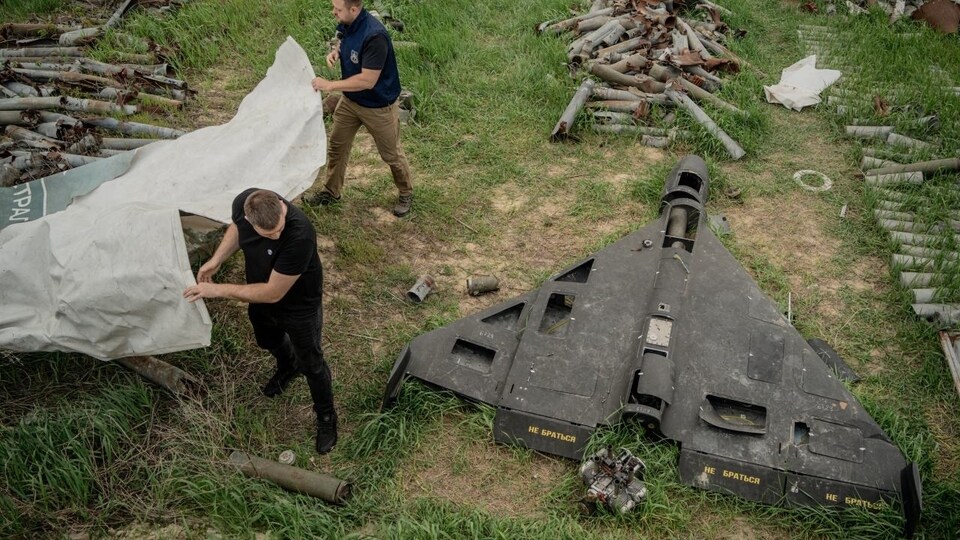
What paved the way for the unprecedented scale of Wednesday’s drone attacks was an agreement Russia signed in November 2022 with Iran, to purchase and produce Iran’s Shahed attack drones on Russian territory. Russia paid $1.75 billion for the Shahed technology, equipment, source code and 6,000 drones, according to a recent report from C4ADS, a nonprofit organization researching illicit networks worldwide.
At the time, Moscow had expended much of its long-range rocket stocks in the course of that year, and the effective but cheap Iranian drones offered an alternative solution enabling Moscow to continue its aerial assaults. Estimates vary widely on how much it costs Russia to produce a single Shahed drone, with defense analysts putting it anywhere from $35,000 to $60,000.
The initial models were shipped directly from Iran, but Russia also paid for the technology and, over time, mastered the different elements of the production chain. In Tatarstan, east of Moscow, facilities inside the Alabuga Special Economic Zone expanded to accommodate the requirements of drone manufacture.
Alabuga drew on Chinese components, a workforce that included cheap laborers hired from Africa, and the logistics networks that Iran had honed during its own yearslong standoff with the West.
Ukrainian drones have struck the facility several times, but Russia has managed to continue the work. Intelligence officials in Kyiv say it has since outsourced parts of it to other facilities across the country.
For Russia, making the drones locally has been a way of reducing its reliance on Iran—a prescient decision in light of Israel’s bombardment of Iran last month and the depletion of Iran’s own drone stocks through retaliatory attacks on Israel.
Moscow’s adaptations have also improved on Iran’s original design, making them faster and quieter. That has increased their maneuverability and helped maximize damage.
Ukrainian officials say Russia is now producing more than 5,000 of the long-range drones and decoys each month, with some able to fly 2,500 kilometers to their target. That has allowed Moscow to saturate Ukraine’s skies with the flying machines.
Ukraine meets the threat by scrambling jet fighters and helicopters, deploying electronic jamming and mobile air-defense teams on the ground and, increasingly, drones tasked with intercepting the Russian munitions hurtling through the sky.
“We’re using all the resources at our disposal,” said Ihnat, the air force spokesman.
At the same time, Russia is regularly changing its own tactics to wreak maximum havoc. Russia’s goal is to force Ukraine to expend valuable interceptor missiles in bringing down decoy drones, which resemble ordinary Shahed drones in appearance but carry no payload. Russia deploys hundreds of these imitator drones to distract Ukraine’s air defenses from the real threat, Kyiv says.
Ukrainian air defenses are, in turn, getting better at identifying these decoys, noting subtle differences in their sound, appearance, and flight path, Ihnat said. He said Ukraine aims to disable them using only electronic warfare, dialing into the radio frequency that guides them.
Drone attacks have been two-way traffic. Moscow has said that Ukraine is launching dozens of its own munitions at Russian territory each day, alleging that some of the projectiles strike civilian areas.
Authorities in Russia’s Kursk said three civilians were killed and seven injured in a drone strike on a beach in the city Tuesday night. A video published by Russian law enforcement showed an official sifting through what he said was the wreckage of a destroyed drone.
Write to Matthew Luxmoore at matthew.luxmoore@wsj.com


