
 E-Paper



The work that earned CR Rao the top honour in statistics, and why it matters
Last week, CR Rao was awarded the 2023 International Prize in Statistics. The announcement dwells on three concepts. What are they and why are they important?

 Prefer HTon Google


In 1945, when he was just 24, C Radhakrishna Rao wrote a seminal paper that continues to be cited by fellow scholars and mentioned in every biography of the legendary statistician. Three results he described in the paper, published in the Bulletin of the Calcutta Mathematical Society, remain the definitive achievements of his long, illustrious career.
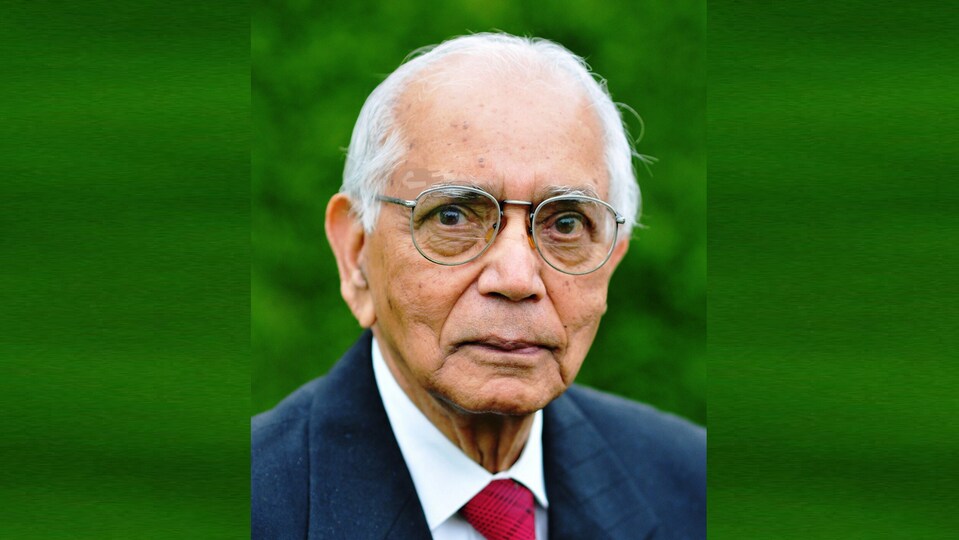
Last week, the International Prize in Statistics Foundation awarded its 2023 prize to Rao, now 102. The announcement of the award, too, dwells on these three results: The Cramér-Rao lower bound, the Rao-Blackwell Theorem, and insights that pioneered a field known as “information geometry”.
So, what are these concepts, and why are they important?
Cramér-Rao lower bound
The Cramér-Rao lower bound and the Rao-Blackwell Theorem relate to the quality of the inferences that a statistician can draw from a set of data. Statistics by definition includes both collection and interpretation of data, and interpretation often involves making estimates about certain quantities. But then, how does one know how accurate those estimates are?
Probal Chaudhuri, a professor at the Indian Statistical Institute in Kolkata, cited the example of estimating the average temperature of a region from data that has been collected from a few places. “As you collect the data, there is an issue of sampling variation. Somebody might collect data at one place and get one estimate; another statistician might collect data at another place and might get a slightly different estimate. Depending on how you draw your sample, there will be variation, and this variation will have an effect on the accuracy of the final inference that you draw,” Chaudhuri said.
That is where the Cramér-Rao lower bound, particularly, and the Rao-Blackwell Theorem come in. “These essentially give you an idea about how much accuracy you will get if you use a certain amount of data to draw a certain inference or get an estimate,” Chaudhuri said. “Especially, the Cramér-Rao lower bound gives you the amount of uncertainty you have when you draw your inference,” he said.
The lower bound has two names associated with it because Harold Cramér, a Swedish mathematician, independently established the same result which would appear in his 1946 book, Mathematical Methods of Statistics. Rao was not aware of this when he derived his result, according to a 2021 article in the International Statistical Review by Nandini Kannan (Indo-US Science and Technology Forum) and Rao’s former student Debasis Kundu, currently a professor of statistics at IIT Kanpur.
Rao-Blackwell Theorem
If the Cramér-Rao lower bound allows a statistician to assess how accurate an estimate is, the Rao-Blackwell Theorem is a procedure to improve that estimate. As described by the International Prize in Statistics Foundation, the theorem “provides a means for transforming an estimate into a better — in fact, an optimal — estimate”.
The Rao-Blackwell Theorem is so named because it was independently established by the American statistician David Blackwell.
The lower bound and the theorem have applications in practically every field where data is analysed and interpreted. The former has been used in signal processing, spectroscopy, radar systems, multiple image radiography, risk analysis, and quantum physics, while the Rao-Blackwell process has been applied to stereology, particle filtering, and computational econometrics, among others, the Foundation noted.
Among these, signal processing refers to a field of study that involves the analysis and modification of signals such as sound, images, potential fields, or seismic signals. To an acoustician, for example, signal processing is a tool to turn measured signals into useful information, while an electrical engineer may use it for digitisation, sampling and filtering.
It was on statistical signal processing that Kundu, Rao’s former student, worked under the latter’s supervision. “I think Rao was the first statistician who could realise the importance of statistics in the area of signal processing,” Kundu told HT.
Information geometry
Rao’s 1945 paper approached probability models with differential geometry, one of the earliest to do so. Differential geometry is a branch of mathematics that studies smooth shapes and smooth spaces using techniques of algebra and calculus. And using differential geometric techniques to study probability theory and statistics is called information geometry.
Among various applications listed by the International Prize in Statistics Foundation, information geometry has been used to aid the understanding of Higgs boson measurements at the Large Hadron Collider, in recent research on radars and antennas, and in advancements in artificial intelligence and signal processing.
“Combined, these results help scientists more efficiently extract information from data,” the Foundation said.
Making of a legend
Although these three results are the definitive landmarks of his career, they are by no means Rao’s only achievements. Technical terms bearing his name appear in textbooks on statistics and other subjects in which his work has applications. Apart from Cramér-Rao lower bound and Rao-Blackwell Theorem, other concepts bearing his name include Fisher-Rao Theorem, Rao Distance, and Rao's Orthogonal Arrays.
Rao’s work has earned him the Padma Bhushan (1968) and the Padma Vibhushan (2001), the Shanti Swarup Bhatnagar Award (1963) and the India Science Award (2009), as well as the National Medal of Science (2002) in the US, where he is based.
The Indian government has instituted a biennial “The Professor C R Rao” Award in statistics. while the CR Rao Advanced Institute of Mathematics, Statistics and Computer Science and Prof CR Rao Road in Hyderabad, too, are named after him. The Pennsylvania State University, where he is professor emeritus, has instituted a C R and Bhargavi Rao Prize in Statistics.
The way he established what is known today as the Cramér-Rao lower bound, too, has become legendary. Back in 1944, there already existed methods for assessing the accuracy of estimates under certain conditions, one of these known as the Fisher Information.
“The main difference between Rao's work and RA Fisher's work is that Fisher derived the results when the sample size is very large, and in the case of Rao, it is for any sample size. Hence, Rao's work is more general,” Kundu said.
"In fact, Rao was teaching Fisher's results in a class, and then a student asked what would happen if the sample size was not large. Then the next day Rao gave his famous result, and that became one of the most celebrated results in statistics,” he said.


