When Naim Qassem, the greying former chemistry teacher who succeeded Hassan Nasrallah as the head of Hizbullah, sat down for a television interview on June 12th, the symbolism displayed marked a subtle but significant shift. Gone were the portraits of Ayatollah Khomeini and the ever-present Iranian flags. Instead, behind him was the yellow standard of Hizbullah and the Lebanese cedar.
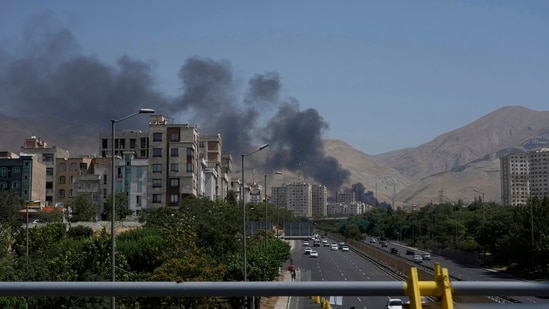
Iran Israel war news live updates: Smoke rises from an oil storage facility after it was struck by an Israeli strike in Tehran (AP)
Last summer, as Israel killed many of Hizbullah’s senior leaders, including Nasrallah, there was simmering discontent within the Shia militia and political party. Iran, its long-time patron, did not intervene to help it. For some in the group, that was a betrayal. But Tehran was never going to trade its own skin for that of its proxy. “Iran sponsored Hizbullah because it wanted Hizbullah to fight the Israelis,” says Meir Javedanfar, an Iran expert, rather than Iran having to. “That would have been completely reversing and putting the whole subcontracting model on its head.”
At the time one Shia critic of the group likened the relationship to a president and his bodyguards. “It is the bodyguard’s duty to defend the president. It is never the president’s duty to defend his bodyguards.”
More on the war between Israel and Iran:
That logic never troubled Hizbullah’s senior ideologues, particularly Nasrallah, who were content with their role as Iran’s loyal enforcers. They were fighting for the Islamic Revolution. But for the movement’s domestic base, it was an unpleasant feeling. “The rank and file, the average Shiites who sustained heavy casualties and who endured Israel…were frustrated,” says Hilal Khashan, a political-science professor at the American University of Beirut. “They really expected Iran to come to the rescue.”
Thoughts and prayers
Those frustrations returned with force on June 13th, when Israel launched a blistering aerial campaign against the Islamic Republic. The strikes bore a chilling resemblance to previous offensives against Hizbullah: precision intelligence, the elimination of commanders and a swift degradation of air defences. From Beirut, there was little more than a formal message of condolence.
Once, Hizbullah was seen as Iran’s ultimate deterrent—a force capable of preventing an Israeli attack on Iran’s nuclear programme. Nasrallah had boasted of 100,000 fighters and an arsenal of rockets. Now, as the members of the high command of Iran’s Islamic Revolutionary Guard Corps (IRGC) are being killed, its Lebanese protectors are silent.
Hizbullah may have little choice but to sit this out. Israel’s intelligence agencies had deeply penetrated the group since the two last fought a major war in 2006. In just over a year of fighting that started after Hamas’s attack on Israel on October 7th 2023, Israel wiped out Hizbullah’s military capabilities. The fall of Bashar al-Assad’s regime in Syria in December has paralysed its efforts to rebuild. Today Hizbullah’s missile stockpiles are depleted, and thousands of its fighters remain marooned and unarmed in Iraq, having fled there after a ceasefire with Israel in November 2024. “Hizbullah as a fighting force is a thing of the past,” says Mr Khashan. “They have become a lame duck. They can’t even defend themselves.”
Constraints are not just military. Domestic politics, too, have clipped the group’s wings. After two years of paralysis and caretaker governments, a new Lebanese president, Joseph Aoun, the former head of the army, was appointed in January. He is determined to reassert the authority of the state over the country, at the expense of militias including Hizbullah.
What remains of Hizbullah’s leadership knows full well that dragging Lebanon into another war could tip the country into internal strife. Though Hizbullah swept recent municipal elections, there are even embers of resentment among its base too. Many remain angry that the group dragged Lebanon into Hamas’s war after the October 7th attacks, while offering little aid to Shia communities whose homes were reduced to rubble.
Hizbullah’s influence over state institutions is waning: its men have been ousted from sensitive airport jobs, and the army is reclaiming control over points it once controlled in the south. The airport road, which only months ago was flanked by portraits of Nasrallah and Qassem Suleimani, head of the IRGC’s foreign operations, now boasts adverts promising “A New Era” for the country. Provoking another conflict, whether internal or external, could weaken the group even more.
More broadly, the network of proxies and militias once known as the “axis of resistance”—Iran’s regional umbrella—has come apart. Hizbullah, long the crown jewel in that axis, is not interested in fighting. As one observer notes, without Hizbullah the axis of resistance no longer really exists.
Many trace the unravelling to the assassination of Suleimani in an American drone strike in Baghdad in 2020. “He was the institutional memory…he created the axis of resistance,” says Saeid Golkar, an Iran expert at the University of Tennessee at Chattanooga. Israel’s bloody campaign in Gaza has massively weakened Hamas’s offensive capabilities, while some of the axis’s more powerful Iraqi chapters are more interested in playing the country’s elections scheduled for later this year.
Without Suleimani, the glue that held Iran’s shadow network together has dissolved. The success is “not just building these networks, but also running the networks was a pair of shoes his successor, Ismail Qaani, was simply never able to fill,” says Mr Javedanfar.
And Hizbullah, once the fiercest of Iran’s proxies, is increasingly behaving like just another Lebanese political party—wounded, wary and watching from the sidelines.
Sign up to the Middle East Dispatch, a weekly newsletter that keeps you in the loop on a fascinating, complex and consequential part of the world.
Get the latest headlines from US news and global updates from Pakistan, Nepal, UK, Bangladesh, Russia and US Iran war Live, get all the latest headlines in one place on Hindustan Times.

 E-Paper