E-Paper


‘Super Earth’: NASA discovers giant planet sending mysterious signal 154 light years away
The planet, named TOI‑1846 b, is about twice as wide as Earth and around four times as heavy.

 Prefer HTon Google


NASA has found a new “Super Earth” planet just 154 light-years away that’s sending out a strange, repeating signal. The planet, named TOI‑1846 b, is about twice as wide as Earth and around four times as heavy. Earlier this year, NASA’s Transiting Exoplanet Survey Satellite (TESS) picked up a repeating flicker of light from a star, according to The Sun report.
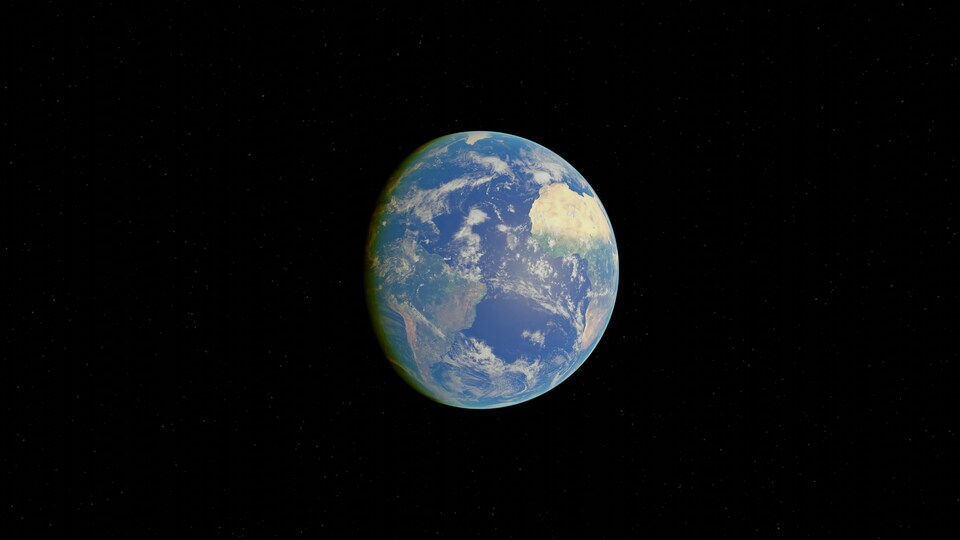
What is ‘Super Earth’?
This light dimming was seen in March each year. When scientists traced it, they found TOI‑1846 b in the Lyra constellation in the northern sky.
The size and weight of the planet put it in what scientists call the “radius gap”—a rare group of planets that are in between small, rocky ones like Earth and big gas planets like Neptune.
Because of this, scientists think TOI‑1846 b might have a layer of thick ice under a thin atmosphere, or maybe even a shallow ocean.
Even though the surface temperature is around 300°C (600°F), researchers think there might still be water. That’s because the planet could be tidally locked, meaning one side always faces its star while the other side stays in darkness. If that’s true, water might be hiding on the cooler, darker side.
But that depends on how heat moves around the planet’s atmosphere. With such high temperatures, scientists say it’s unlikely that life exists there.
Abderahmane Soubkiou and his team at the Oukaimeden Observatory in Morocco confirmed the planet’s discovery by working with observers on four continents.
“We have validated TOI‑1846 b using TESS and multicolor ground‑based photometric data, high‑resolution imaging, and spectroscopic observations.”
The team found the planet circles its star in just under four days.
Also Read: NASA discovers potentially habitable 'super-Earth' 137 Light-Years Away
TESS watches the sky every 30 minutes
TESS watches the sky every 30 minutes using four sensitive cameras. It looks for tiny dips in starlight, like those caused by TOI‑1846 b.
Each time the planet passes in front of its star—a red dwarf—it blocks a tiny bit of light. Even though the star is faint, TESS can spot these tiny drops in brightness.
However, more advanced tools are needed to learn more about the planet.
The team says the MAROON‑X instrument on the Gemini North telescope in Hawai‘i can help confirm the planet’s mass and look for any other planets nearby.
NASA scientists also hope to use the James Webb Space Telescope to study TOI‑1846 b’s atmosphere with infrared light. The $10 billion telescope found its first exoplanet just last month and is continuing to study others as it travels through space.