E-Paper


The factions jostling for Donald Trump’s favour
We have identified five Republican tribes. This is what they mean for the party


 Prefer HTon Google


WHAT UNITES the Republican Party today is a near-universal devotion to Donald Trump. But loyalty to the president masks some divisions among Republican voters. Anti-establishment populists jostle with old-school conservatives over tax cuts and welfare. Nationalists cheer the MAGA tariffs that business-minded conservatives loathe. Mr Trump’s success has been to bind these factions together, an achievement his eventual successor might struggle to replicate.
To map the tribes, The Economist analysed data from almost 14,000 Republicans who took part in the Co-operative Election Survey in 2024. Across dozens of policy questions, from zoning laws to TikTok, individual voters are idiosyncratic. But five distinct clusters emerge.
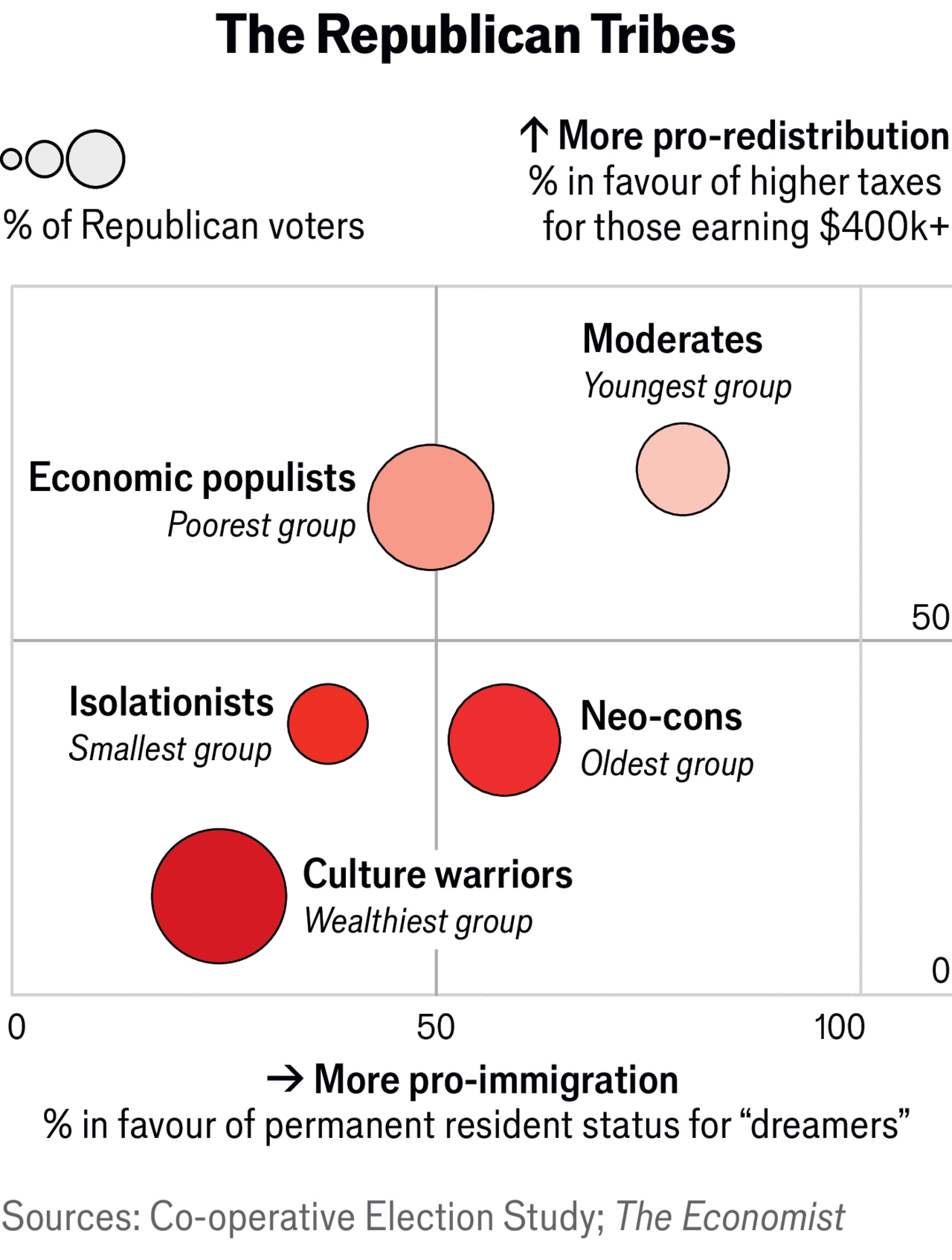
These factions can be plotted along a spectrum. On both immigration and taxation, for example, members of the Culture Warrior tribe are most likely to hold a conservative position, while Moderates are the most pragmatic (see chart). Neo-cons, Isolationists and Economic Populists fall somewhere in between. This pattern holds across many of the 83 policy questions that feed into our analysis.
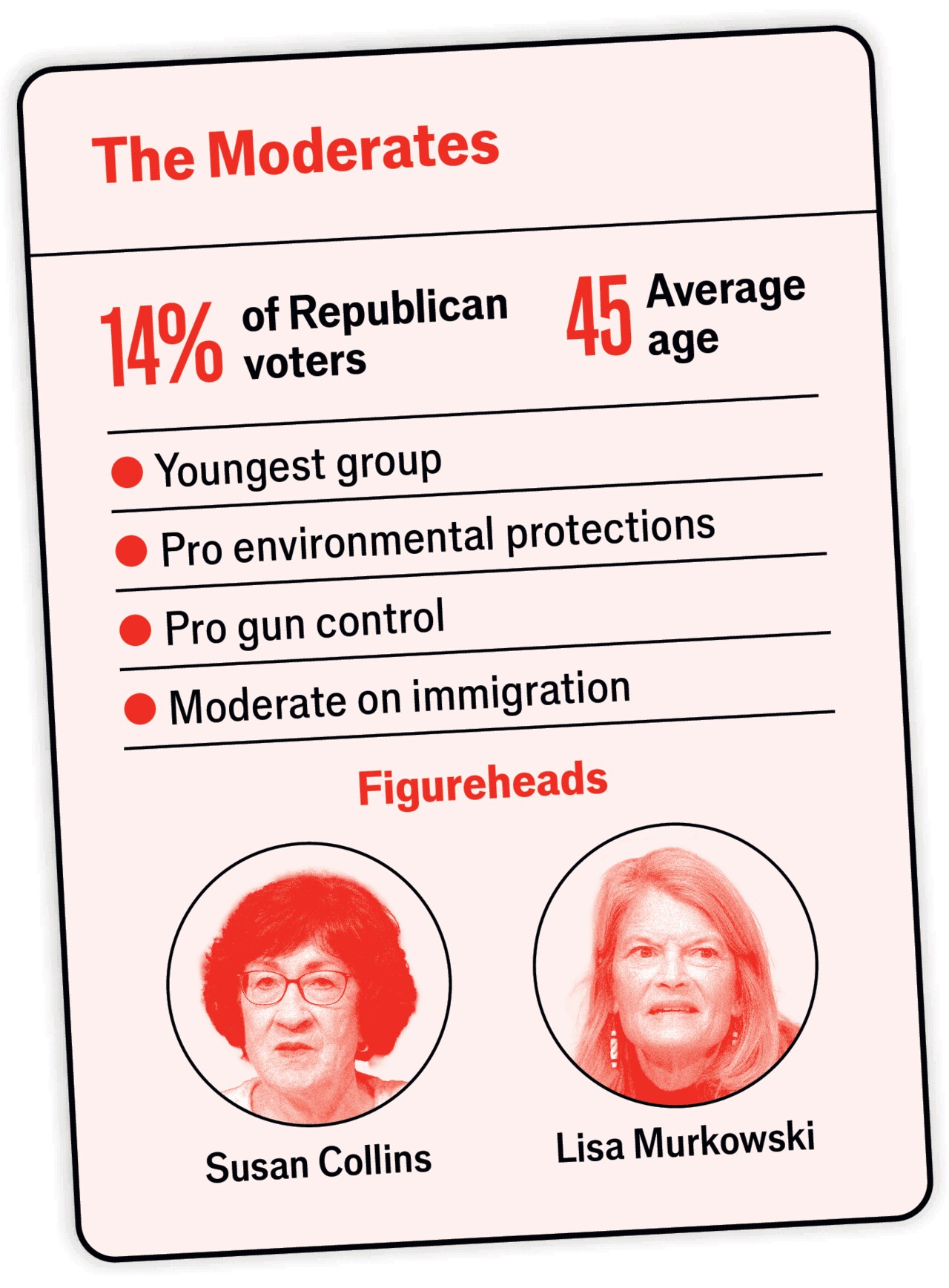
The Moderates are the only tribe that includes a sizeable minority who are sceptical of Mr Trump. One in five members of this group did not vote in last year’s presidential election; one in six voted for Kamala Harris, the Democratic nominee. On a range of issues, including environmental protections, immigration and gun control, they tend to be sympathetic to Democratic policies, while still leaning to the right of the country as a whole. Despite this tribe’s reservations about Mr Trump, efforts to mobilise against him have failed. The Moderates’ figureheads in Congress, such as Susan Collins and Lisa Murkowski, are known for their feeble opposition.
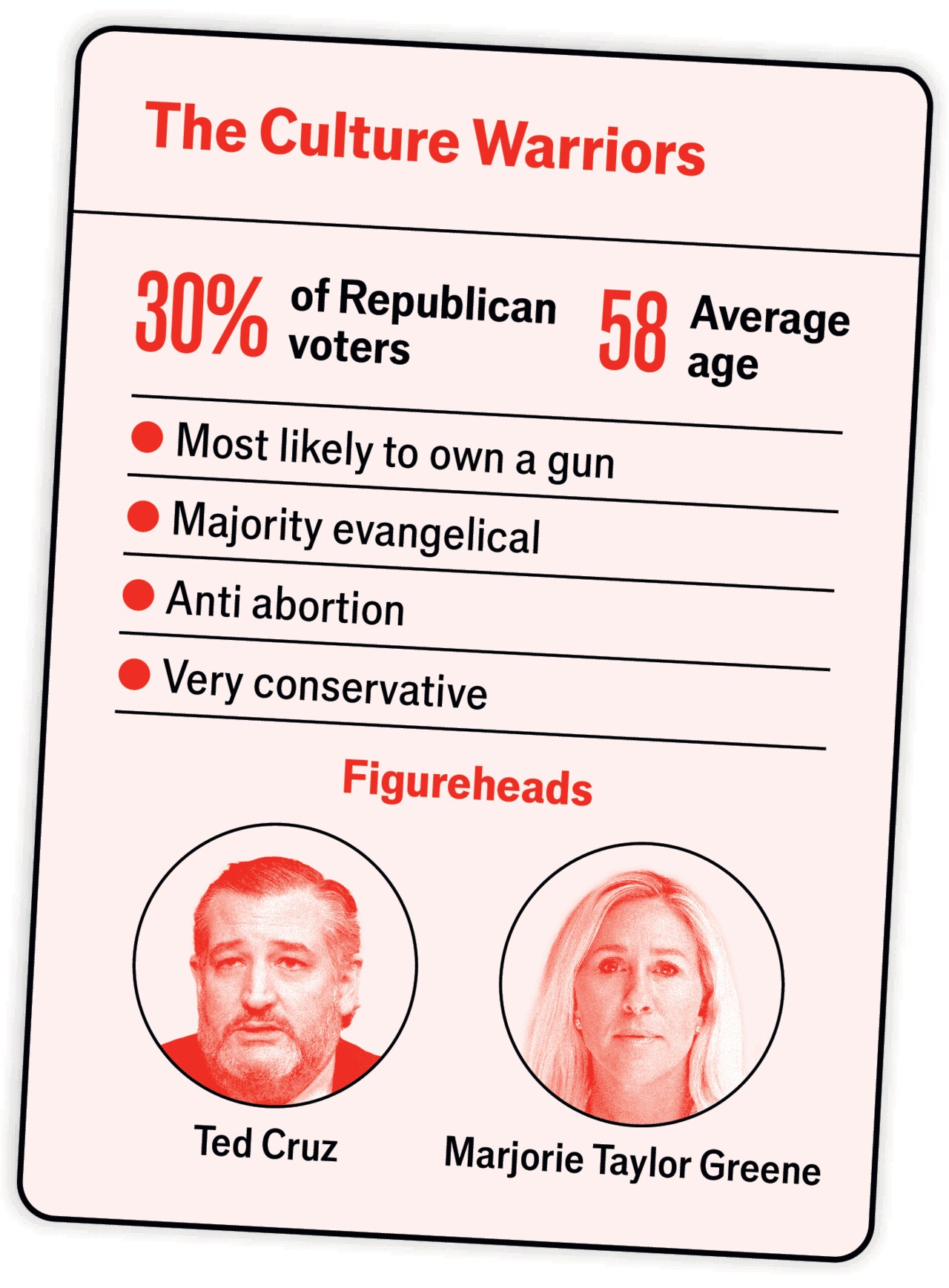
The Culture Warriors sit on the opposite side of the party. This tribe is the richest. Its members are the most likely to own a gun and the most likely to be born-again evangelical Christians. These voters are the backbone of the modern Republican Party and they are particularly strident on so-called “culture war” issues. Take abortion: 95% of people in this tribe agree with the decision to overturn Roe v Wade, the Supreme Court judgement enshrining abortion rights. Some 88% of them support repealing the Affordable Care Act, Barack Obama’s signature health-care policy. Only 7% agree that assault rifles should be banned.
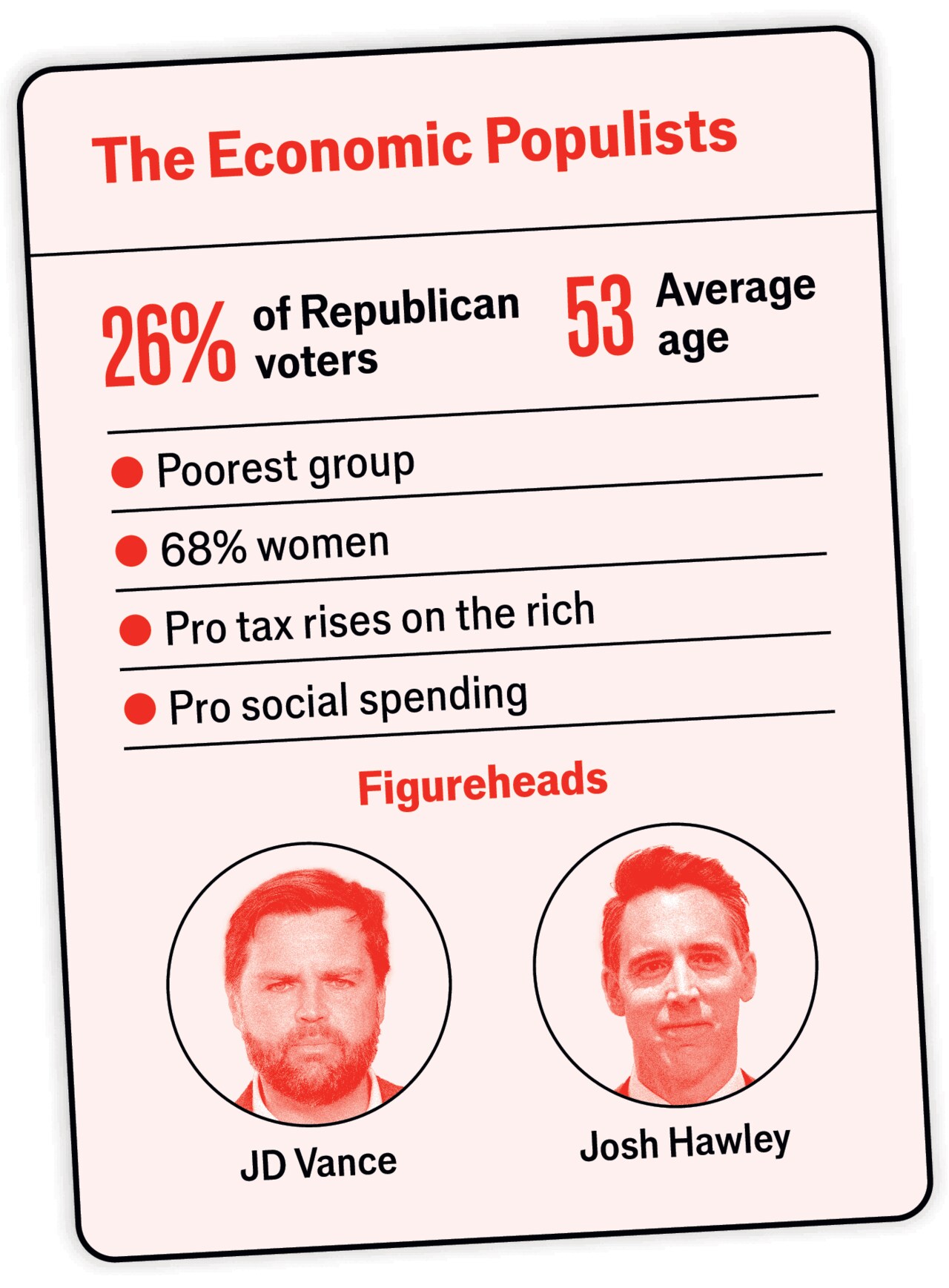
The three remaining cohorts tend to have broadly conservative views on most policy issues, with some distinguishing characteristics. The Economic Populists are defined by their support for more redistributive economic policies, such as welfare spending and taxes on business and the rich. They also tend to have more favourable views on environmental regulation. This tribe has a similar profile to the voters Mr Trump wooed away from the Democratic Party in 2016—they are the poorest segment of the party and the least likely to have a college degree.
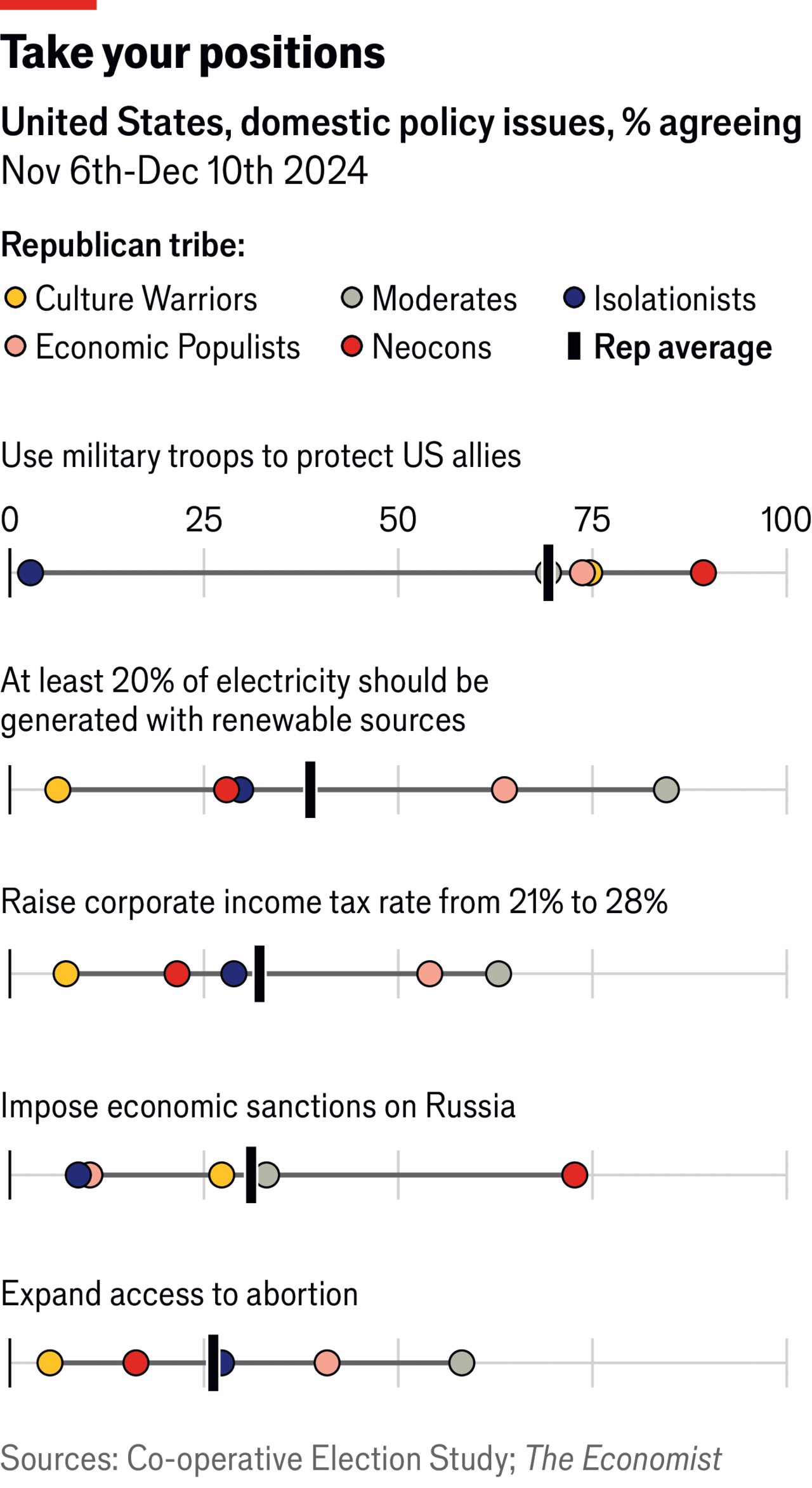
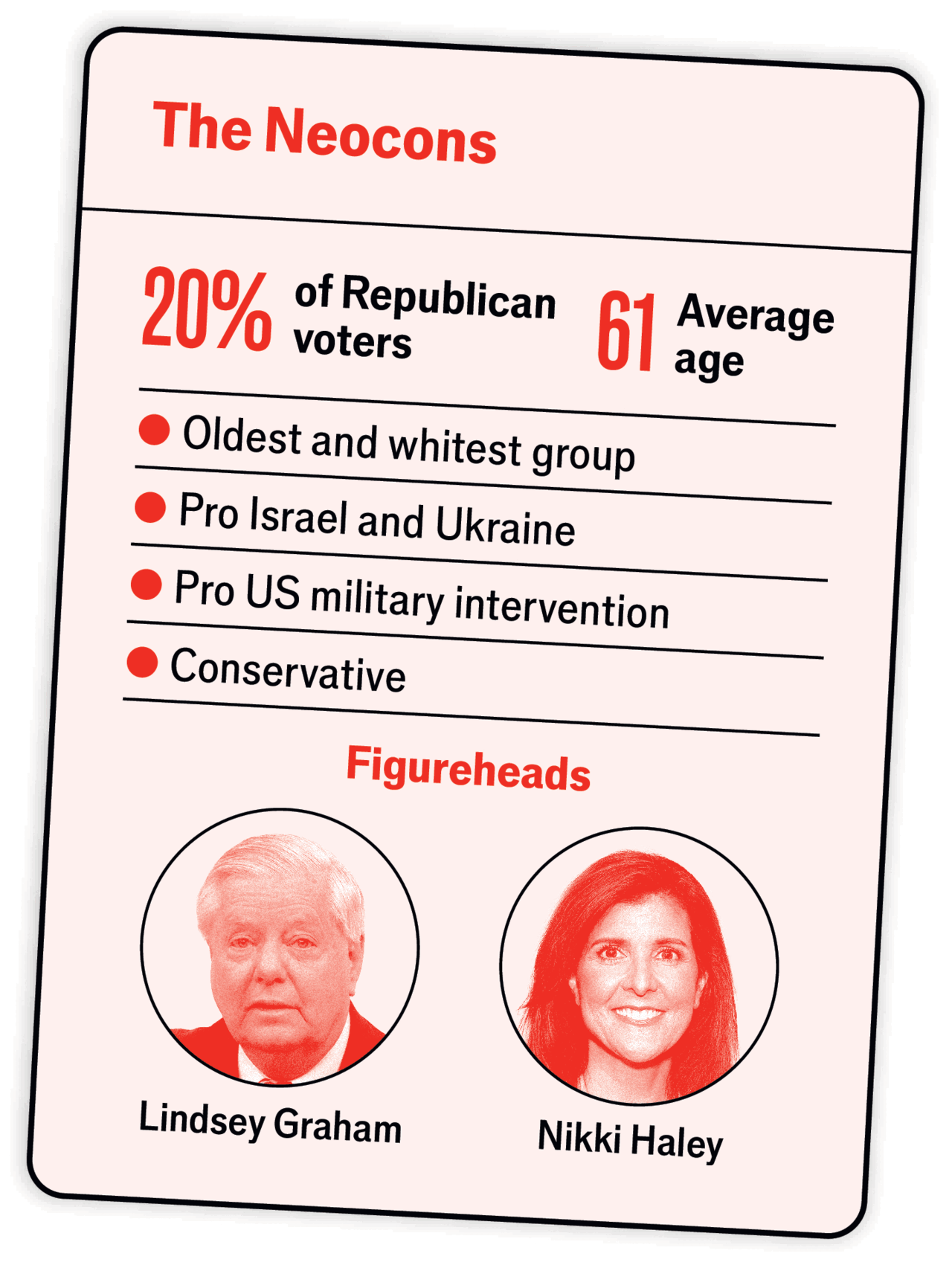
The Neocons, by contrast, look more like the Republican Party’s traditional base. They are the oldest, whitest and most college-educated tribe. In policy terms, their distinctive feature is their support for an activist foreign policy. They are much more likely than other tribes to be in favour of sending aid to Ukraine and weapons to Israel, and placing economic sanctions on Russia. Given a list of scenarios when American troops might be deployed, the Neocon tribe is 21 percentage points more likely than other Republicans to back sending troops to destroy a terrorist camp, 20 points more likely to back defending an ally and 17 points more likely to back intervening in a genocide or civil war.
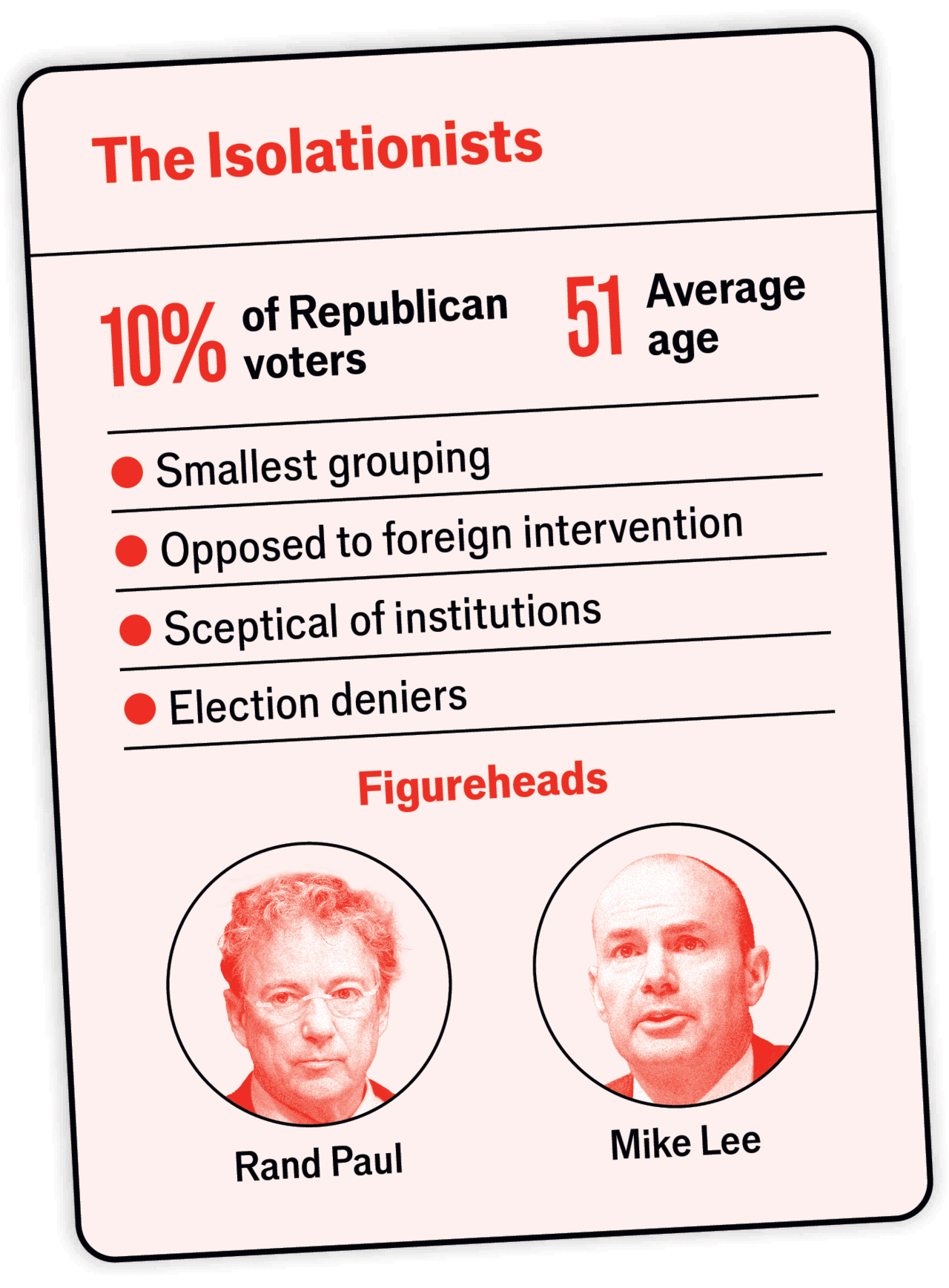
The Isolationists are at the other extreme of foreign policy. Some 63% said that America should not be involved in the Russia-Ukraine conflict in any capacity; 55% said the same for the conflict in Gaza. The Isolationists also tend to be less trusting of institutions. In the election survey, when the Biden administration was still in power, only 24% said they had “a great deal” or “a fair amount” of trust in the federal government to handle the biggest problems facing the country. Only 46% of them said they agreed that elections in the country are fair, compared with 64% of Republicans overall.
No tribe is big enough to hold decisive sway. The Culture Warriors are the biggest, making up one in three Republicans. Candidates who might appeal to this tribe have been successful in recent primary elections but less effective at defeating Democrats. High-profile examples include Kari Lake of Arizona and Herschel Walker of Georgia, both of whom have lost elections to the Senate.
The second-largest tribe, the Economic Populists, make up 26% of the party. J.D. Vance, the vice-president, is their most prominent figurehead. On August 6th Mr Trump said that Mr Vance was his most likely successor. Yet this tribe has also suffered some policy defeats in Mr Trump’s second term. Most notably, the One Big Beautiful Bill slashed Medicaid spending.
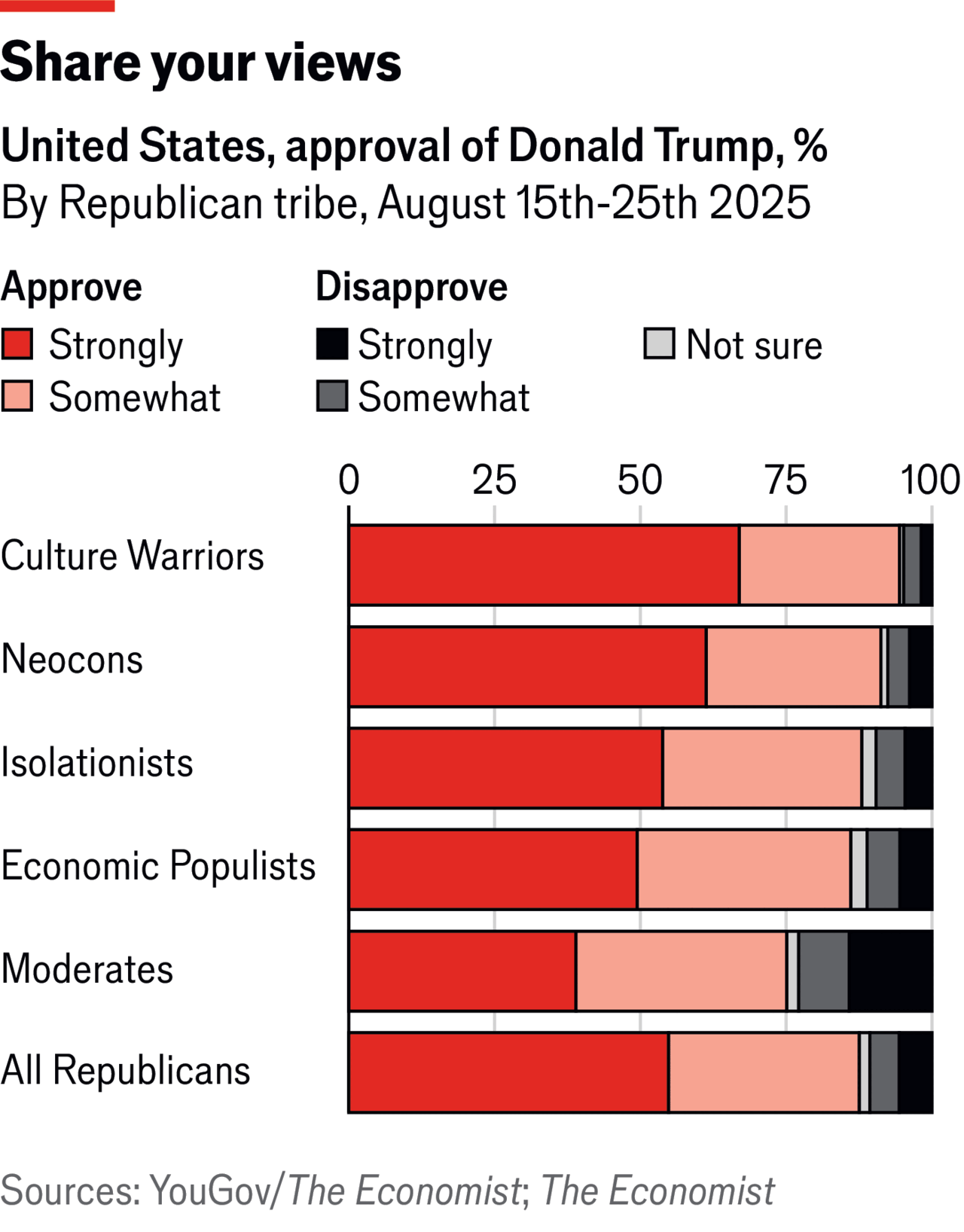
Despite their differences, the tribes have much in common. In the latest polling by YouGov and The Economist, we estimate that more than three in four members of every cluster approve of Mr Trump’s performance as president, albeit with varying levels of enthusiasm: 67% of Culture Warriors strongly approve compared with just 39% of Moderates (see chart 3). They are also in agreement on many policy issues: across all the tribes a majority favour building a wall along the Mexican border and are sceptical of gender ideology.
Some of these factions find their anchor in particular institutions. The House is brimming with culture warriors; the Senate, older and more traditional, still hosts neocons and the few remaining moderates. Across the executive branch mainly isolationists, culture warriors and economic populists jostle for influence. And still some prominent figures come from outside these tribes entirely—political nomads such as Elon Musk and Robert F. Kennedy junior, Mr Trump’s health secretary.
To win the Republican nomination in 2028 Mr Trump’s heir must attempt to do what he does best: appeal to all of the party’s competing factions, while alienating none. It is a skill he makes look easy, yet it is anything but.