
 E-Paper



US strategy prioritises China challenge in Indo-Pacific as top threat, Russia next
On Russia, the strategy says that it poses “acute threats”, as illustrated by its invasion of Ukraine, but also points to the need for burden-sharing without using the term.


Allaying apprehensions that the Ukraine crisis may lead to a reset in the US’s geopolitical priorities, the US national defence strategy 2022 - a key document that outlines goals and strategies and serves as a basis for policy for Pentagon - has prioritised the challenge from China in the Indo-Pacific over the Russian challenge in Europe, and termed China as America’s “most consequential strategic competitor”.
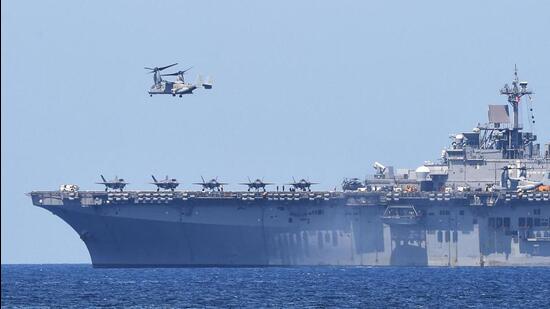
According to a factsheet with the salient points of the strategy, the Department of Defence said its top priorities included “defending the homeland, paced to the growing multi-domain threat posed by the PRC (People’s Republic of China)”, “deterring strategic attacks” against the US, allies and partners; “deterring aggression, while being prepared to prevail in conflict when necessary, prioritising the PRC challenge in the Indo-Pacific, then the Russia challenge in Europe”; and finally, building a resilient joint force and defence ecosystem.
“The department will act urgently to sustain and strengthen deterrence, with PRC as our most consequential strategic competitor and the pacing challenge for the department,” says the document.
The classified strategy has been sent to the Congress, while an unclassified strategy will be put out in the public domain in the future. It lists out other threats, the methods to deal with challenges, and places importance on the role of allies and partners.
OTHER THREATS
On Russia, the strategy says that it poses “acute threats”, as illustrated by its invasion of Ukraine, but also points to the need for burden-sharing without using the term. “We will collaborate with our Nato allies and partners to reinforce robust deterrence in the face of Russian aggression.”
US defence planners have been encouraged in recent weeks by the willingness of European across, particularly Germany, to take on more security responsibilities.
The strategy also points to other threats - both State and non-State, both regional and thematic. It says that the department “will remain capable of managing other persistent threats”, from North Korea, Iran and other violent extremist organisations. It recognises that “changes in global climate” and other dangerous transboundary threats such as pandemics are changing the way in which Pentagon operates, put pressure on the joint force and systems that support it, and pledges to adapt to it. And it acknowledges “growing kinetic and non kinetic threats” from strategic competitors and speaks of “increasing resilience” to withstand, fight and recover from disruption.
Recognising the value of “multi-beneficial alliances and partnerships”, the strategy says that the department will incorporate ally and partner “perspectives, competencies, and advantages at every stage of defence planning”. The Joe Biden administration has emphasised the value of allies and partners, both in the European theatre with Nato and in the Indo-Pacific theatre with Quad.
METHODS
To achieve all these goals and deal with threats, the Department has proposed three strategies.
The first is “integrated defence”. This entails developing and combining strengths by working across warfighting domains, theatres, spectrum of conflict, other instruments of US national power, and with allies and partners - “enabled by combat-credible forces, backstopped by a safe, secure and effective nuclear deterrent”.
The second is “campaigning” to strengthen deterrence. The strategy explicitly states that the US will operate forces, synchronise efforts and align its activities with other instruments of national power “to undermine acute forms of competitor coercion, complicate competitors’ military preparations, and develop our warfighting abilities together with allies and partners”.
And finally, the strategy proposes “building enduring advantages” for the future. This involves reforms to accelerate force development, getting technology quickly, and investing in the department’s personnel.
“The department will develop, design and manage our forces - linking our operational concepts and capabilities to achieve strategic objectives. This requires a joint force that is lethal, resilient, sustainable, survivable, agile and responsive.”


