
 E-Paper



‘Warning to US’: Former PLA colonel claims China’s missiles hit moving target in sea
Wang Xiangsui’s claim was made in the wake of the US military flowing a U-2S Dragon Lady spy plane near a Chinese naval live-fire drill in the Bohai Sea off China’s northeast coast in August.


In the month of August, China fired two of its most capable conventional missiles - a DF-26 intermediate-range ballistic missile (IRBM) and DF-21D anti-ship ballistic missile (ASBM) - into the South China Sea from bases in the mainland.
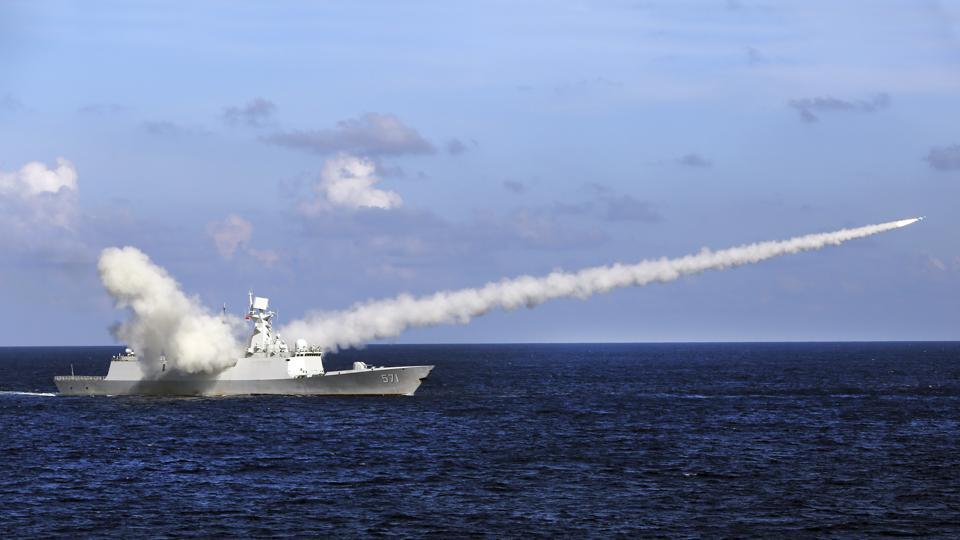
There was no official information so far about the reason or whether they hit any target on the day of the launch on August 26. But now, a former senior colonel of the People’s Liberation Army (PLA) has claimed that these missiles hit a moving ship target near the Paracel Islands.
Wang Xiangsui’s claim was made in the wake of the US military flowing a U-2S Dragon Lady spy plane near a Chinese naval live-fire drill in the Bohai Sea off China’s northeast coast in August. China had declared a no-fly zone in international airspace above the Bohai Sea, meaning its declaration had no legal merit.
“So several days later [after the aircraft carrier manoeuvres], we launched the DF-21 and DF-26, and the missiles hit a vessel sailing south of the Paracel Islands,” said Wang, who is now a professor at Beihang University in Beijing.
“Shortly after that, an American military attache in Geneva complained and said it would lead to severe consequences if the missiles hit an American aircraft carrier. They see this as a show of force, but we are doing this because of their provocation,” Wang said at a closed-door meeting of the Moganshan Forum in Zhejiang.
Though the meeting was held in October, the transcripts of Wang’s comments were made public on Tuesday.
Read more | Malabar exercise that upsets China is a tectonic shift in power balance | Analysis
“This is a warning to the US, asking it not to take any military risks. Such actions mark the bottom line of Sino-US confrontation,” he had said.
The US had said that the flight was “within the accepted international rules and regulations governing aircraft flights”, and that the air force would “continue to fly and operate anywhere international law allows, at the time and tempo of our choosing”.
In previous months, the US Navy had sailed two aircraft carrier strike groups (USS Nimitz and USS Ronald Reagan) in the South China Sea “in support of a free and open Indo-Pacific”.
Out of the two missiles fired by China on August 26, the DF-26 was launched from Qinghai Province in northwest China (approximately 2,500 km away from the Bohai Sea), and the DF-21D from eastern China in Ningbo, Zhejiang Province (a distance of 1,600 km).
Read more | Russia to consider India’s request for speedy delivery of S-400 air defence systems
The DF-21D “carrier killer” has a range of approximately 1,800 kilometre. The DF-26 IRBM, on the other hand, has a 4,000-km range and it can carry either a nuclear or conventional warhead.
The DF-21D and DF-26 are in categories banned under the Russia-US Intermediate-Range Nuclear Forces (INF) Treaty, which the US withdrew from in 2019. China was never a signatory, and Washington cited China’s possession of such weapon categories as one justification for its INF withdrawal.
August 2020 was not the first time China fired ballistic missiles into the South China Sea.


