
 E-Paper



Why slow job growth doesn’t mean the labor market is in trouble
A smaller supply of potential workers is keeping unemployment low, but it is a challenge for the economy at large.


 Prefer HTon Google


This past week’s anemic employment report rekindled a burning question for the U.S. economy: How many new jobs does it actually need?
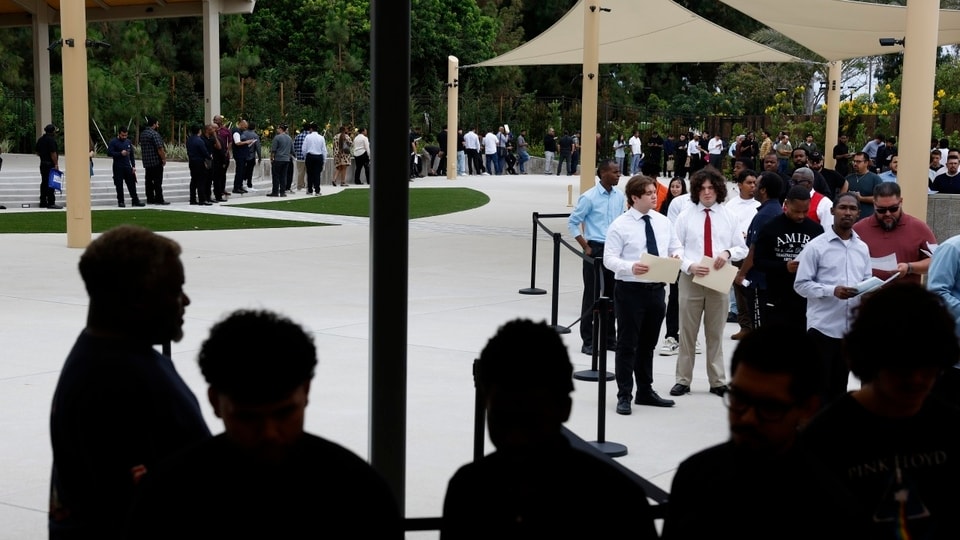
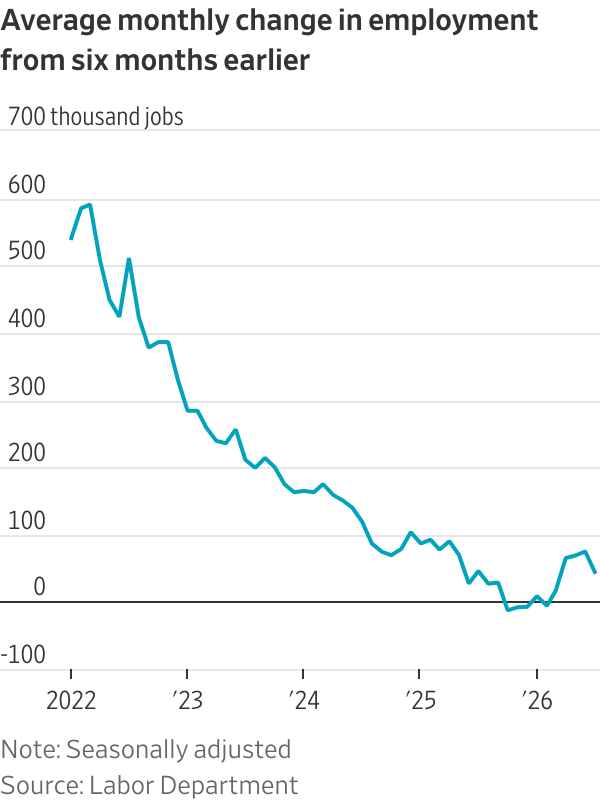
The Labor Department on Friday reported that the U.S. shed 23,000 jobs in July, and lowered its May and June figures. With that, the data now shows the economy added 44,000 jobs a month over the past six months. That isn’t as weak as the back half of last year, but it is a far cry from what people used to think of as healthy.
Yet the unemployment rate has fallen from 4.4% to 4.1% this year. That is an indication that the U.S. might not need to generate that many jobs to keep up with a dwindling supply of new workers.
The youngest of the baby boomers are turning 62 this year—eligible for Social Security retirement benefits—while there is a low supply of younger, U.S.-born workers to take their place. Meanwhile, President Trump’s immigration crackdown has limited the supply of foreign-born people entering the workforce.
Some economists expect more of the same in the months ahead.
“My guess would be that the rest of the year will, if anything, see slower jobs growth than what we’ve seen so far,” said the American Enterprise Institute’s Stan Veuger. In joint work with the Brookings Institution economists Wendy Edelberg and Tara Watson, Veuger estimated that the economy only needs to add about 15,000 jobs a month to keep the unemployment rate steady.
Some aspects of Friday’s report suggest that immigration restrictions are having an effect. Labor-force participation—the share of people either working or actively seeking work—has weakened across a range of age groups. That “is consistent with the immigration-headwinds narrative,” wrote Barclays economists on Friday.
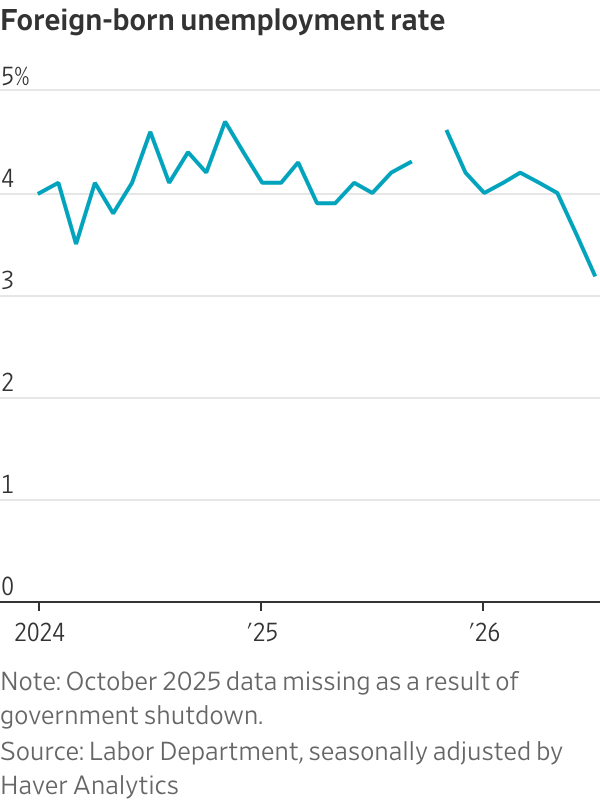
Moreover, the unemployment rate among the foreign-born population slipped to 3.2%, adjusting for seasonal swings, from 4% in January, according to Haver Analytics. That could be because those foreign-born workers who are engaged in the labor market—for example, those with green cards—are having an easier time securing a job.
Construction, which employs a lot of immigrant workers, added 22,000 jobs last month, with gains concentrated in the specialty-trade contracting work that continues to benefit from the AI build-out. But leisure and hospitality—also highly immigrant-dependent—shed 40,000 jobs.
To an extent, a smaller supply of potential workers suggests that the labor market can be considered healthy even if there aren’t as many jobs being created as in the past. That is one message from the low unemployment rate.
For the overall U.S. economy, it could be more of a mixed bag. That is because the economy relies on two big engines in the labor market: growth in the workforce, and growth in how much workers get done, or productivity.
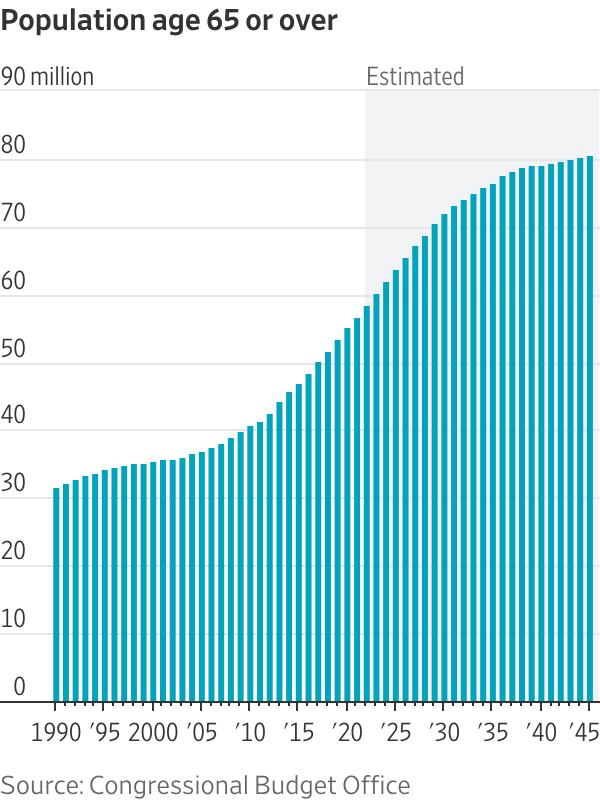
The aging population, and the workforce the U.S. will need to support it, create particular urgency. There are now about 66 million people living in the U.S. who are 65 or older, according to Congressional Budget Office estimates. In 10 years, the CBO projects that will increase to 78 million.
AI could help: One of the few things economists generally agree on about the new technology is that it will boost productivity. But they also generally think those productivity increases aren’t showing up broadly thus far.
Few workers are using AI intensively. And while the Labor Department has registered a productivity pickup in recent years, Barclays economists argue that this is probably just an artifact of the whipsawing of the labor market following the Covid-19 shock. Even though AI investment has been occurring at a breakneck pace, it takes time for workers and businesses to adapt to a new technology: You can’t just hand somebody a nail gun and expect him to know how to use it.
That could mean that, for the next few years at least, the economy might not be able to grow very quickly—or at least not without the unemployment rate going even lower, with the risk that a tightening labor market starts pushing inflation higher.
The alternative might be for the U.S. to expand its labor pool. Japan, for example, has struggled with its aging population, but it has succeeded in bringing more women into the workforce. The share of women ages 25 to 54 in Japan working or actively seeking work has lately been 86% versus about 67% in 2000.
In the U.S., labor-force participation for women ages 25 to 54 went from a bit less than 77% in 2000 to 77.8% as of July.
Write to Justin Lahart at Justin.Lahart@wsj.com


