
 E-Paper



World War II codebreaker Alan Turing is the new face of Britain's £50 note
This comes in recognition of Turing's pivotal role in breaking Nazi Germany's Enigma code during World War II.


The rainbow flag is flying proudly Thursday above the Bank of England in the heart of London's financial district to commemorate World War II codebreaker Alan Turing, the new face of Britain's 50-pound note.
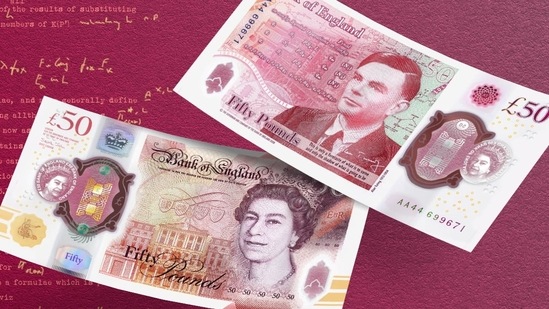
The design of the banknote was unveiled before it is set to be formally issued to the public on June 23, Turing's birthday. The 50-pound note is the most valuable denomination in circulation but is little used during everyday transactions, especially during the coronavirus pandemic as digital exchanges increasingly replaced the use of cash.
The new note, which is laden with high-level security features, completes the bank's rejig of its stable of paper currencies over the past few years. Turing's image joins that of Winston Churchill on the five-pound note, novelist Jane Austen on the 10-pound note and artist J. M. W. Turner on the 20-pound note. All the notes are made from polymer rather than paper, which means they should last longer and remain in better condition through their use.
The new note incorporates two windows and a two-colour foil that designers say will make it very difficult to counterfeit. There is also a hologram image that changes between the words “Fifty” and “Pounds” when the note is tilted from side to side, as well as an embedded microchip to pay tribute to Turing's role in the birth of computers.
Turing was selected as the new face of the 50-pound note in 2019 following a public nomination process, recognition of his pivotal role in breaking Nazi Germany's Enigma code during World War II. The code had been believed to be unbreakable as the cypher changed continuously. Historians say the cracking of the code may have helped shorten the war by at least two years, potentially saving millions of lives.
The 250,000 or so votes supporting Turing's nomination also represented a recognition of the discrimination that he faced as a gay man after the war.
“There’s something of the character of a nation in its money, and we are right to consider and celebrate the people on our banknotes," Bank of England Gov. Andrew Bailey said.
“Turing is best known for his codebreaking work at Bletchley Park, which helped end the Second World War. However, in addition, he was a leading mathematician, developmental biologist, and pioneer in the field of computer science. He was also gay, and was treated appallingly as a result."
During World War II Turing worked at the secret Bletchley Park code-breaking centre, where he helped crack Enigma by creating the “Turing bombe,” a forerunner of modern computers. He also developed the “Turing Test” to measure artificial intelligence.
After the war, he was prosecuted for homosexuality, which was then illegal, and forcibly treated with female hormones — a form of chemical castration. His conviction led to the removal of his security clearance and meant he was no longer able to work for Government Communications Headquarters (GCHQ). He died at age 41 in 1954 after eating an apple laced with cyanide.
Turing received a posthumous apology from the British government in 2009, and a royal pardon in 2013. Four years later, the Turing law, which pardoned gay men with past convictions, was passed.
Actor and author Stephen Fry said the choice of Turing to appear on the 50-pound note marks another step in the nation’s long overdue recognition of “this very great man,” whose “talents ranged far and wide.”
In a YouTube video posted by the Bank of England, Fry laid out the levels of discrimination and “barbaric punishments” that gay men faced in the years after World War II.
“Alan Turing was among the thousands of men who were harried and harangued by the authorities," he said.
“Not just down to the hostile attitude to their sexuality alone, but also under the bigoted belief that there was a link between homosexuality and communism," Fry added.
Over the past decade, Turing's life has become known to a much wider audience, especially in the wake of the 2014 film “The Imitation Game” that saw Benedict Cumberbatch play the role of Turing.
Great-nephew James Turing, who runs the Turing Trust which refurbishes U.K. computers for use in African schools, said the Bank of England’s move was an "unbelievable honour” for his family.
“It certainly highlights the enormity of Alan’s legacy, which hopefully we are doing something through the Turing Trust that he would be proud of in continuing to further enable access to a digital world," he told BBC radio.


