E-Paper



Heavy snowfall heightens misery of Nepal quake survivors
Nearly a year after the Nepal earthquakes, there seems to be no end in sight for the misery of its survivors. Now, snowfall over the weekend in the upper Himalayan regions has affected thousands of people who are still living in temporary shelters.


Nearly a year after the Nepal earthquakes, there seems to be no end in sight for the misery of its survivors. Now, snowfall over the weekend in the upper Himalayan regions has affected thousands of people who are still living in temporary shelters.
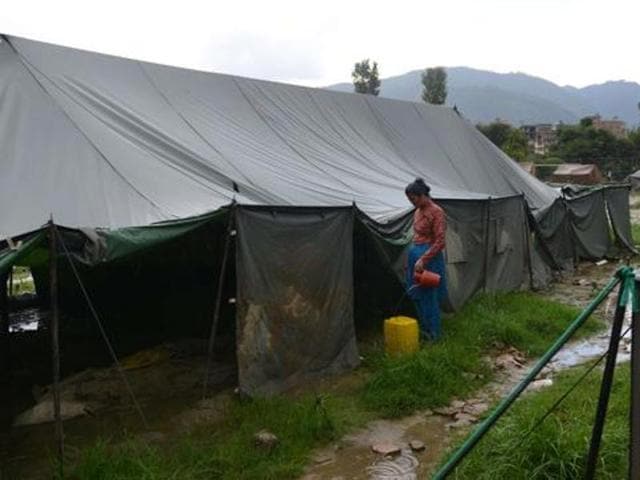
Villages near the epicentre of the April 25 quake in Gorkha district, accommodating as many as 1,500 families of quake survivors, witnessed heavy snowfall, rains and hailstorms through Friday and Saturday. Those living on the heights of neighbouring Rasuwa district were also affected.
“We are staying in tents, but they don’t provide enough protection,” The Kathmandu Post quoted Maya Gurung, a quake survivor residing in temporary shelters at Gupsipakha, as saying.
Most of the camps constructed for survivors in hill districts affected by the quake are covered with snow. The weather has also affected the movement of vehicles on the Rasuwagadhi border point with China.
According to UNICEF, nearly 200,000 families affected by the quake are still residing in temporary shelters at altitudes of 1,500 metres. Most of these tents – made of plastic sheets, tarpaulin and tin sheets –don’t provide sufficient protection from the biting cold. Consequently, nearly a dozen earthquake survivors have reportedly died of cold-related ailments in the last few weeks.
District officials, however, say there is no truth in those claims. “Some of those (deaths) may have been due to cold-related ailments, but it is incorrect to attribute all deaths to the same cause,” Uddhab Prasad Timalsena, chief district officer of Gorkha, told Hindustan Times.
“Snowfall over the past two days at higher altitudes has affected quake survivors. The weather started clearing from Sunday,” said Shibram Gelal, chief district officer of Rasuwa. Over 700 families from the district currently reside in temporary shelters.
Nepal will begin quake reconstruction work, including building permanent homes for quake survivors, from January 16 – nearly nine months after the disaster occurred.
Bickering among political parties had delayed the appointment of the chief executive of the reconstruction authority, which would be tasked with utilising the aid of nearly $4.1 billion promised by international agencies and donor countries.
An ongoing blockade of border points with India by Madhesis, residents of the terai bordering India, has also been affecting the flow of relief materials meant for quake survivors since September last year.
The Nepal earthquakes, which occurred in April and May last year, claimed nearly 9,000 lives.