Sign in

India talks tough as Paris climate summit enters final lap

A pushback by India and China on behalf of less-privileged nations sent the Paris climate talks into overtime as a jagged rift between developing nations and the developed world deepened on Friday over a thicket of prickly issues.

Updated on: Dec 12, 2015, 08:56:34 IST
Hindustan Times | By , Paris
Share
Share via
  • facebook
  • twitter
  • linkedin
  • whatsapp
Copy link
  • copy link

A pushback by India and China on behalf of less-privileged nations sent the Paris climate talks into overtime as a jagged rift between developing nations and the developed world deepened on Friday over a thicket of prickly issues.

The slogan "Decarbonize" is projected on the Eiffel Tower as part of the World Climate Change Conference 2015 (COP21) in Paris, France. (Reuters Photo)

Conference president and French foreign minister Laurent Fabius announced that the final draft of an emerging agreement to curb climate change will come on Saturday morning with a meeting to adopt it slated for later in the day.

However, sources did not rule out another round of discussion that could see the talks spill into Sunday.

“The agreement can happen only on the efforts of the developing world. Rich nations will have to show spirit of accommodation and flexibility,” said environment minister Prakash Javadekar.

The French capital witnessed high drama on a chilly Friday night with US Secretary of State John Kerry threatening to walk out, saying he cannot go back to Washington with a mandatory obligation to reduce emissions and provide “predictable” finance.

Recalling the inability of the US to ratify the 1997 Kyoto Protocol, the only existing climate treaty, sources quoted Kerry saying he cannot “afford” to repeat it.

Read: ‘Very difficult’ issues dog Paris climate talks, says ‘hopeful’ Kerry

A negotiator from a developing country described as “nasty” Kerry’s language in the Fabius-headed Indaba, a Zulu word that means “meeting of elders”, while he urged developing countries to consider the domestic political compulsions of the US.

“After those consultations, I will be able to present, tomorrow at 9 am, to all Parties, a text which, I am certain of it, will be approved and will be a big step forward for humanity,” said Fabius.
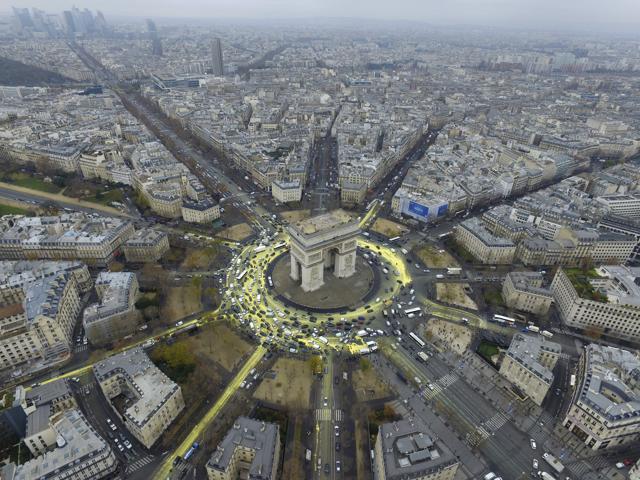
Yellow paint, symbolising the sun and its rays, is seen around the Arc de Triomphe during a protest on Champs Elysees avenue on the sidelines of the World Climate Change Conference 2015 (COP21), in Paris. (REUTERS)

The NGO Third World Network’s Chee Yoke Ling described the United States as the “villain” of the negotiations, saying Kerry was not willing to give anything away but wanted to pull down the firewall between the developed and developing world and the right to climate finance.

“We (the developing world) cannot be cheated again and again,” she said, adding that the time had come for rich nations to deliver on their promises and a just agreement for all.
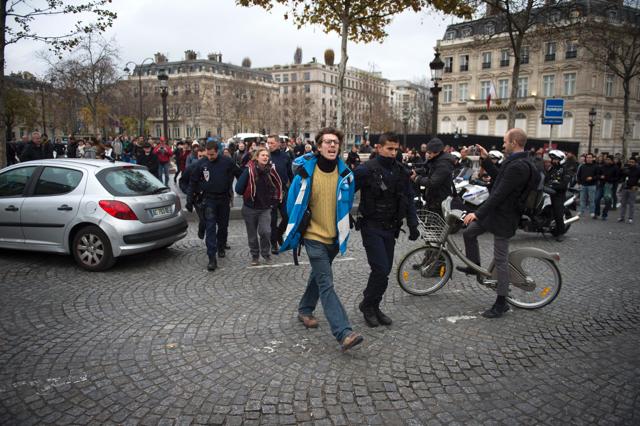
French Police officers arrest Greenpeace activists after they sprayed yellow paint on the Etoile square in front of the Arc de Triomphe in Paris. (AFP)

Sources said India and China fought hard, seeking more than 30 changes in the draft agreement submitted on Thursday to restore a differentiation balance in finance as well as the review and verification sections of the draft.

Developing countries like India want the concept of differentiated responsibilities to seep into every element of the deal while rich nations like the US view differentiation as more limited in scope.

Countries like Venezuela asked the US and other rich nations to meet their commitments, saying the developing nations had already done much more than their “capacity” and obligation under the UN climate convention.

Emerging economies like India also rejected the US proposition of expanding the donor base for climate finance to the developing world and include South-South financial cooperation (from developing to developing countries) in the agreement.

The concept of self-differentiation drew a clear “no” from the developing world that said it would undermine the UN climate convention.
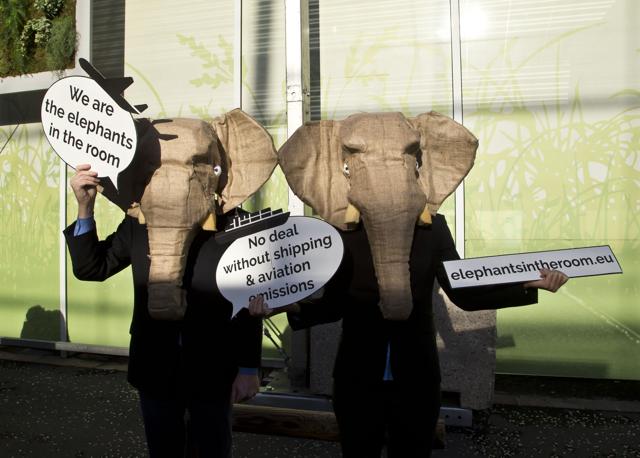
Representatives of NGOs wear elephant masks and hold banner at the COP21, United Nations Climate Change Conference, in Le Bourget north of Paris. (AP)

Observers said India and China along with some other countries emerged as a leading voice of the developing world against the United States, which even opposed a liability clause in the compensation mechanism called “Loss and Damage” for the most vulnerable nations.

Despite the sticking points, a compromise by Saturday night or Sunday morning was not ruled out with consensus-building measures in progress.

As part of this, Javadekar held meetings with several other heads of delegations including Kerry on Friday.
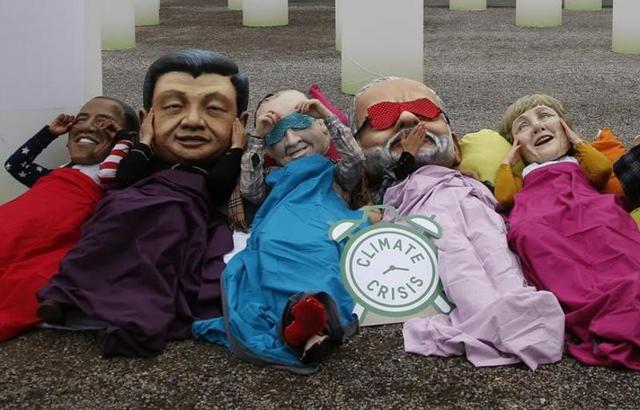
Activists of global anti-poverty charity Oxfam wearing masks depicting some of the world leaders stage a protest outside the venue of the World Climate Change Conference 2015 near Paris. (Reuters)

For India, there was some consolation as the points of climate justice and sustainable lifestyle were mentioned in the preamble but not in the operational text.

Sources said India still had some concerns over the language in the article on finance and differentiation and it was working with other countries to settle them.

Read: Paris burns the midnight oil, climate talks go into overtime

Climate justice issue, highlighted by Modi, missing from Paris summit

  • Chetan Chauhan
    ABOUT THE AUTHOR
    Chetan Chauhan

    Chetan Chauhan is the National Affairs Editor looking into all aspects of news and features from across India. A Chevening scholar with over three decades of experience in reporting and news management, Chetan has extensively covered all important aspects of the social sector, political economy, environment and climate change nationally and internationally. He did a journalism course at the Reuters Institute of Journalism in Oxford and Digital Media training at Nanyang Technological University in Singapore. He started as a reporter with The Statesman in 1996 and joined the Hindustan Times in 2000 in the metro bureau covering environment, crime and Delhi politics. He covered hot local news, from the Jessica Lal murder case to the rebellion of Delhi Congress MLAs against then Chief Minister Sheila Dikshit, to the replacement of toxic vehicle fuel with cleaner compressed natural gas (CNG) in the national capital. Some of his stories on air pollution became part of the Supreme Court’s landmark MC Mehta versus Government of India case in the National Capital Region (NCR), forcing the government to take corrective measures. As part of the national political bureau since 2004, he covered important central sectors such as environment, education, social justice, labour, rural development, water resources, renewable energy, agriculture, broadcasting and the Planning Commission for more than a decade producing several exclusive and investigative breaking stories. His specialisation is the environment, having covered at least a dozen United Nations global conferences on climate change, biodiversity and wildlife including climate summits in Paris, Copenhagen and Bali. He also covered India’s two five-year plans ---11th and 12th and reported on drafting and execution of right based laws such as Right to Education, Right to Information and rural job guarantee law, MG-NREGA, now being introduced in new format as VG-RAM-G Act. He has in-depth knowledge of social sector issues. He was one of the first to report on tigers vanishing from Sariska and Panna wildlife reserves in 2004 and 2008, respectively, leading to the setting up of the National Tiger Conservation Authority (NTCA) and the introduction of stringent penal provisions for poaching. He has written extensively on the rising human-animal conflict in India and the degradation of India’s biodiversity hotspots because of mining and other activities. Since 2004, Chetan has covered Parliament comprehensively and participated in training on the nuanced coverage of Parliament proceedings. He has travelled extensively across India to cover national and provincial elections since 1998, especially in the Hindi heartland states, considered India’s road to power. He writes a regular column for Hindustan Times, Ecostani, on important national politics, economy, Himalayan ecology and environmental issues. His other responsibilities include providing inputs for edits and edit page articles for the publication, apart from managing news flow from across India.Read More

Get the latest headlines from US news and global updates from Pakistan, Nepal, UK, Bangladesh, Russia and US Iran war Live, get all the latest headlines in one place on Hindustan Times.