
 E-Paper



Nasa finds Pluto's moons tumbling in absolute chaos
Two of Pluto's moons, Nix and Hydra, wobble unpredictably, according to a comprehensive analysis of data from Nasa's Hubble Space Telescope.


Two of Pluto's moons, Nix and Hydra, wobble unpredictably, according to a comprehensive analysis of data from Nasa's Hubble Space Telescope.
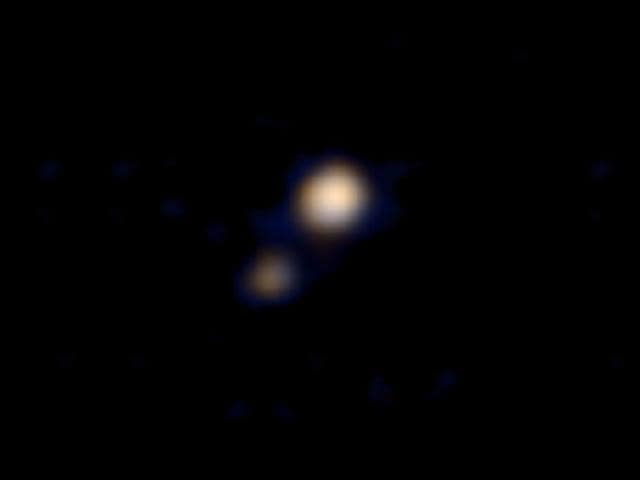
The moons wobble because they are embedded in a gravitational field that shifts constantly, researchers said. This shift is created by the double planet system of Pluto and Charon as they whirl about each other. Pluto and Charon are called a double planet because they share a common centre of gravity located in the space between the bodies.
Their variable gravitational field sends the smaller moons tumbling erratically. The effect is strengthened by the football-like, rather than spherical, shape of the moons. Scientists believe it's likely Pluto's other two moons, Kerberos and Styx, are in a similar situation.
"Prior to the Hubble observations, nobody appreciated the intricate dynamics of the Pluto system," said Mark Showalter of the SETI Institute in Mountain View, California, who conducted the study with Doug Hamilton of the University of Maryland at College Park.
"Our research provides important new constraints on the sequence of events that led to the formation of the system," Showalter said.
The researchers also found three of Pluto's moons are presently locked together in resonance, meaning there is a precise ratio for their orbital periods.
"If you were sitting on Nix, you would see that Styx orbits Pluto twice for every three orbits made by Hydra," noted Hamilton.
Hubble data also showed that the moon Kerberos is as dark as a charcoal briquette, while the other frozen moons are as bright as sand.
It was predicted that dust blasted off the moons by meteorite impacts should coat all the moons, giving their surfaces a homogeneous look, which makes Kerberos' colouring very surprising, researchers said.
Nasa's New Horizons spacecraft, which will fly by the Pluto system in July, may help settle the question of the asphalt-black moon, as well as the other oddities uncovered by Hubble.
The turmoil within the Pluto-Charon system offers insights into how planetary bodies orbiting a double star might behave, researchers said.
Nasa's Kepler space observatory has found several planetary systems orbiting double stars.
"We are learning chaos may be a common trait of binary systems. It might even have consequences for life on planets if found in such systems," Hamilton said.
The research is published in the journal Nature.


