
 E-Paper



New archives shine light on history of black Britons
The first archive dedicated to the culture and experiences of black people in Britain is now open, with the aim of shining a light on a long overlooked history.


The first archive dedicated to the culture and experiences of black people in Britain opened on Thursday, with the aim of shining a light on a long overlooked history.

The £7-million ($11.9-million, 8.8-million euro) Black Cultural Archives houses books, diaries, newspapers, photographs and artefacts dating back almost 2,000 years, as well as an exhibition space and learning tools for schools.
It is the culmination of three decades of campaigning and fundraising, and those behind the project hope it will increase awareness of the long history of people of African and Caribbean roots in Britain.
"It's very much a hidden history," Paul Reid, the director of the archives, told AFP at a launch event filled with performances of music, poetry and dance.
The goal is to "collect, preserve and celebrate the history of people of African descent in the UK", he said, adding that this was "critically important" to people's sense of identity.
"When you know that we've always been here, it gives you a different sense of belonging," he said.
Black African or Black Caribbean people currently make up 3.3 percent of the population of England and Wales, according to the 2011 census, the second largest ethnic minority after South Asians.
Many communities were established after World War II when large numbers of immigrants from the Caribbean -- many of them soldiers who fought for the British empire -- arrived to start a new life.
But historians argue the story began much further back, noting the African-born Roman emperor Septimus Severus, who died in York in the year 211 and is remembered on a coin held in the archive.
Throughout history, black Britons were not just servants brought over as part of the slave trade, but were soldiers, sailors and successful business people -- although their contribution was for a long time ignored.
"There's a tradition in Britain of a history of the rich, great, white men of property, and a history which is related to empire," said Dr Hakim Adi, a reader in the history of Africa and the African diaspora at the University of Chichester.
"That tends to look down upon the history of women, of working people, of minorities, or think it is unimportant."
'History of everybody'
Reid, a tall, sharply dressed figure with long dreadlocks tied back from his face, said black Britons themselves were also to blame for failing to grasp the scale of their own history.
"The Americas, the Caribbean, Africa – that's where we often look for history. We've completely overlooked the presence of people of African descent in these shores," he said.
"It's always an emphasis that looks primarily at the Caribbean experience, of coming here in 1948, and behind that the grand narrative of enslavement."
The new building in Brixton, an occasionally troubled district of south London home to a large West Indian community, is primarily a place for researchers.
Organisers hope it will persuade communities across Britain to think about how to preserve their own histories for future generations.
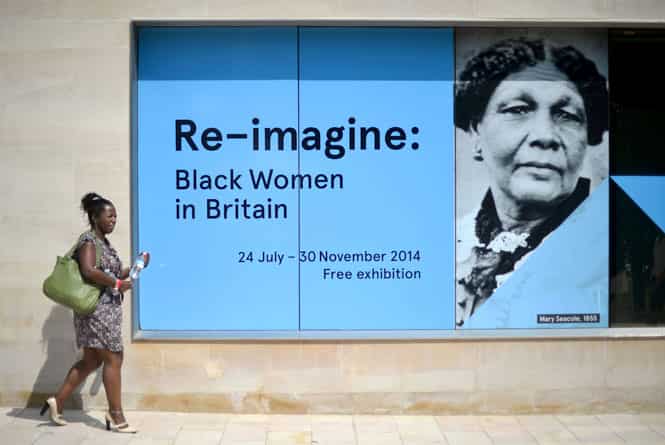
The exhibition space is also open to the public, and launched with a display highlighting the achievements of black women in Britain.
Among them is Mary Seacole, a Jamaican-born nurse who tended to British officers during the 19th-century Crimean war, and who was last year at the centre of a political controversy.
There was an uproar when Seacole was excluded from the school syllabus in a shake-up of the curriculum, that critics said enforced an outdated view of the history. The reforms were watered down and she stayed.
"There is a general sentiment that history should be a history of everybody, to show the world as it is, and as it was," Adi said.
He hopes the new archive should also help promote research into other minority communities in Britain, "so that we can all learn".


