E-Paper



Number Theory: Caste composition of CMs after elections in 5 states
Even a cursory reading of the castes of its new chief ministers shows that the BJP has taken care to assemble a diverse caste coalition – with an eye on 2024

 Prefer HTon Google


More than a week after the results of the latest round of assembly elections were declared, the new chief ministers of all five states are now known. To be sure, it was only the Bharatiya Janata Party (BJP) that took more than a week to declare the names of the chief ministers and a key factor behind this was that the party was effecting a generational change in leadership in the Hindi heartland states. Even a cursory reading of the castes of its new chief ministers shows that the party has also taken care to assemble a diverse caste coalition – with an eye on 2024. In August, HT developed a long-term database of chief ministers’ castes in 20 big states and Delhi (it was used first in a two-part series by Nishant Ranjan), the current caste composition of chief ministers can be compared with that of chief ministers over the years. Here is what the comparison shows.
 An analysis of chief ministers of 20 big states and Delhi shows that the new list of chief ministers has essentially decreased the other backward classes (OBC) representation among chief ministers in favour of Scheduled Tribe (ST) representation and of castes other than from Scheduled Castes (SC), ST, and OBC. Before the latest round of elections, there were 13 chief ministers from non-SC/ST/OBC castes, seven from OBC castes, and one from an ST caste. These numbers are now 14, five, and two. Of the two states where OBC chief ministers have been replaced, in one case the top job has gone to an ST chief minister (Chhattisgarh) and in one to an upper caste chief minister (Rajasthan). Telangana’s second chief minister, Congress leader Revanth Reddy, is from the same broad category as the state’s first chief minister K Chandrashekar Rao – not from the SC, ST or OBC groups.

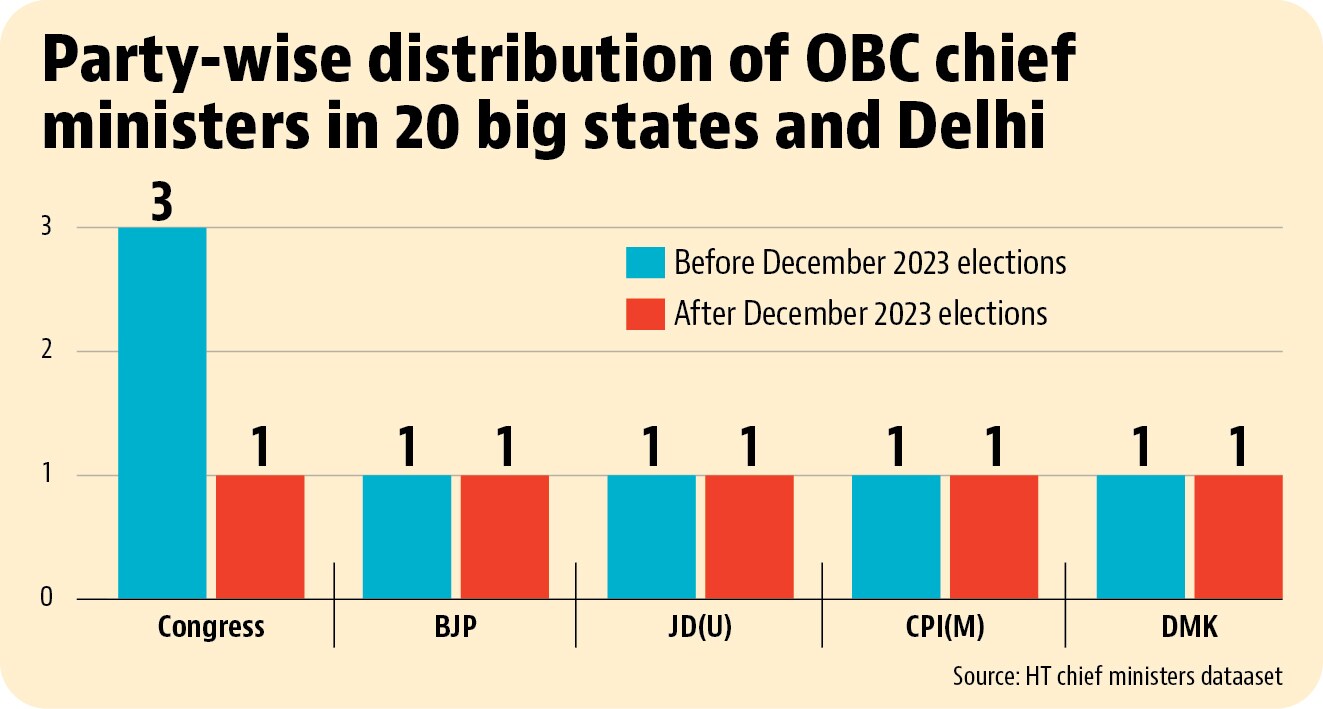
- While the BJP has decreased the count of OBC chief ministers in India after the latest elections, it does not necessarily mean that the party will be at a disadvantage compared to the Congress, which made caste (particularly OBC) representation a key poll plank in recent elections. As explained above, one reason for this is that the BJP has replaced an OBC chief minister with an ST chief minister in Chhattisgarh. Moreover, Arun Sao, who is from an OBC caste, was sworn in as the deputy chief minister of the state on December 13. Similarly, in Rajasthan, where the BJP has replaced an OBC chief minister (Ashok Gehlot of he Congress) with an “upper caste” chief minister, it has also made a person from a Scheduled Caste one of the two deputy chief ministers. There is another reason why the Congress is unlikely to have an edge over the BJP in OBC representation. The Congress simply does not have enough governments in place to demonstrate its seriousness about promoting OBCs. Before the latest round of elections, the Congress had three OBC chief ministers (in Rajasthan, Chhattisgarh, and Karnataka) while the BJP had one (in Madhya Pradesh). Since the Congress lost both the Rajasthan and Chhattisgarh elections, now both parties have an OBC chief minister each. To be sure, this does not hold true if the count of OBC chief ministers from the wider INDIA group of parties is compared with that from the BJP. Four of the five current OBC chief ministers are from the INDIA group of parties. To be sure, the BJP has always pointed out that Prime Minister Narendra Modi is from an OBC himself.
- In terms of OBC representation, the current caste status of OBC chief ministers is the same as the October-December period in 2014, when there were five OBC chief ministers (in Assam, Tamil Nadu, Karnataka, Madya Pradesh, and Uttar Pradesh). The highest number of OBC chief ministers India has had in the 21 states included in this analysis is eight (from May 2006 to May 2011, when Telangana was not a separate state). On the other hand, there have only been two previous periods when there have been two ST chief ministers in India. One of these was the 2000-2003 period when both Chhattisgarh and Jharkhand had ST chief ministers, just as they have currently. The second period was 2020-2021 when Jharkhand and Assam had ST chief ministers. For about 81% of the days since January 1, 1962, the list of states analysed here had no SC chief minister. The best representation of the group was from January to August 2003 when Sushilkumar Shinde and Mayawati were chief ministers of Maharashtra and Uttar Pradesh respectively.