
 E-Paper



Is government right to go slow on wheat support price?
The increase in MSPs for winter-sown or rabi crops was 2% for wheat, a decade’s low, while being generous for non-cereals, up to 8.6% higher than the last season

 Prefer HTon Google


The announcement this week of federally fixed minimum support prices (MSPs) for winter-sown or rabi crops has fuelled more anger among farm unions already protesting the Narendra Modi government’s economic policies. Unions have accused the government of being tight-fisted when it comes to wheat, the biggest driver of farm incomes in the world’s second largest grower.
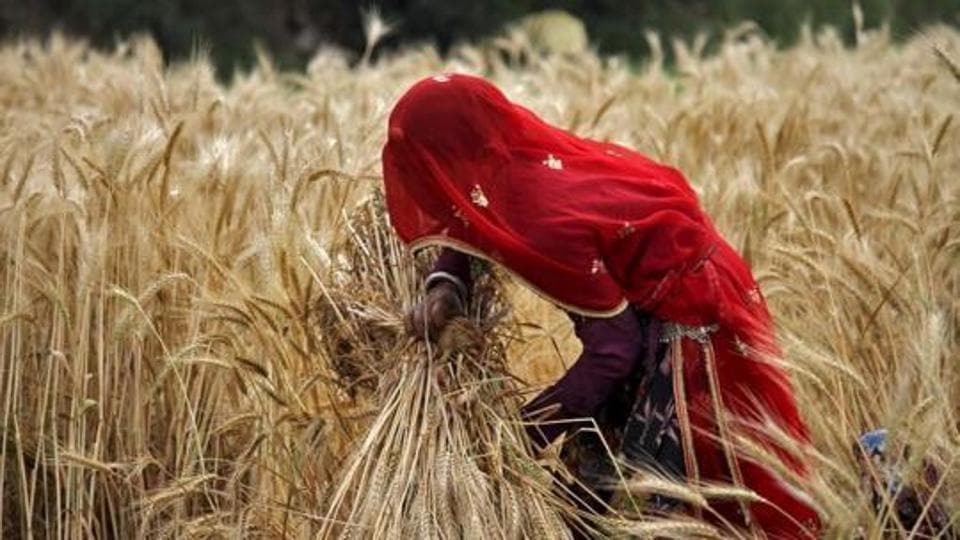
The increase in MSPs for winter-sown or rabi crops was 2% for wheat, a decade’s low, while being generous for non-cereals, up to 8.6% higher than the last season.
Vastly different MSPs, the holy grail for growers, has provided farm unions with fresh ammunition. “This is another joke on farmers by the Modi government,” said activist Yogendra Yadav, a key face of the ongoing farmers’ agitation.
Some independent experts said the government was right to slam the brakes on large increases in MSPs for cereal, such as wheat. However, without an accompanying policy, they said, the critical aim behind lowering wheat MSPs -- crop diversification -- will not be met.
First off, the rates. The Cabinet committee on economic affairs on September 8 raised wheat prices by ₹40 a quintal (100kg), or just 40 paise a kg to ₹2,015 a quintal and barley by ₹35 to ₹1,635 a quintal. This works out to an increase of 2% and 0.76% respectively. Wheat is India’s main winter-grown staple.
Rates for non-cereals, however, were hiked by up to ₹400--8.6%. The MSP on lentil (masur), rapeseed/mustard were hiked by ₹400 a quintal each, while gram rates were hiked by ₹130 per quintal and safflower by ₹114 per quintal, which translates to a hike of 7.8%, 8.6%, and 8.3% over current rates.
The current MSP for safflower (before the hike) is ₹5,327 a quintal while that of mustard is ₹4,650 a quintal.
The key to understanding the price differential between cereals and non-cereals lies in their relative production. In a single season, the country produces enough wheat to take care of three years of consumption but not enough of essential edible oils and pulses.
In 2021, edible oil prices have trebled, while that of main lentils, such as masur, have doubled.
In a country where half the population depends on a farm-derived livelihood, MSPs are floor rates that are meant to offer a price signal for farmers on what to grow and also, notionally, avoid distress sale. Notional, because in real-world agricultural markets, it’s demand and supply, not MSPs, which determine how much a farmer makes.
The exception is wheat in winter and rice in summer because only these two commodities are actually bought by the government at declared MSPs.
Farmers often sell non-cereals, and even cereals in some states, at prices below what it takes to produce them, suffering negative returns.
“Farmers don’t grow enough of these oilseeds because the government only procures them in token quantities, not sufficient quantities. So, the government has to procure sufficiently large quantities of these items so that there is a market-clearing mechanism at least,” said Abhijit Sen, a renowned economist.
A market-clearing price is a jargon that refers to the price of a good at which quantity, output in this case, is at least equal to demand. Also called the equilibrium price, economists believe markets ultimately shift toward this price.
“That’s not true in the case of non-cereals in India, because higher MSPs for wheat and rice is price distorting,” said TS Mani, a former economist with the Tamil Nadu Agricultural University.
India therefore has meet to two-thirds of its domestic edible oil demand through costly imports.
Farmers say the recent hikes in MSP will not offset the sharply higher prices of diesel and electricity. “We also buy food, LGP (cooking fuel). Look at how costly diesel has become. A farmer cannot cover his costs with these MSPs,” said Naresh Tikait, a farm leader of the Bharatiya Kisan Union.
MSPs, which spurred the Green Revolution in the 1960s, mainly benefit paddy and wheat growers. Even so, the MSP policy benefits farmers only in a handful of states. The 70th round of the National Sample Survey showed only 13.5% of paddy growers and 16.2% of wheat growers actually received MSPs.
Since the government has expanded its crop-buying operations, the number of farmers benefiting from MSP has surely gone up but there are no fresh data to show by how much.
Research by the OECD-ICRIER, a think-tank, shows Indian farmers receive lower-than-international prices for most produce because of increasing costs of cultivation, inadequate markets and the government’s obsession with keeping food prices low.
This has worsened agriculture’s terms of trade, measured as a ratio of prices of agri-products to prices of manufactured items. The crisis, therefore, is not one of low production, but of low prices.
According to economist Ashok Gulati, the cost of procuring, storing and distributing rice to the poor comes to about ₹37 a kg. For wheat, it is around ₹27 a kg. The cost to company (CTC) of labour of the Food Corporation of India (FCI) is six-eight times higher than private labour. Therefore, market prices of rice and wheat are much lower than what it costs the FCI to buy the staples.
“The net effect of this is that wheat MSP in India is far higher than prices in international market. Therefore, exports are unviable,” said Agrawal of Comtrade. So, farmers find it lucrative to grow far more wheat than the country needs and dump it at the doorsteps of the government.


