E-Paper



Number theory: Is the Congress today where the Jan Sangh was in the ‘60s and ‘70s?
A look at how Cong is trying to achieve what the Jan Sangh did by forming a diverse opposition grouping against a dominant party.

 Prefer HTon Google


India’s electoral competition is witnessing a triangular alignment with the three poles being the BJP-led NDA, an opposition grouping with the Congress as the biggest party, and unaligned regional parties in the states of Odisha, Andhra Pradesh, Telangana, and Punjab. To be sure, an alliance of the Congress and regional parties is not new. But what differentiates the current situation is the fact that the Congress’s own strength has significantly declined. In a way, the Congress is trying to achieve today what a bunch of ideologically different groups, including the socialists, Communists and Dravidian parties tried to do in alliance with the BJP and its predecessor Jan Sangh when the Congress was the dominant party in Indian politics. Here are charts which explain this in detail.
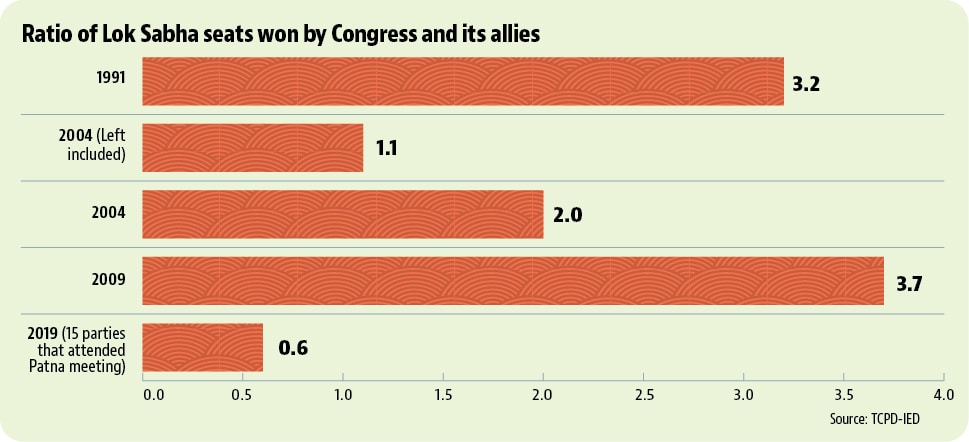
 The Congress was much smaller than its prospective allies in the 2014 and 2019 electionsOf the 10 governments the Congress has had at the Centre, only the seven governments up to 1984 were formed with a majority of its own. The 1991 Congress government was a minority government which survived on support of other parties; and the governments in 2004 and 2009 were run by an alliance with the Congress having the Prime Minister’s post. In 1996 the Congress gave outside support to a United Front government. If one were to look at the ratio of Lok Sabha MPs of the Congress and that of all its allies taken together, it was always higher than one. If one were to recalculate this ratio for the Congress and the political parties it is talking to at the moment, this ratio comes down to 0.6.
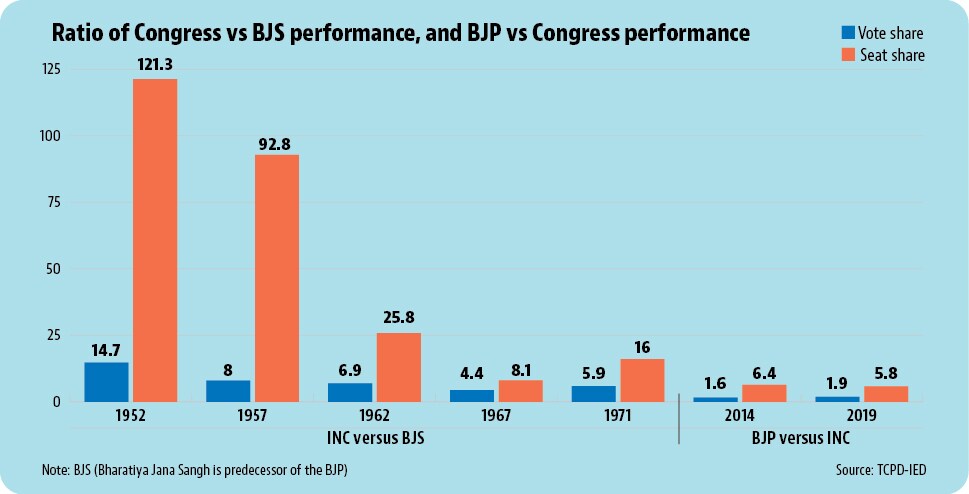
- The Jan Sangh was in an even weaker situation in its initial years...The Congress’s weakness vis-à-vis its allies, or more appropriately, the BJP’s adversaries, is in a way similar to what the Jan Sangh faced when it was trying to find a place for right-wing politics in India in the hegemonic phase of the Congress. In fact, the Jan Sangh’s challenge was much bigger than what the Congress faces today. In the five elections it contested – the 1977 elections saw a large part of the opposition fielding candidates under the Janata Party’s and the Bhartiya Lok Dal’s (BLD) symbols – the Jan Sangh’s vote share and seat share deficit vis-à-vis the Congress was much bigger than what the Congress faces vis-à-vis the BJP today.
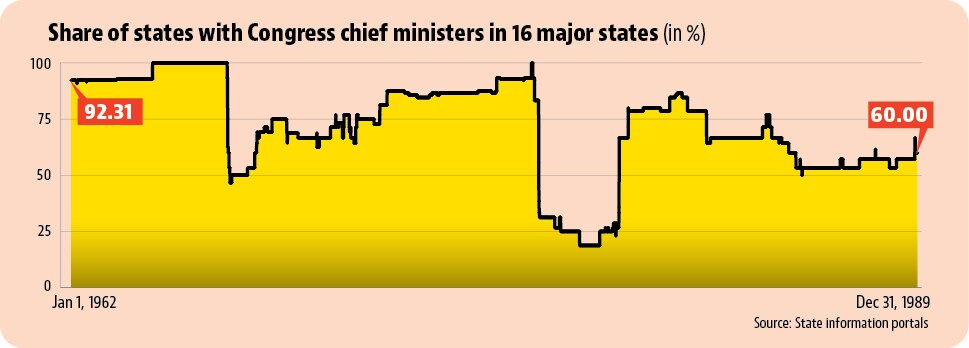
- …but ideology-agnostic opposition alliances managed to keep the Congress out of power in many statesDespite this, the opposition forged ideology-agnostic alliances to defeat the Congress in state elections. An HT analysis of 16 major states (13 before Punjab, Haryana, and Himachal Pradesh came into existence in their current form in 1966) in the 1962-1989 period shows this clearly. The share of states with Congress chief ministers decreased sharply to less than half (47%) in 1967. This is also when the Jan Sangh (the BJP’s predecessor), the Communist Party of India (CPI), the Samyukta Socialist Party (SSP), and the Swantantra Party (SP) – parties otherwise opposed to each other – partnered to defeat the Congress. This coalition was termed “Samyukta Vidhayak Dal” (United Legislators Party or SVD) and formed governments in states such as Uttar Pradesh, Bihar, and Odisha. While the Congress started recovering from these defeats by 1971 (it had chief ministers in Uttar Pradesh, Bihar, and Odisha by June 1972), ideology-agnostic coalitions again defeated the Congress in state elections after the emergency, when opposition parties formed a government under the Janata Party’s umbrella at the Centre. During the period from October 1978 to June 1979, states with Congress chief ministers reached a low of 19%. This trend changed after the Janata Party government fell at the Centre and Congress dominated states again until 1989. In 1989, an ideology agnostic coalition again came to power at the Centre, this time with outside support The Janata Dal won just 143 seats in the 1989 Lok Sabha election. However, Viswanath Pratap Singh of the Janata Dal was able to become prime minister with outside support of the BJP and the left parties (CPI and CPI-M), which stand at opposite poles in terms of ideology.
This is the second of a two-part data journalism series looking at the tripartite realignment taking place in Indian politics. The first part quantified the relative strength of the three groups.