
 E-Paper



Modi’s endorsement of ties with Israel has rewritten India’s West Asia policy
Modi kicked off a high-profile visit to Israel aimed at celebrating 25 years of diplomatic relations and strengthening his country's already warm ties with the Jewish state.


India’s coming out party in West Asia is perfectly playing out to the script.
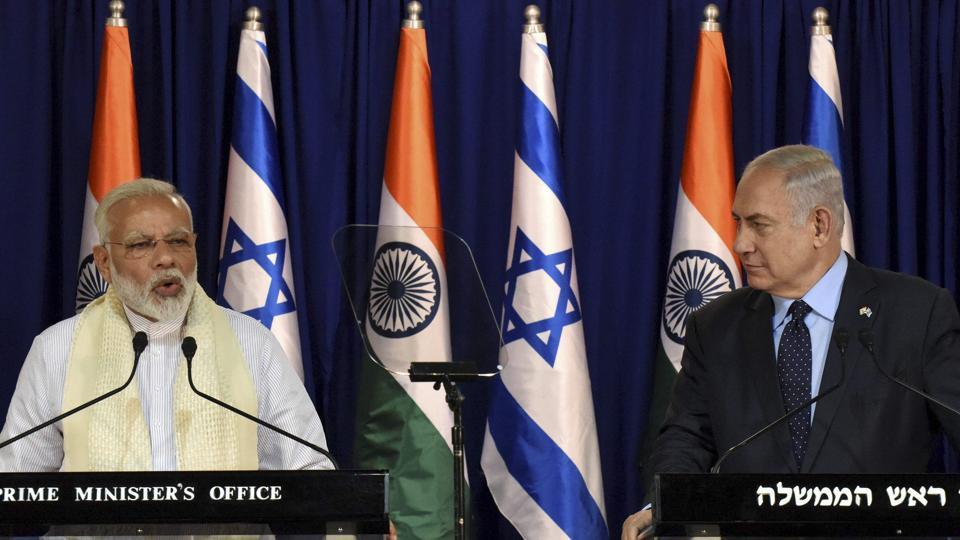
Prime Minister Narendra Modi has bitten the bullet in embracing Israel, and its leader Benjamin Netanyahu as well as the world have taken note.
Modi’s Israel visit, the first by an Indian prime minister, has got more media coverage in the United States and Europe than his June 26 bear-hugging of US President Donald Trump.
Modi has been unambiguous in showing the importance India accords to ties with Israel.
From the time he stepped out of Agra Air India-747 aircraft at Tel Aviv’s Ben Gurion airport, Modi seemed like a man who knew what he was doing.
The hug and the warm handshake with Prime Minister Netanyahu, who received the Indian leader at the airport in a rare gesture, set the tone for the visit.
Both Modi and Netanyahu know that the entire world, particularly the United States, Saudi Arabia and Iran, are watching India take its relations with Israel, an international pariah not so long ago, to the next level.
The two countries have been security partners for more than a decade. India is Israel’s biggest arms buyer, purchasing weapons at an average of $1 billion each year.
Tel Aviv has exported radar killer missiles, synthetic aperture radar, ground sensors, assault rifles, laser-guided bombs, beyond visual range missiles and unmanned aerial vehicles to India.
The two sides are expected to announce on Wednesday a deal for hand-held anti-tank guided missiles under Netanyahu coined “Make with India” initiative. Unarmed drones are also on the menu.
While many Israeli diplomats and media experts are confused over why Modi won’t visit any defence company, it is evident he is more impressed with how a semi-arid nation has turned into agriculture- and water-surplus state through technology.
With 60% of India’s farmland dependent on rains, there is a lot to learn from Israel, which supports a third of its irrigation needs through desalination plants and reuses 80% of its water supply.
It is not just India that stands to gain from Modi’s visit.
Netanyahu, too, is playing the visit it to his advantage. Israel had the world’s oldest democracy, the US, on its side and on his watch, the world’s biggest democracy, India, has gone ahead an embraced the majority Jewish state.
This will help Israel in forging a working relationship with former adversaries such as Saudi Arabia and the United Arab Emirates.
In Modi’s visit, Israeli leaders see the final recognition for the “Jewish state”. Netanyahu greeted Modi by saying “we waited 70 years from you”.
India recognised Israel in 1950 but the two countries established diplomatic ties only in 1992.
Right from meeting Modi at the airport, Netanyahu will be by the Indian PM’s side during all his engagements and plans to see him off when the visit ends Thursday.
After becoming the first world leader to be hosted by President Donald Trump for a dinner at the White House and a rockstar welcome in Israel, Modi will host King Salman of Saudi Arabia and possibly Netanyahu later this year.
Modi’s ringing endorsement of ties with Israel has rewritten India’s West Asia policy.


