
 E-Paper



Muizzu's ‘Out India’ campaign in Maldives a political slogan devoid of reality
Maldives president-elect Muizzu's claim of Indian troops in the Maldives is baseless. There are no troops; only Indian humanitarian assets.

 Prefer HTon Google


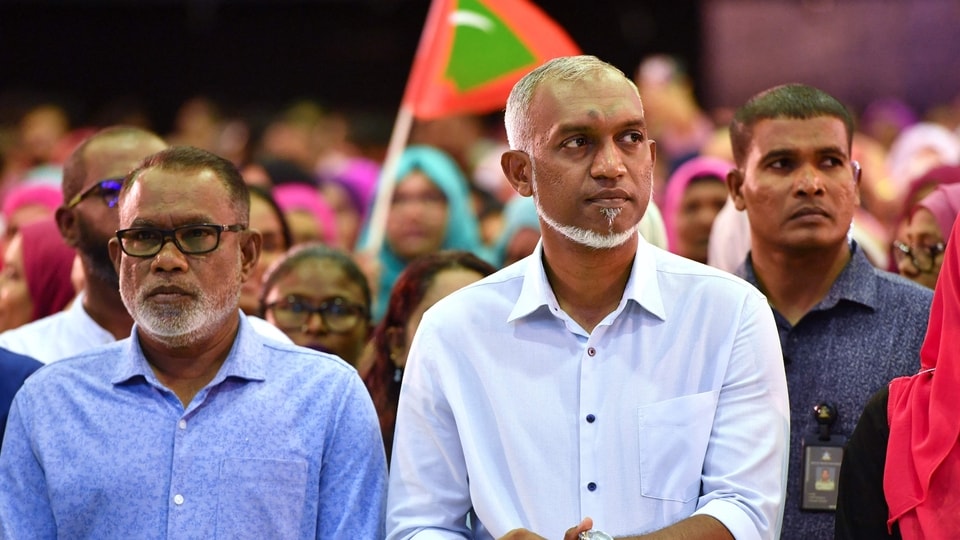
Maldives president-elect Mohammed Muizzu's recent statement about removing Indian troops from the islands within a week of his inauguration has raised eyebrows and garnered attention, but the fact of the matter is that there are no Indian troops stationed in the Maldives. Muizzu's claim is a political slogan devoid of any basis in reality.
What India has in the Maldives are a couple of ALH helicopters and a Dornier aircraft used for medical evacuation, surveillance, and air rescue operations. These resources are deployed to assist the Maldivian government and its people. The Maldivian National Defence Force (MNDF) operates the helicopters, which fly under the Maldivian flag, and the Dornier aircraft lacks an Indian flag. To label these assets as "Indian troops" is not just a misrepresentation but a falsehood.
The 176 personnel associated with these assets are engaged primarily in medical evacuation and rescue missions for the benefit of the Maldivian population, not for Indian interests. Since 2019, they have undertaken 976 such missions, with air surveillance being a small fraction of their activities. Therefore, to claim that India maintains troops in the Maldives is a distortion of the truth.
It's important to understand the political context of Muizzu's statement. He hails from the party of former Maldivian President Abdullah Yameen, whose election campaign was centered around an anti-India stance. Yameen's pro-China leanings were evident during his tenure. However, his successor, Ibrahim Solih, adopted a more balanced approach, emphasizing the importance of maintaining strong ties with India, their nearest neighbour.
Muizzu must recognize that treaties and agreements govern the presence of these assets, and it's not a decision that can be made on a whim. The process for altering such arrangements is laid out clearly within these agreements, and it's not as simple as "removing Indian troops."
From a political perspective, Muizzu's statement could be a gambit to garner votes for his party in the upcoming Majilis election in April. He's playing the "Out India" card for political gain, and that's the real truth behind the current situation in the Maldives.
Moreover, the Maldives is facing the dire consequences of climate change, with rising sea levels threatening its existence. In the event of a serious crisis, the Maldives could find itself submerged, resulting in a potential refugee crisis. India is well-positioned to provide immediate humanitarian relief, not China. The presence of helicopters, Dornier aircraft, and coastal patrol vessels is in anticipation of such a scenario, as India is expected to be the first responder.
India has invested significantly in the Maldives, amounting to over 1.5 billion dollars, which is substantial considering the country's small population of half a million. This investment includes contributions through the State Bank of India (SBI), bonds, and treasury bills. The first repayment of 100 million dollars is expected by the end of this year, a sum that President-elect Muizzu doesn’t have.
It's high time for Muizzu to smell the coffee and realize that India is the Maldives' true ally. Instead of pushing the "Out India" campaign, he should focus on building a stronger partnership with India and consider an "Out China" campaign, which aligns with the Maldives' long-term interests and regional stability. The Maldives' well-being and prosperity depend on choosing its allies wisely, and India is the natural and reliable choice.
For India and the world, the Maldives hold significant strategic importance. Situated in a critical location, it is a conduit for two-thirds of global oil, half of bulk shipping, and nearly one-third of container shipping. Each day, 120 ships navigate through its waters. Any political instability or crisis in the Maldives or neighbouring Sri Lanka could have severe repercussions on global trade and maritime security. India, therefore, must exercise caution and ensure the stability of this region, as it directly affects its maritime security.


