E-Paper



Number Theory: How important are pilgrims among domestic tourists in India?
The run-up to the inauguration of the Ram temple in Ayodhya has generated discussions on the economic potential of religious tourism in India

 Prefer HTon Google


The run-up to the inauguration of the Ram temple in Ayodhya has also generated a lot of discussion on the economic potential of religious tourism in the country, especially Uttar Pradesh. A lot of investment in Ayodhya – this includes an international airport, hotels and other facilities – is being made in the hope of exploiting the rise in footfall of religious tourists in Ayodhya. Whether or not Ayodhya lives up to this potential remains to be seen. However, this is a good opportunity to look at the importance of religious tourists in India. This two-part data journalism series will use a 2014-15 National Sample Survey Office (NSSO) report to answer some questions about religious tourism in India. The survey (conducted in July 2014-June 2015 across 139,688 households) collected data largely for domestic overnight trips. The first part will answer who is the proverbial religious tourist in India and the second part will look at the economic importance of religious tourism in overall domestic tourism.
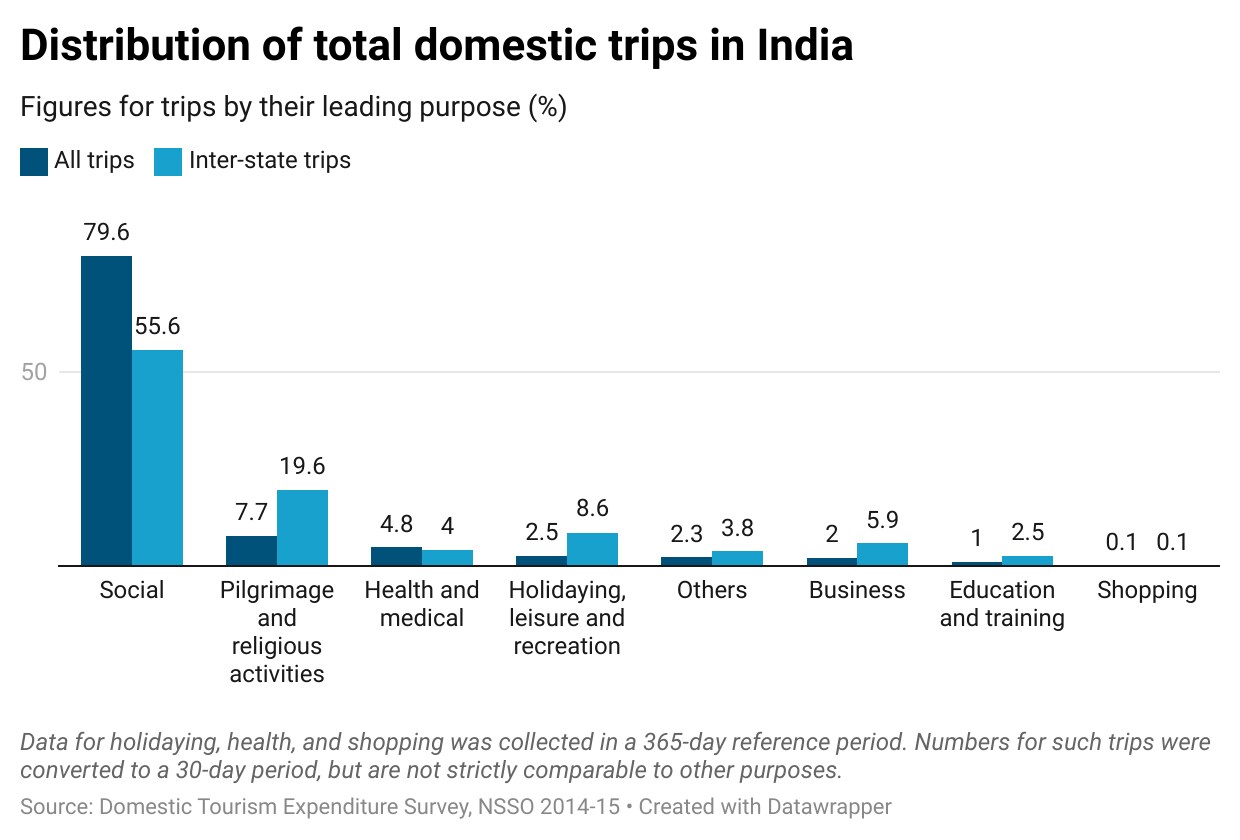
 How frequent are religious trips in India?It is important to answer what the survey counts as trips before getting into this question. By the survey’s definition, trips excluded regular visits from the usual place of residence to any other place such as work, school or even a religious place. To give an example, someone staying in Ayodhya and going to the temple regularly will not be counted as a religious tourist in the data. In fact, what has been counted as a religious trip; there are other categories as well, in the survey has to be an overnight trip, lasting at least 12 hours and must include the period between midnight and 5 am. To be sure, the survey makes a difference when it comes to recording religious and other kinds of trips. While data for religious trips and three other categories was collected over a 30-day recall period, responses on the other three kinds of domestic trips were sought over a 365-day recall period. With these caveats in place, the data shows that religious trips had the second-highest share among all domestic trips in India. To be sure, they just accounted for 7.7% of all domestic trips in the country and were significantly behind social trips which account for almost 80% of all domestic trips in India. However, there is some evidence in the survey to suggest that religious trips are more popular when it comes to long-distance trips. While the survey has not sought information on the actual distance travelled during a trip, it does ask whether or not the trip was taken outside the state of the household. If one were to use inter-state trips as a proxy for long-distance trips, religious trips reduce their gap vis-à-vis social trips in a big way. To be sure, most inter-state trips are also to adjacent states.
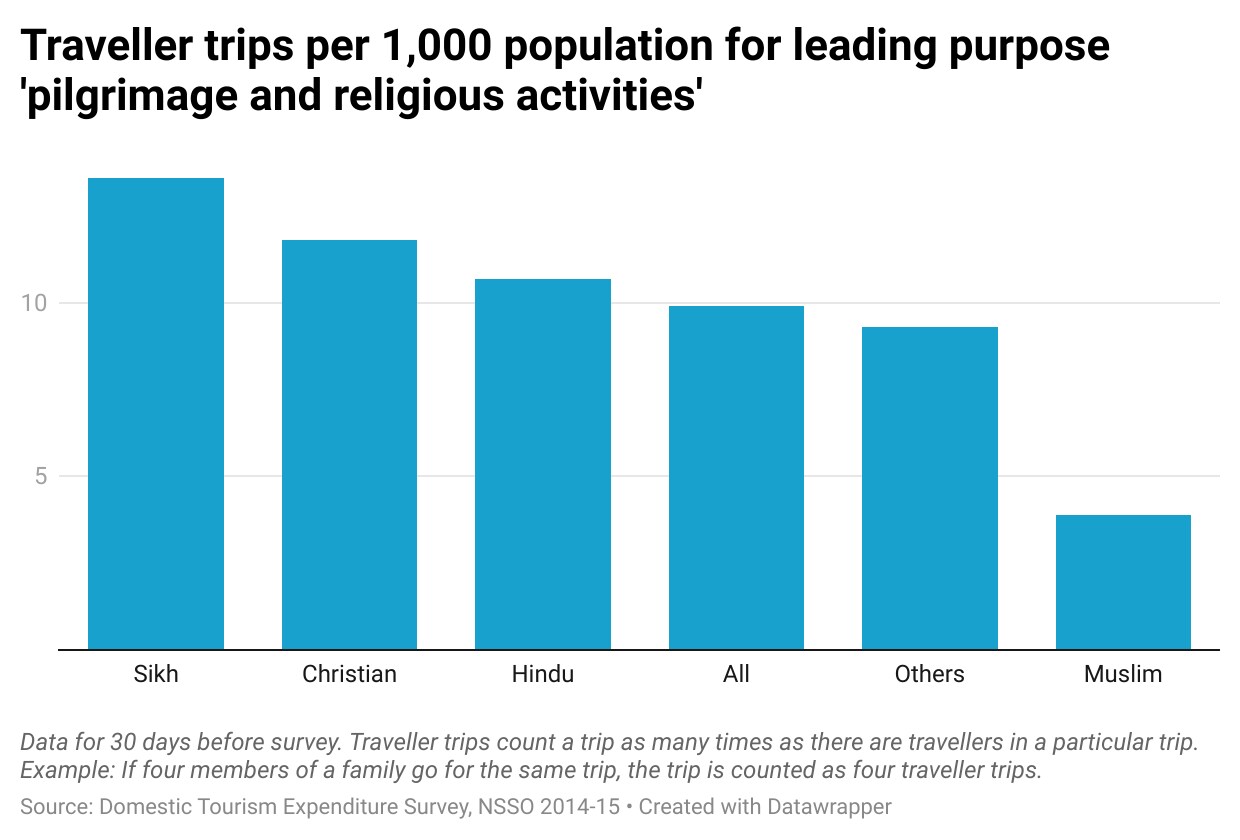
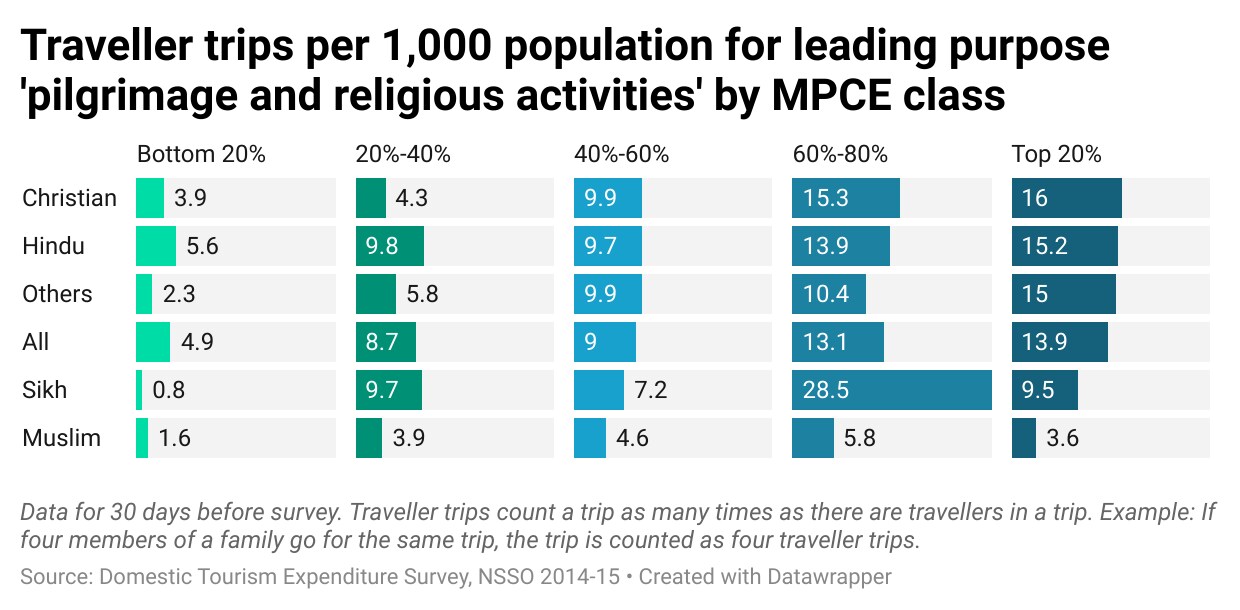
- Muslims are least likely to take religious trips, Hindus do it less than Christians and SikhsThe data allows us to find out the likelihood of households from different religions taking religious trips. Since Hindus are the most populous religious group in India, they accounted for the largest 88% of religious-traveller trips (the sum of trips multiplied by the number of travellers in each of them) in the NSSO survey. However, when adjusted for their population, they averaged fewer religious-traveller trips per 1,000 population (10.7) compared to Sikhs (13.6) and Christians (11.8). Muslims, on the other hand, averaged only 3.9 religious-traveller trips per 1,000 population and other smaller religions combined averaged 9.3 religious-traveller trips per 1,000 population.
- Income is a big factor, but not the only factor deciding who takes pilgrimagesBecause trips involve expenditure over and above regular spending, it is obvious that the poor undertake fewer religious trips than the rich. However, this does not mean that the rich or poor class from different regions undertakes pilgrimages at a similar frequency. For example, southern states show a higher number of religious-traveller trips per thousand population even if one compares them with northern states with similar monthly per capita expenditure (MPCE) levels. Among various religious groups, the number of religious-traveller trips increases with rising MPCE among Hindus and Christians but shows a fall among the top 20% among Muslims and Sikhs.
This is the first of a two-part data journalism series on domestic religious tourism in India. The second part will show the spending on such tourism.