
 E-Paper



Assembly election results: Aspirational Uttarakhandi clicked for BJP
The BJP had a master campaigner in Prime Minister Narendra Modi, who clicked with masses instantly. He spoke a few lines in the local dialect at a number of rallies, including his last in Rawat’s bastion– Kumaon– connecting instantly with locals, especially women.


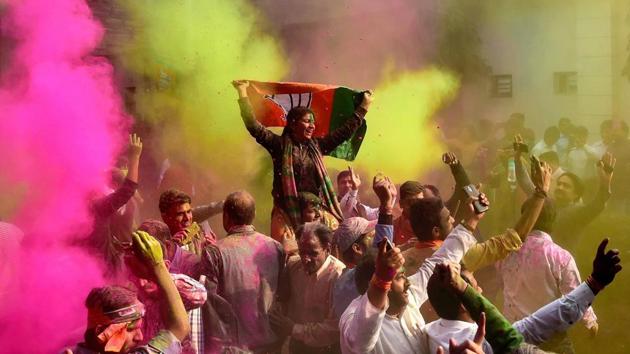
The aspirational Uttarakhandi clicked for the Bharatiya Janata Party (BJP) in a primarily bi-polar poll.
That is what I could make out from my visits during the polls in the hill state. When I visited the hill state for the first time in the non-internet era of early 1990s, when it was part of Uttar Pradesh, a common Uttarakhandi was just looking for a happy two square meals a day and improvement in existing roads.
That was not the case in 2017. The aspiration to do better was evident. The older generation wanted roads to their homes, women tapped drinking water and assured power supply and youngsters jobs at their doorsteps.
Defeated chief minister Harish Rawat had promised all this but did not deliver much in his three years of troubled rule, mired by dissidence and intense coterie politics that alienated him from the people.
There was an opportunity for Opposition BJP to latch on. It took so, smartly.
First, it fostered dissidence within the Congress and took away senior mass leaders away from the party. Second, the BJP’s dirty tricks wing dismantled Harish Rawat’s so-called clean image by exposing him through sting operations and social media. Third, it pumped money into polls that the Congress was not able to match.
More than that, the BJP had a master campaigner in Prime Minister Narendra Modi, who clicked with masses instantly. He spoke a few lines in the local dialect at a number of rallies, including his last in Rawat’s bastion– Kumaon– connecting instantly with locals, especially women.
Modi spoke about people issues and his plans to deal with them. It had an emotional connect with people who were willing to forget about corruption allegations against the previous BJP government with a common refrain “Modiji will deliver” for us.
BJP’s many Harish Rawats
The Congress had only one poster boy in Harish Rawat.
The BJP had many with similar stature like Bhagat Singh Koshyari, Satpal Maharaj, Ramesh Pokhriyal Nishank to name a few. They were assigned specific tasks months in advance.
A senior BJP leader said Koshyari was asked to remain in his area of influence in the hills, Maharaj tasked to exert influence among ashrams and muths and Pokhriyal to handle only crucial Haridwar region having 13 seats. The leader counted two gains --- minimising infighting and making use of their influence.
The BJP also managed the rebels well, promising them a post when they form the government and adjusting some of them within the party organisation. Former state BJP chief Tirath Singh Rawat, who was denied ticket, was adjusted as the party’s national secretary.
Well-oiled strategy
When it came to strategic, the BJP was miles ahead of the cash-strapped Congress. The party had connected with voters even before the poll dates were announced in the first week of January after which the Congress launched its campaign.
The BJP posted workers from other states in all constituencies. “We have assigned every village to our workers from Himachal who know the customs and topography,” a central minister told this correspondent during the campaign.
“They have been asked to stay in villages and not in towns”.
Hindu card
A good strategy would not have been enough. The party carefully crafted the Hindu card from Haridwar in the plains to Badrinath and Kedarnath in the hills. In the plains, having high Muslim votes, it was used to polarise the majority votes while in hills the card was to showcase the BJP as “real” party of Hindus.
The BJP scripted an unprecedented win –never seen before in the young state born in 2012– with the Congress left with only solace --- its vote share almost remained intact.


