E-Paper



Bhopal communal clashes: A heritage gate is what caused Hindu-Muslim tensions
On Tuesday, Muslim crowds came face-to-face with men from the Vishwa Hindu Parishad who wanted to pray next to the minarets but weren’t allowed. Stone pelting ensued for hours.


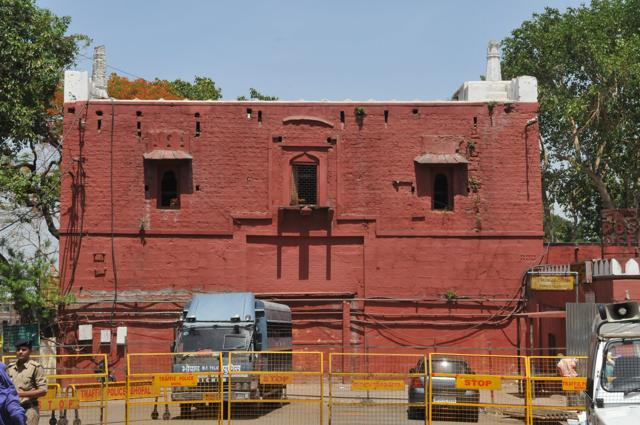
A structure inside Bhopal’s Hamidia hospital that sparked communal tensions in the heart of the city isn’t a mosque as claimed by Muslim groups but a “heritage entrance gate”, archaeologists said on Wednesday evening.

Dr Ahmed Ali from the state archeology and archives department termed the two-storeyed structure as a “heritage entrance gate structure over 200 years old” on which later a memorial plaque for the World War I martyrs was put. He said it was not a mosque at all.
“I have communicated my findings to the government so that there is no doubt in anybody’s mind on this issue now on”, he said.
This came after hours of stone pelting and arson in old Bhopal where Hindus and Muslims clashed over the right to pray inside the structure found during excavations recently. Muslims called the structure a mosque and wanted to pray inside but were denied permission.
On Tuesday evening, large Muslim crowds came face-to-face with men from the Vishwa Hindu Parishad who wanted to pray next to the minarets but weren’t allowed. Stone pelting ensued for hours and police were forced to cane the mobs.
Hundreds of police personnel have fanned out across the old city and most roads were sealed to ward off clashes.
Dr Ali said the structure was the entrance gate to the Fatehgarh fort that led to the old walled city of Bhopal. He said Fatehgarh fort was constructed by Dost Mohammad Khan (1657–1728), the founder of the erstwhile Bhopal State and the fort was later expanded to encircle Bhopal.
HT visited the historic structure at Hamidia. The marble memorial on the left side of the gate reads “Bhopal State… From this state, 994 men went to the great war 1914 -1919. Of these, 36 gave up these lives.”
A senior government official, requesting anonymity, said, “Such memorial plaques are not found on the gates of mosques”. He said it was a major proof that it was not a mosque.
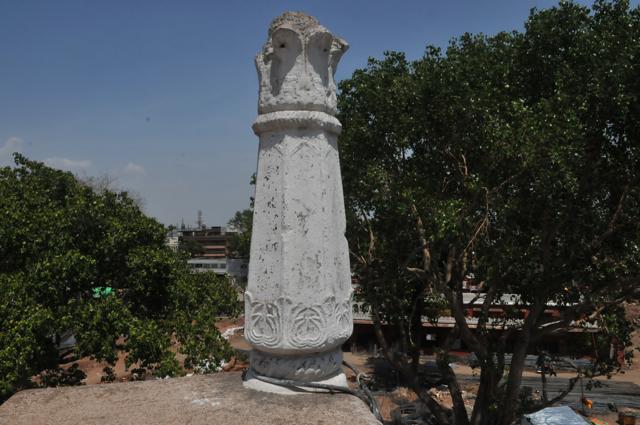
Dr Ali said soldiers from erstwhile principalities participated in World War I. “As this was a very important gate in the heart of Bhopal, the soldiers left from this very gate. This is why after 1919, a memorial plaque was set up on the left side of the gate”, he said.
Nilamber Mishra, sub-divisional magistrate (SDM) Bhopal told HT that the no excavation was done at the historic structure site inside the Hamidia hospital premises. “Nearby, a 2000-bed hospital is being constructed due to which some people felt concerned about the fate of this heritage structure. We sought help of archeologists who made it clear that it was a not a mosque”, he said.
During the visit to the heavily guarded heritage structure, HT found that it had a big gate on one side while on the other side, the gate opening had been closed with a brick wall. On the front side of the historic gate, few rooms had been constructed by the hospital authorities, where drugs were stored.
The city has many historical gates (darwazas) such as Lal Darwaza near Model Ground, the Military (Regiment) Gate that is the entrance to the Sultania Infantry settlement, the Islami Gate at Shahjehanabad, the Dakhil Darwaza of the Taj Mahal and the Gate of Bagh Farhat Afza.
The first three gates were the entrances to the walled Shahjehabad area constructed by erstwhile Bhopal ruler Shahjehan Begum (reigned 1868-1901). Jumerati Gate, considered the oldest surviving gate of Bhopal was built by the founder of Bhopal Nawab dynasty Dost Mohammad Khan about 300 years ago.