Politicians, ministers yet to visit ‘Remember Bhopal’ museum
High footfall at state-of-the-art museum ‘Remember Bhopal’ suggests that residents are yet to forget what happened in the middle of December 2-3, 1984, night.

However, the visitors’ diary at the first gas tragedy museum of the state reveals that none of the politicians and ministers of MP have bothered to visit the memorial inthe past one year.
“Students, activists, foreign tourists, families and even bureaucrats visited the museum to gather information, but in the past one year not a single politician or minister visited the place to feel the pains of survivors,” a volunteer of the movement told HT.
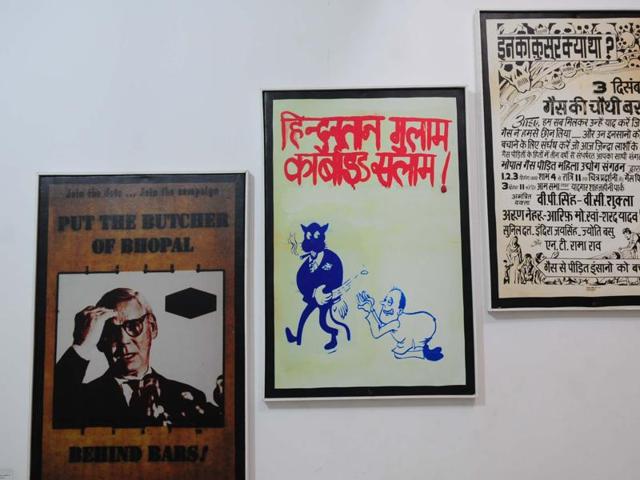
The artefacts, oral histories, photographs, protest songs and campaign posters at hall of memories, stand testimony to the trauma the people of Bhopal faced 31 years back after a poisonous gas leaked from the Union Carbide factory.
Suresh Melettukochy, who works as a volunteer at the museum, told HT: “Families who lived through the biggest industrial disaster of the country have contributed objects, artefacts, photographs, protest songs, posters and slogans to the museum, which shapes the narrative of the museum.”
Rama Laxmi, a driving force behind the museum, said the museum attempts keep the harrowing tales of survival and loss alive so that the present generation could take lessons from it and keep the campaign on.
ABOUT THE AUTHORShruti TomarI have spent over a decade chronicling Madhya Pradesh’s political and social landscape, covering politics, investigative journalism, crime, human interest, and government policy, blending sharp insight with ground‑level depth. I have closely tracked three assembly elections, three Lok Sabha elections, leadership transitions in MP while exposing governance lapses, tender irregularities, and flawed policy rollouts. My reports have revealed gaps in the Cheetah project, irregularities in medical education, rigging in recruitment exams, and loopholes in policy implementation. In crime reporting, I have moved beyond FIRs to map systemic patterns — from organised crime networks and gender‑based violence to custodial accountability — balancing urgency with sensitivity. My journalism is defined by a commitment to human interest. I have profiled the marginalised Bancchda community, documented atrocities against tribal groups, and highlighted efforts to preserve their culture through heritage liquor and revival of spiritual practices. I have reported on farmers struggling with failed MSP promises, giving voice to those often reduced to statistics in policy files. Passionate about field reporting, I have reported on rampant sand mining in Chambal and Narmada, pharmaceutical companies supplying medicines under altered names, the dire condition of schools and colleges, the plight of commercial sex workers, and skewed sex ratios in specific districts. Beyond deadlines, and as HT’s state correspondent and assistant editor in Madhya Pradesh, I engage with ministers, farmers, students, and activists, believing the best policy stories begin with a single human voice. A postgraduate in Journalism and Mass Communication, I also hold a diploma in sports journalism.Read More

E-Paper