
 E-Paper



Book Box | A double dose of literary exploration with 'Quarterlife' and 'Sakina’s Kiss'
Delve into the conversations and themes of modernity, identity, and rebellion found in "Quarterlife" and "Sakina’s Kiss," two compelling literary works

 Prefer HTon Google


Dear Reader,
Drum beats sound outside my window, rhythmic, pounding, thunderous.
The pull of the percussion, synthesizer sounds, the loudspeaker music, it all calls to me, drawing me down to the narrow street below. Suddenly I am a part of a throng of people, a procession full, spilling out all over the street (there is no pavement here).
All fortnight now, this street has been full of people taking their gods to sea. I have been away and missed many immersions; but I am glad to be back in time for the mahavisarajan (grand immersion), when gigantic Ganeshas from pandals all over the city, make their way down to this beach.
But this year, my perspective on the procession has shifted.
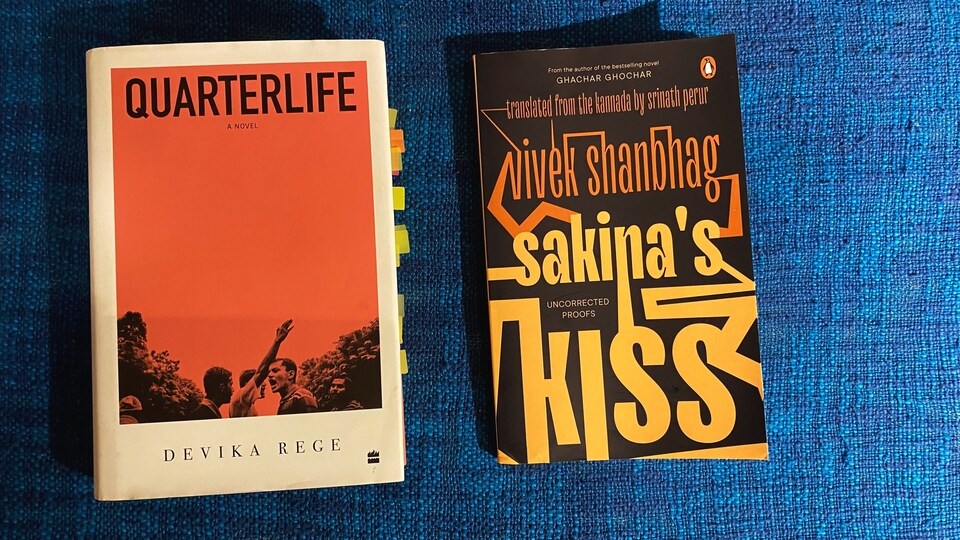
It's thanks to Quarterlife, Devika Rege's debut novel set in modern-day Mumbai. This ambitious book begins in the grey loneliness of the United States and moves into the frenetic chaos of India's financial capital.
Quarterlife introduces us to Naren and Amanda, two characters embarking on journeys to the East. One is burned out, the other drifting, both seeking a new path in life. India, with its growth story, economic miracle, and inequalities, promises a fresh start.
In Mumbai, Naren uses his old boy Konkanastha Brahmin network to land deals for his multinational consulting firm and Amanda works as an impact fellow in the slums of Deonar. Yet, as we follow their paths, we uncover the sharp ripples that rend the narrative of India's growth. We meet Naren's family living in their gated community flat, his brother Rohit, and their cousins—one a bhakt, the other a Naxalite.
There's an underlying sense that things aren't as they seem; forces are gathering, ideologies are clashing, and a relentless momentum builds, much like the drumbeat of a visarajan.
In Quarterlife, the god Ganesh is everywhere. The book explores the dichotomy of Ganesh as both a personal deity and the god of crowds and communities. There is the small idol the Agashe family brings into their high-rise flat. This Ganesh will be immersed in a 'brass bucket near the Anthuriums’. There are the twenty-foot-high Bappa Raja Ganeshas, the god of crowds and communities, who will make their way through the streets, halting in a ‘sensitive area before the ivory domes of the Hindustani Masjid’

Like this novel, art follows the ideology of the times. Naren was perhaps drawn back home by the economic growth prospects, but his brother Rohit is seduced by the power and purpose of the bhakt ‘Brotherhood’. He travels to the Konkan on a ‘roots tour’, comes back with his bhakt cousin Omkar, and decides to produce and fund Bappa, a film on Ganesh.
This is a slow burn of a novel. At first, I found Rege’s prose overwrought. But as the novel progressed, I found myself liking it more and more, and I was glad I persisted. The friends and family in Quarterlife have long conversations, like the characters in a Sally Rooney novel. They discuss economic growth (‘corruption today is almost like a tax; it didn’t stand in the way of our boom and won’t be the reason for our bust’) they debate whether religion is simply a route to power, and argue on whether the Mughals were colonizers or part of India’s history. The characters and the themes of this very contemporary book, set in my city, stayed in my head for a long afterwards.
As I listen to the rhythmic drum beats, I go back to this book. I’d love to know your opinions too, on this book of ideas set in this city. And on what do you think fiction, especially in these inflammable contemporary times, can achieve?
And after you read Quarterlife, how about a novella; a change of taste, a change of pace and of length.
Celebrate International Translation Day this Saturday, September 30, by ordering Kannada author Vivek Shanbhag’s new novella. After an eight-year gap, we finally have another book from the man whose Ghachar Ghochar catapulted him onto the international map, featuring on The New York Times Critics' top books. Shanbhag's new novella releases next week, and thank you to the publishers for my advance reading copy.

I have to confess I approached this book with some trepidation - could anything live up to the spare pleasure of Ghachar Ghochar?
I am happy to report Sakina’s Kiss does. It shares an interesting feature with Ghachar Ghochar, that of the unreliable narrator, telling some of the story in the silence of the text. And yet Sakina’s Kiss is very much its own novella, drawing on history, geography and patriarchy to tell a tantalizing tale - Rekha, the daughter of the house, has gone missing. Or has she? What's the story here? The narrative unpeels like the layers of an onion - I don’t want to say too much and give anything away, it is intriguing, and will stay with you for a long time.
So here’s a novel and novella for you, both very different, and yet they intersect as they bring up rebellion in a very provocative way.
Until next week then, happy reading!
Sonya Dutta Choudhury is a Mumbai-based journalist and the founder of Sonya’s Book Box, a bespoke book service. Each week, she brings you specially curated books to give you an immersive understanding of people and places. If you have any reading recommendations or suggestions, write to her at sonyasbookbox@gmail.com
The views expressed are personal


