
 E-Paper



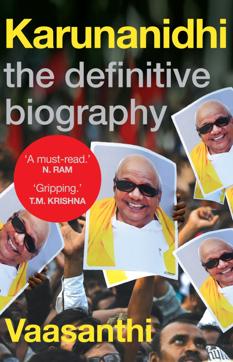
Excerpt: Karunanidhi; The Definitive Biography by Vaasanthi
This chapter from the book, which was released today, looks at the 2G scam and at how Karunanidhi was shattered by Kanimozhi’s arrest

 Prefer HTon Google


There was more pain and trauma in store for Karunanidhi in the year 2011.
‘I hear that there is talk that something has seriously gone wrong in the distribution of 2G spectrum.’ Karunanidhi’s voice shook as he spoke on the telephone to A Raja, Central minister for information technology. ‘It seems questions are being asked why there was a change from the original plan of holding an auction. They say there is a big scandal as the allotment was fraudulently given to a select few. Is it true? En peyarai keduthoodatheit.’ Don’t ruin my reputation.
Raja had great respect and affection for the DMK patriarch, and it saddened him to hear his revered leader sound so agitated. Raja tried to explain over the phone why they did not go for an auction.
Karunanidhi got to know about the brewing controversy from N Ram, a good friend and reliable source, who would not create a scare if there were no substance to it. Karunanidhi now advised Raja to meet N Ram and explain the whole thing, just as he had done to him. ‘You may be a Central minister, but Ram is a big man and you must show respect to him.’
Raja sat with N Ram for more than two hours and presented his case, while the latter listened patiently. But the 2G spectrum genie had already grown so big, it could not be contained easily. It affected not only the destiny of Karunanidhi, but also that of his daughter Kanimozhi, and the future of the DMK.
What was the 2G spectrum story?
It was actually a leap to second-generation (2G) telephony. Spectrum or airwaves are a natural resource and a national asset. The government allocates frequencies of these electromagnetic waves after what remains of their use by the defence establishments, to telecom and communication companies to operate their voice and data services.
Raja was excited that he had been entrusted with the task of allocating 2G spectrum to various telecom companies. 2G had the potential of bringing about a communications revolution. It was meant to make phone calls cheaper, mobile networks more accessible to Indians and connect the country like never before – all of which it did.
Since 1994, allocation of spectrum had happened through auction or bidding. The only exception was in 2008 when A Raja was the minister for information technology – the Telecom Regulatory Authority of India (TRAI) and the Department of Telecom (DoT) along with the minister opted for the first come, first served method. The idea was to make spectrum allocation more transparent instead of it being monopolized by the big gamesters alone. This was not to the liking of established companies, which preferred the auction method.
The call for allotment of 2G spectrum to various interested companies was made in August 2007, with 1 October being the deadline. Over 575 applications arrived, out of which forty-six were old players.
A Raja writes in his book 2G Saga Unfolds, ‘It was observed and recorded that in view of the large number of applications pending and to discourage speculative players, we may close receiving applications on 1 October . . .’
On the basis of the availability of spectrum and the quantum of spectrum that would become available soon, it was later decided to consider in the first phase all applications received until 25 September 2008. DoT found that several applications received by 25 September qualified to receive the allotment. And since the availability of spectrum was limited, they decided to stop further applications, thus bringing forward the deadline by a week. The way this decision was conveyed to the press created the impression that there was a sudden change in the date. There were loud protests from the corporate sector, questioning the change in date. They said that the procedure seemed dubious.
There was also news that the price was fixed at the market price that prevailed in 2001. That led to the charge that it caused an enormous loss to the government. It was pointed out that those who purchased spectrum at a lower price sold it on to IT companies at a high rate.
Meanwhile, the prime minister and the finance ministry raised concerns about the procedure adopted by Raja and his team, as per documents leaked to the media at that time.
Suddenly the 2G spectrum deal became the subject of a big controversy and the Opposition said it smelt a rat. The Janata Party president Subramanian Swamy (who merged his party with the BJP in 2013) sought Prime Minister Manmohan Singh’s permission in November 2008 to prosecute Raja over allegations of corruption in the issue of 2G licences.
Raja and DoT and TRAI explained periodically to the media that they had gone by the rulebook and done nothing wrong. A belligerent Swamy took the case to the Supreme Court. In 2009 the Central Vigilance Commission (CVC) began a probe into the allegations. In September 2009 the Supreme Court declared it a Rs 70,000 crore scam.
By October 2009 the CBI entered the scene under direction from the Supreme Court, filing an FIR against unknown DoT officials and unknown private companies.
A month later the issue exploded.
The Comptroller and Auditor General’s (CAG) report on the 2G spectrum allocation was leaked to the media before it was tabled in Parliament. CAG Vinod Rai, who was about to retire, had pinned a mind-boggling Rs 1,76,000 crore loss to the government!
Print and visual media went to town with the news, touting it as the greatest scam India had ever seen. They never once questioned the CAG’s loss figures. Raja was chased by cameras everywhere he went, hounded by reporters in Delhi and Chennai. When Karunanidhi saw the visuals on TV he felt it was he who was being hounded and chased. He must have regretted not heeding Prime Minister Manmohan Singh’s advice against reinstating Raja as IT minister.
Central government monitoring agencies such as the CVC, CAG, CBI and the Supreme Court each looked into the case almost independently. Each concluded Raja had had his own agenda. The truth became a blur and the trial a mockery.
Th e CAG’s figures of loss to the government may have been inflated, but they could not be ignored. This turned into a powerful weapon in the hands of the Opposition – the BJP – who stalled proceedings in Parliament for several weeks and raised its verbal assault on the UPA government to a hysterical pitch.
So aggressively did the BJP fling the charge of unprecedented corruption in the UPA in the allocation of 2G spectrum that the public mood turned against the UPA. Even those who didn’t know what the alleged scam was about or who Raja was believed that a minister in Manmohan Singh’s Cabinet was hugely corrupt.
For Manmohan Singh there was no option but to have Raja resign, who agreed only after Karunanidhi too asked the same of him. However, he continued to support him and even said that Raja was accused because he was a Dalit. On 2 February 2011 Raja and two of his assistants were arrested. Karunanidhi could do nothing, though the DMK was an ally of the ruling UPA and also part of the government. It didn’t help that the media in north India was not very sympathetic towards Karunanidhi, who had bargained plum ministerial berths for his partymen.
In May 2011 came the Assembly elections in Tamil Nadu. Jayalalithaa’s campaign speeches in every district aggressively addressed the 2G scam: ‘DMK plundered the nation!’ she cried. The crowds at her rallies may not have understood what this scam was, but they were convinced that Jayalalithaa’s corruption paled in comparison. They even began to believe that all the allegations against her were lies spread by the DMK. Jayalalithaa was back in power with a thumping majority.
During her victory celebrations, she announced to her partymen, ‘The DMK story is over!’ The roaring cheers from the AIADMK headquarters shook the walls of Karunanidhi’s residence at Gopalapuram, which was a stone’s throw away.
•
Just a week after the election results another thunderbolt struck Karunanidhi – an allegation that a Rs 200 crore loan was circuitously given to Kalaignar TV, the DMK mouthpiece, by some beneficiaries of the 2G spectrum. Kanimozhi was a director of Kalaignar TV at that time.
The CBI described the loan as kickbacks for getting spectrum. Raja had already been jailed. On 20 May 2011 a Delhi court ordered Kanimozhi’s arrest.
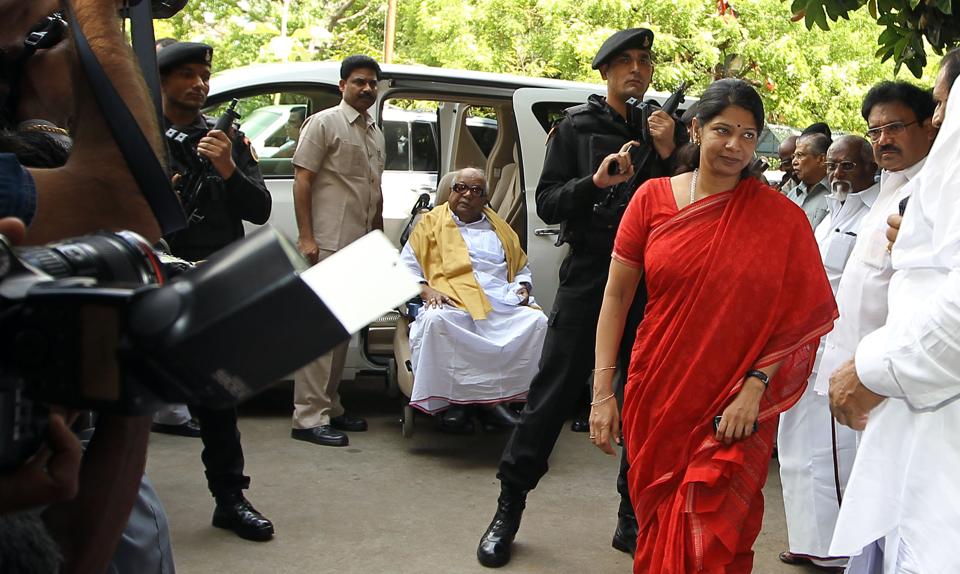
Karunanidhi, eighty-seven, was shattered. Alagiri, Stalin and a few DMK senior members who were with him when the news arrived failed to be of any comfort to him. Karunanidhi eventually pulled himself together and left for the CIT Colony house where Kanimozhi’s mother Rajathi Ammal lived. As he arrived at the gate reporters swarmed around him and asked the distraught man how he felt.
‘How do I feel? If your daughter were arrested how would you feel? She was held for no fault of hers,’ was his response.
He had no words to console Rajathi, who broke into uncontrollable sobs. For the first time in his life, he was so desperate he saw nothing but darkness ahead. He had never lost his nerve when his party suffered defeats in elections, he would quickly recover his fighting spirit, crack jokes and make everyone around him laugh. On the day he was arrested and dragged down the stairs into a police van he may have suffered physical pain but his spirit remained unbroken. When twenty-three-year-old Stalin was arrested during the Emergency, he stayed calm. But now, fear gripped his heart. The future seemed so uncertain and completely beyond his control, beyond the control even of the Central government since the 2G probes were under the Supreme Court’s watch. To whom could he appeal? ‘It’s a matter between the court, the accused person and the probing authority,’ said Congress spokesperson Abhishek Singhvi while Kanimozhi headed for jail on being denied bail.
Kanimozhi was taken to Tihar Jail and lodged in sub-jail number six in a single occupancy cell, 15 x 10 foot in size. She showed amazing composure and dignity as she followed the cops silently to her new abode.
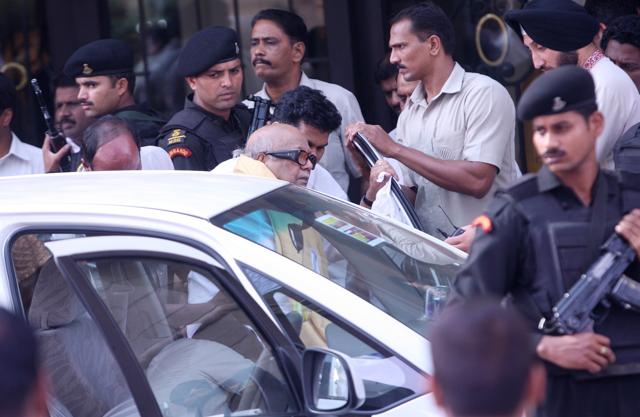
When Karunanidhi watched Kanimozhi being taken by the police to Tihar Jail on TV he broke down. ‘They are taking our daughter like a sacrificial goat,’ he wept.
Karunanidhi could notionally upset the UPA apple cart by withdrawing from the alliance with the Congress, but expediency demanded that he keep his share of power in Delhi. Once again he came to the painful realization that he had no one but himself to blame for the turmoil he was in.
As Vinod Sharma, political editor, Hindustan Times, commented, ‘The story would have been different had Karunanidhi acceded to the prime minister’s wish to drop [A. Raja as] telecom minister in June–July, 2010 in the wake of the CBI probe. Then came the damning CAG report, the UPA–Opposition face-off over setting up a joint parliamentary committee (JPC) and the Supreme Court’s decision to oversee CBI investigations.’
Raja was in jail for more than a year and Kanimozhi for 190 days before they could come out on bail.
Meanwhile, Enforcement Directorate officials landed up at Karunanidhi’s Gopalapuram home to question Dayalu Ammal, who was named as one of the directors in Kalaignar TV. This despite Karunanidhi asking for reprieve for his aged wife, who was reportedly afflicted with Alzheimer’s.
Peter Alphonse describes the atmosphere of those days, saying: ‘We Congress members were actually terrified at that time by the way the BJP went about putting pressure on the Congress government, accusing it of the mother of all scams . . . Vinod Rai’s mindboggling figure quoted as loss to the government frightened us all. It made us think there may be some truth in it. We could do nothing about it. We could not defend ourselves. It was even said nothing could have happened without the knowledge of Manmohan Singh.’
Kanimozhi revealed later in an interview, ‘When my father spoke to me about Kalaignar TV I did not want to be in it. I said I am not interested in associating with television media, and that I will not be able to accept a lot of things there. Finally he convinced me because he wanted it to be a family-run thing.’ She said that her father felt great remorse when she was caught in an alleged fraud connected to Kalaignar TV. ‘He knew I wasn’t making any decisions at Kalaignar TV. I was completely clueless as to what was going on. I think that made him feel very bad. He came regularly to see me in jail [Karunanidhi was by then wheelchair-bound], and became emotional. I told him it is an experience and I was learning a lot and reading a lot.’
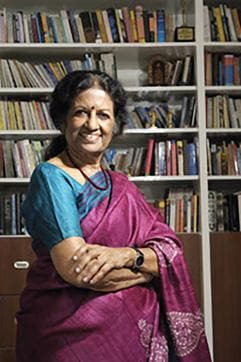
Kanimozhi was especially close to Karunanidhi, widely believed to be his favourite. She shared his passion for reading and writing poetry and he believed she brought him luck, for it was after her birth that he rose to prominence in the DMK. For the favourite daughter who had led a comfortable life away from the glare of public scrutiny, the stint in jail like an ordinary criminal must have been traumatic.
‘Kalaignar was devastated,’ says Durai Murugan. ‘I had never seen him like that. The fear that the allegations of the 2G scam may be true was what affected him most, I think . . . The day he went to Tihar Jail and saw Kanimozhi there, he came back and wept. “It is entirely my fault,” he moaned. “She was only interested in poetry and literature and I forced her into something she did not want.”’
After seven long years of hearings, the CBI court in Patiala House in Delhi pronounced the verdict on 21 December 2017. Judge OP Saini acquitted every one of the accused, stating in court, ‘I have no hesitation in holding that the prosecution has failed to prove the charges beyond reasonable doubt. So all are acquitted.’
Raja, a lawyer by profession, had argued the case himself with confidence and conviction.
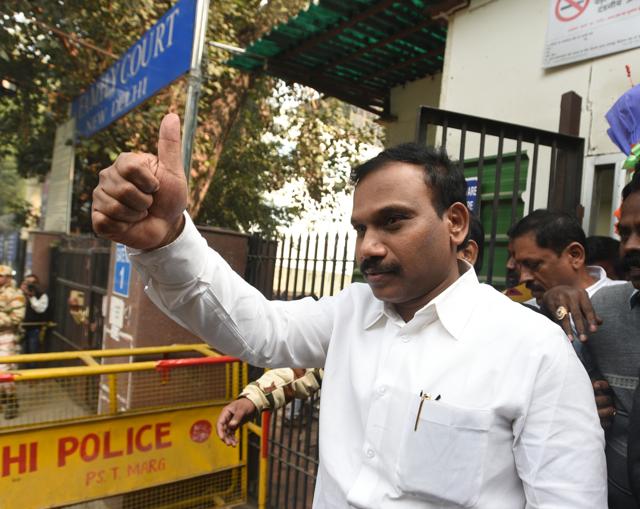
His book, The 2G Saga Unfolds, came out in January 2018. In it he attacks Vinod Rai, former CAG, for being driven by political motives; he attacks Sunil Mittal, chairman, Bharti Enterprises, and also then Solicitor General, G Vahanvati, for placing him at the centre of the so-called scam. But he has words of respect for Manmohan Singh and Karunanidhi, who had his back through it all even if they couldn’t do much under the circumstances.
When news of the acquittal came, Karunanidhi had a tracheostomy tube down his throat and was unable to speak. But he still managed to get out the word ‘magizchi’ (happy).
Karunanidhi; The Definitive Biography available on the Juggernaut app for free till the lockdown lasts


