
 E-Paper



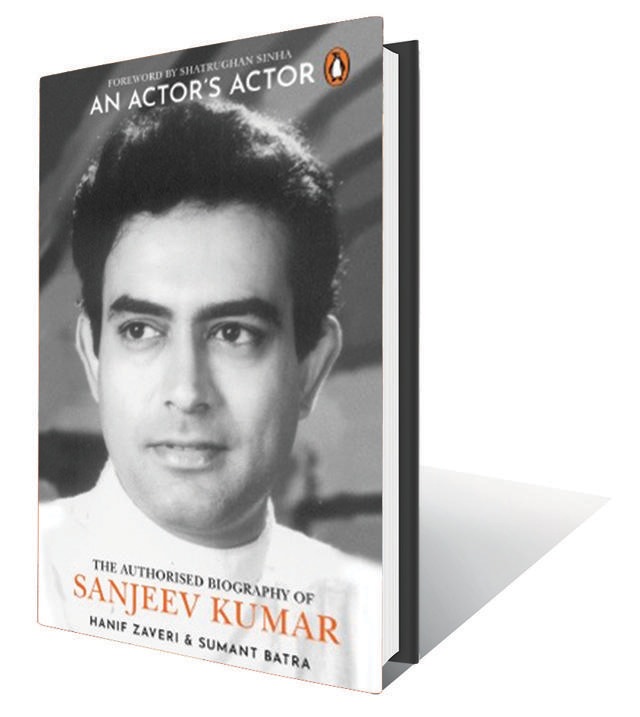
Excerpt: An Actor’s Actor; The Authorised Biography of Sanjeev Kumar by Hanif Zaveri and Sumant Batra
This first exclusive excerpt from the biography of one of the finest actors of Hindi cinema looks back at his unfortunate love life

 Prefer HTon Google


…After the completion of his debut film Andaz (1971), director Ramesh Sippy was looking for a subject for his next venture. He had a good team of writers — Salim Khan and Javed Akhtar — and they were in search of a fresh script to work on. Coincidentally, producer-director Pramod Chakravorty happened to be planning to make a new version of the superhit film Ram Aur Shyam (1967), focusing on identical female twins. The Dilip Kumar-starrer, in its turn, had been based on the English film The Corsican Brothers (1941). Chakravorty passed the idea on to his writer, Sachin Bhowmick, but, while the idea was still germinating, he heard that Ramesh Sippy was planning to make a film along the same lines. Thankfully, his film had not hit the floor yet, and he decided to put it on hold. According to Chakravorty, Sippy had somehow gotten hold of his idea and immediately told his writing team to develop a script around it. Unsurprisingly, both Chakravorty and Sippy envisioned the star of the time, Hema Malini, in the lead role.
…Seeta Aur Geeta is the story of twin sisters, Seeta and Geeta, who are separated at birth. Seeta is brought up by her uncle and aunt, who mistreat her and deprive her of her inheritance, and Geeta is raised by her slum-dwelling maternal aunt, who had stolen her from her cradle, and gets by working as a street performer. Seeta is homely, naive and submissive, while Geeta is vivacious, loud and street-smart. The plot turns into a comedy of errors where both are mistaken for each other. Amid all this, the sisters find love.
When Ramesh Sippy narrated the script to Hema Malini, she was not convinced that she could do justice to a role similar to what had been done by the legendary Dilip Kumar. Mindful of the divide between male and female stars in the industry, Sippy assured her that the audience would never compare her acting prowess to his. The only obstacle that remained was finding actors to play the twins’ love interests, and this was solved when Dharmendra and Sanjeev Kumar agreed to play the parts. ..
Although the Indo-Pak war of 1971 caused some setbacks, the film was completed in eighteen months and released on Diwali in 1972. A complete entertainment package, the movie was a phenomenal hit.
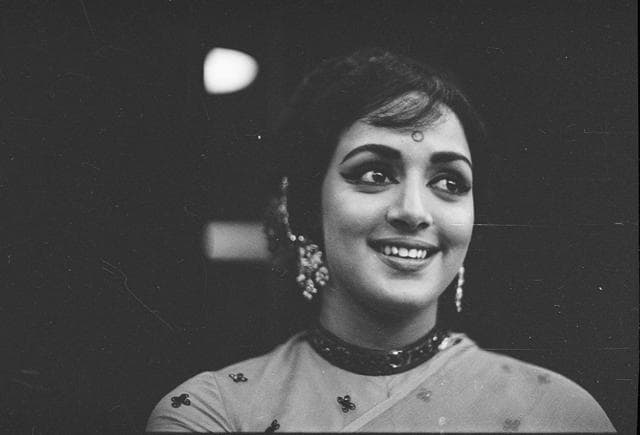
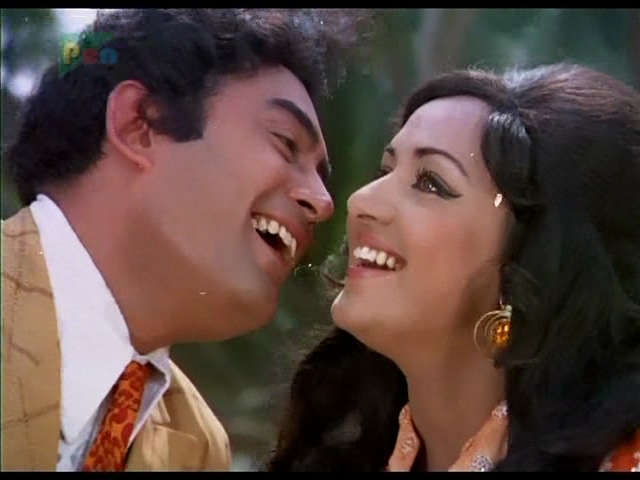
Sanjeev Kumar and Hema Malini became acquainted with each other while shooting for the song ‘Hawa Ke Saath Saath’, in which they had to skate through the picturesque roads of Mahabaleshwar. Since both actors were novice skaters, they fell an umpteen number of times. Ramesh Sippy, however, kept all the shots where they tripped, adding them to the song sequence to make it look natural. Eventually, a contraption in the form of a low trolley supported by sticks was devised to make it seem like they were whizzing through the valley. A makeshift arrangement, this was ill-equipped for the rough Indian roads. In one terrifying moment, the trolley came loose while both Hema Malini and Sanjeev Kumar were on it, and veered towards a cliff. Luckily the road bent inwards and both the actors fell away from the treacherous precipice. They escaped with minor cuts and bruises. This brush with death brought them closer. The moment they recovered from the accident, they were more concerned about each other than their own well-being. Many believe that this was the moment they began developing feelings for each other.
In love once again, Sanjeev was determined to marry Hema. Once again, he faced resistance from his mother… Shantaben did not want an actress as a daughter-in-law... (But) Hema won Shantaben’s heart. A humble woman despite her immense success, Hema always covered her head with her pallu and touched Shantaben’s feet every time they met. She gradually became one of the Jariwala household... Contrary to all expectations, Hema Malini became the only actress Shantaben was ready to accept as her daughter-in-law.
Expressive in front of the camera, in real life Sanjeev was awkward and shy. This lack of communication caused misunderstandings between the pair. ..
Eventually, the Jariwalas decided to visit Hema’s family in Madras and ask for her hand. Sanjeev, Hema and Shantaben planned the visit, fixed a date and got their tickets. As was customary, Shantaben arrived at Hema’s home with boxes of sweets, and Hema Malini’s mother, Jaya Chakravarthy, was happy to meet Sanjeev’s family. The cultural differences did not pose a hurdle, but Hema Malini’s film career became a bone of contention…
Firm in her ambitions for her daughter, Jaya Chakravarthy declared to Shantaben,
It is my pleasure that you have agreed to accept my daughter Hema as your daughter-in-law. But my only condition is that she continue her career as an actress after her marriage.
For the Jariwala family this was a difficult condition to accept. Shantaben and Sanjeev were clear from the start that they would not allow Hema to act in films after marriage. According to Gayatri Patel, Hema herself had promised Sanjeev that she would complete only her pending assignments before bidding farewell to the film world.
Hema, however, could not withstand her mother’s iron will. She was one of the highest-paid actresses of her time; she could understand the reason behind her mother’s decision. Hema was hopeful that Sanjeev would eventually come around and allow her to carry on with her career. Sanjeev remained hopeful that Hema would convince her mother…
It became increasingly difficult for Sanjeev to understand Hema. Trapped between her mother and Sanjeev, she wavered irresolutely, going this way one day and the other, the next… But Sanjeev was not ready to compromise.
Rajesh Khanna knew about Hema and Sanjeev’s differences. When Damu Jhaveri, the general secretary of Indian National Theatre (INT), organized a premiere show for a Hollywood film at Sterling Cinema, Bombay, as a fundraiser, both Rajesh Khanna and Sanjeev Kumar were invited. INT producer Bachoo Sampat recalls the organizers asking Rajesh to bring Sharmila Tagore with him, since they were shooting together, and asking Sanjeev Kumar to bring Hema Malini.
Both agreed to attend the premiere. Rajesh Khanna knew that Sanjeev was invited, but Sanjeev did not know that Rajesh Khanna was coming. Sanjeev arrived early, and, at the request of the announcer, straightaway sat in his designated chair on the stage. Well-known personalities like Mahesh Desai, Tarla Joshi, Tarla Mehta, Kalpana Diwan, Bachoo Sampat, Pravin Joshi and Padmarani had graced the occasion. No sooner had everyone settled down than suddenly, heads whipped around and hushed whispers rippled across the auditorium. Sanjeev looked up to see what the commotion was about and was shocked to see Rajesh Khanna walking down the carpeted aisle holding hands with Hema Malini. Both of them walked to the front row of the cinema hall and sat down as part of the audience.
Sanjeev was humiliated and hurt. Hema was equally shocked to see him. She had merely accompanied Rajesh Khanna at his insistence and did not know of the animosity that existed between the two. Although she could gauge to some extent the damage she had unwittingly inflicted, she did not dare confront Rajesh Khanna. Sanjeev Kumar stepped down from the stage and joined the audience in a different row, far away from them. None of them spoke to each other during the show.
Many members of the audience were shocked by Rajesh Khanna’s disrespectful behaviour. Tarla Mehta felt terrible for her friend, while Nargis Irani, Aspi Irani’s sister, admired how Sanjeev kept his cool. His relationship with Hema was already hanging by a thread and seeing her with Rajesh Khanna in public would prove to be the last straw.
Sanjeev’s friends tried to explain to him that Rajesh Khanna had done it on purpose to humiliate him and that Hema was innocent. But Sanjeev took this insult to heart. He spent a sleepless night nursing a troubled mind and grieving heart.
The next morning, he was to shoot for Raghunath Jhalani’s film Anamika with Jaya Bhaduri at SD Burman’s bungalow Sur Mandir, Khar, Bombay. The song Baahon Mein Chale Aao was being filmed. Sanjeev delivered every shot perfectly, but as soon as each shot was done, his face darkened. It was plain to all that he was trying to stem the flow of tears. Jaya Bhaduri could sense her co-star was upset. Later, in one of her interviews, she mused on that day, saying she tried to make him laugh but failed, and he tried to distract himself but could not. At last, during the lunch break, he told her what had happened. She was shocked. How had he been working all day in such emotional turmoil? After their lunch, even Jaya Bhaduri could not perform, so moved was she by his troubles. He told her to set it aside. As artistes, their first duty was to perform their given character, and the audience had nothing to do with their personal lives. It was the first glimpse she had into his dedication to his work.
Sanjeev was avoiding Hema Malini’s calls, but she was not easily deterred. She went to Parin Villa to speak to him directly. Sanjeev was sitting with Jamnadas. They had a row about their career, marriage and the Rajesh Khanna incident then and there. After going round in circles, when he asked her for a definitive answer about her intention to work in films after marriage, she said that she wasn’t ready to give it up. He asked her to leave him forever, and then walked out of the room. Hema couldn’t believe that this was the end, just like that. She sat there stupefied, and, when it finally dawned on her that there was nothing more to be done, she left as well. Rehana Sultan recalls ruefully:
And so they both parted ways. More than friends, Sanjeev needed a wife who could take care of him, and Hema was capable of that.
Actress Sulakshana Pandit, who had worked with Sanjeev Kumar in Uljhan and Waqt ki Deewar, was in love with him. After his breakup with Hema Malini, a lot had been written about Sulakshana and Sanjeev, but it was merely an unrequited love affair. By her own admission, Sulakshana Pandit once went to a Hanuman temple with him and asked him to put sindoor in her maang. He refused to do so, saying he was still in love with Hema Malini and had made up his mind to not marry at all.
…Hema Malini always avoided talking about Sanjeev Kumar in her interviews, but, on one occasion, she expressed her displeasure at journalists’ probing into her personal affairs. Like Sanjeev Kumar, Hema maintained that while love was important, it had its place, and it could not interfere with work. In an interview with Bhawana Somaaya for Junior G’s April 1991 issue, Hema broke her silence:
A Sanjeev Kumar who desired a stay-at-home, all-sacrificing wife who would care for his ageing mother and support him, while he mesmerized the audience and won accolades, seems like a caricature of a male chauvinist. But before judging him too harshly, let’s consider the era we are dealing with. Back in the day, it was common to look down upon women who chose to be a part of showbiz. A ‘good woman’ and a ‘good wife’ was a woman who chose her family over herself and her career, a tireless homemaker who helped her husband reach the pinnacle of success — rubbed oil in her mother-in-law’s hair, taught her daughter good manners and helped her son with his homework. Times have changed and women are liberated from this unfair burden. The truth is that an ‘ideal woman’ or, for that matter, an ‘ideal man’ is a myth, and perhaps this is the reason Sanjeev Kumar could not settle down in his lifetime. The perfectionist in him searched for the perfect woman — who frankly doesn’t exist.


