E-Paper



Bill to bar state taxes on minerals tabled in Parliament, Oppn calls for committee review
The bill seeks to give the Centre greater regulatory command over mines, while expanding this power to mineral-bearing lands.

 Prefer HTon Google


The government on Monday introduced an amendment bill in the Lok Sabha that seeks to bar state governments from imposing taxes, cesses or levies on mineral rights and mineral-bearing lands, saying excessive and unpredictable taxation would make the sector commercially unviable.
The Mines and Minerals (development and regulation) Amendment Bill, 2026 seeks to give the Centre greater regulatory command over mines, while expanding this power to mineral-bearing lands, for the “sustainable and uniform development of minerals”, citing larger public interest. Opposition leaders, however, said the bill would undermine state fiscal powers and federalism, cautioning that it should not be passed in haste.
Supreme Court's July 2024 ruling
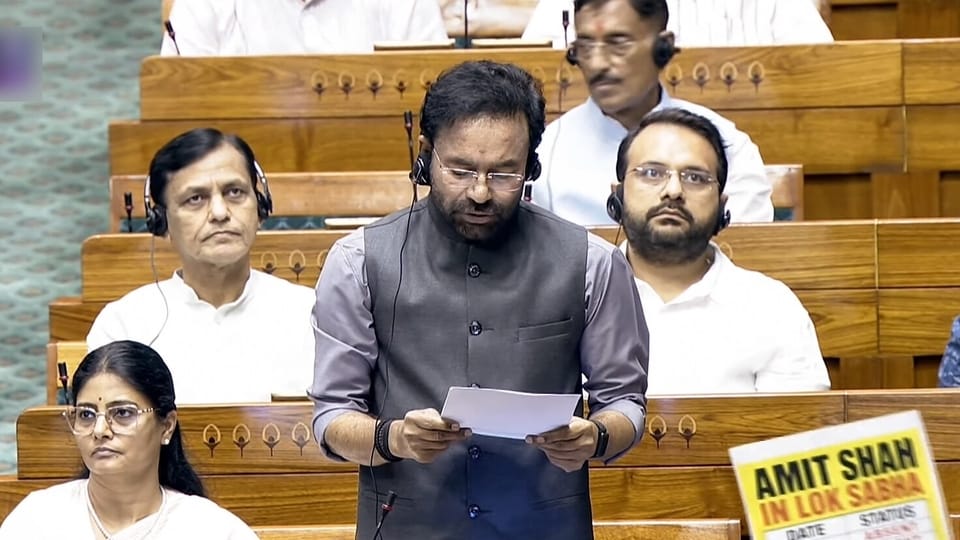
The bill was introduced in the Lok Sabha on Monday by Union Minister G Kishan Reddy amid vociferous opposition protests over police action against protesting students that have set the backdrop for the Monsoon session of Parliament. Parliament has passed five bills out of the 12 introduced or taken up for debate so far this session.
Deep Dive

The amendments are the fallout of a July 2024 ruling by the Supreme Court that upheld the power of states to levy taxes on mineral rights and and mineral-bearing lands-- separate from royalty under the Mines and Minerals (development and regulation) Act, 1957. The court had held that royalty payable under the Act was not a tax and that the MMDR Act does not limit the legislative power of states to tax mineral rights.
Also Read I SC to hear PIL alleging breach of guidelines in Odisha DGP appointment process
The verdict was hailed as a major fiscal victory for mineral-rich states such as Jharkhand, Odisha, Chhattisgarh and Rajasthan, potentially yielding a revenue windfall, but it deeply unsettled mining companies facing retrospective taxation from April 1, 2005. Industry observers estimated the financial impact between ₹1.5-2 lakh crore, with the Centre informing the court that public sector undertakings alone would face a burden of roughly ₹70,000 crore.
Acting on the ruling, the top court in August 2024 permitted states to recover past dues over 12 years beginning April 1, 2026, though it barred penalties and additional interest, granting partial relief to the sector. However, the retrospective nature of the levy and competitive ramifications continue to be contested by the Centre and private mining entities.
“No tax, cess or such other levy” on mineral rights
The amendment bill introduces a new section that states that “no tax, cess or such other levy (by whatever name called) shall be imposed by the state government on mineral rights; or mineral bearing lands, either based on mineral quantity or mineral value or royalty payable…except in accordance with such conditions or restrictions as may be prescribed by the Central Government.”
The new section also invalidates state levies that are uncollected or undeposited as of the amendment Act coming into force. Levies already deposited or collected would be not liable for refunds.
Also Read I Let’s make critical minerals deal work
Through amendments in Section 2 and 3 of the Act, the Centre also seeks to take under its control the regulation of mineral-bearing lands having mineral contents in accordance with the parameters prescribed under the MMDR Act. “Unbalanced imposition of steep taxes and levies will prompt the industry to completely bypass local supply lines, leading to sub-optimal development of markets, increased transportation costs and the resultant pollution load,” Reddy said in the statement of objects and reasons.
Referral to Parliamentary Standing Committee
Congress MP Sasikanth Senthil has written to the Lok Sabha speaker, calling for the bill to be referred to the Parliamentary Standing Committee on Coal, Mines and Steel for a detailed scrutiny first.
“The Bill raises serious concerns over State fiscal powers, federalism, retrospective legislation and the delegation of legislative powers to the Centre. I have particularly flagged the proposed Section 9D, which seeks to restrict state governments from imposing taxes, cess and other levies on mineral rights and mineral-bearing lands, while giving the Centre the power to prescribe the conditions governing such levies,” he said in the letter, adding any bill that directly impacts state revenues, federalism and judicial determination should not be rushed through in Parliament.
Environmental experts' and opposition's concerns
RSP MP NK Premachandran, meanwhile, called the bill ‘dangerous’. “It is taking away the power of states,” he told reporters. “What we were seeing was that the Imposition of high taxes, cesses and levies particularly by mineral-rich states, through the ‘mineral bearing land’ tax was impeding growth overall,” said B K Bhatia, a mining policy expert and former Director General at the Federation of Indian Mineral Industries (FIMI). “Some states were effectively free to levy a bunch of taxes, which now, can be properly regulated in a more uniform way by Centre’s guidelines,” he added.
Environment experts, however said the shift from regulating ‘mines’ to ‘mineral-bearing land’, coupled with restrictions on States’ power to levy cess or taxes, may curtail their fiscal space to regulate and mitigate the impacts of mining.
Also Read I Eye on China, India and US conclude critical minerals and rare earths framework
“It is therefore important that, while framing the rules under the amended law, the States’ ability to impose levies for environmental remediation and public health is preserved, particularly given that much of India’s mineral belt overlaps with forests, rivers and other ecologically significant landscapes that provide critical ecosystem services,” said Debadityo Sinha, lead for climate and ecosystems at the Vidhi Centre for Legal Policy.