
 E-Paper



Interview: Soumitra Ranade, author, Bhrigu and the Palace of Mirrors
Film maker talks about writing his first action-adventure novel for children


In the book, you’ve mentioned your experiences of weaving stories for your kids. Is there a story you’ve heard from your parents/grandparents that has stayed with you?
I don’t know if this is a generational thing, but my parents always told us real stories. Both of them came from highly educated and yet extremely poor families, and survival itself was a big struggle for them. Their childhood stories were fascinating for us. They were both political beings and told us stories of the independence movement, the Partition, the Gandhi assassination and so on. During the summer vacations we would stay at my grandparents’ place in Kolhapur. My grandmother was a devotee of Sant Dnyaneshwar, the Marathi poet-saint, who was the harbinger of the Bhakti movement in Maharashtra. She would recite verses from his book and interpret it for us. Listening to her, late into the night, in the dim yellow light of an oil lamp in this very old house in Kolhapur was absolutely mesmerising.
Do you feel that the current generation of children is less likely to fall for “illogical” fantasy? Have adults created an atmosphere where children are unlikely to willingly suspend disbelief?
In fact, it is the other way round isn’t it? We were told by our parents to read newspapers every day; to keep abreast with what’s going on in the world and also to improve our language. Today, I can’t even tell my children to read the papers. They carry only depressing news and the language is terrible! The “real” being what it is, and hardly ever inspiring, children have no other option BUT to move towards the “unreal”. But regardless of the period, I think children have always lived in their own little worlds, full of fantasy, adventure and mystery. It’s easier for children today to articulate their fantasies in tangible terms as they are exposed to such magnificent animation and VFX films.
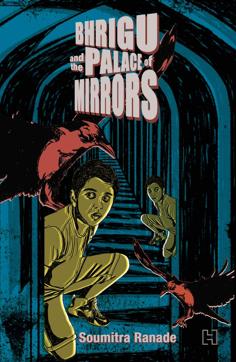
Lucknow is at the core of Bhrigu… You’ve mentioned how the city’s Bhool Bhulaiya has always fascinated you. What draws you to it?
The very reason for its creation is fascinating. In 1785, when a devastating famine had hit Awadh, Nawab Asaf-Ud-Daula started its construction and the objective was to provide employment for people in the region for almost a decade while the famine lasted. What a noble thought it was and while the people were looked after, they ended up creating a masterpiece! Architecturally, the labyrinths are extraordinary. There are more than 1000 passages and about 500 identical doorways. One can get lost in seconds. And they have done some wonderful things with acoustics as well.
You have used black-and-white illustrations in Bhrigu… Was this to keep it in line with the “ancient”, historical aesthetic of the story?
The reason is more financial than aesthetic. Colour books are expensive to publish and hence become unaffordable. We want more people to read books and keeping them cheaper helps that cause. Personally, this wasn’t a compromise. A lot of my work since my art school days has been in black-and-white.
In Bhrigu… it’s Lucknow; you also illustrated a children’s picture book, Varsha’s Varanasi, in 2018. Do you consciously engage with cities more or is that incidental?
Cities do fascinate me. Each city, town or even a hamlet has its own ethos, its own culture. And in India we are especially lucky to have such an enormous diversity. This is what makes us so unique. Imagine Ajmer and Madurai or Nashik and Itanagar! Even Mumbai and Pune are so vastly different. Within Mumbai, too, Mulund is so different from Malad. This blows my mind. I am continuing with the adventures of Bhrigu, and this time I am considering Jantar Mantar at Delhi as the backdrop.
Whether it’s animation or graphic novels or anything remotely using illustration as a medium of storytelling, in India it’s still seen as catering to a younger audience. How have you engaged with such preconceived notions over the years?
For a nation that has such enormous visual traditions, quite remarkably, today we are pretty much visually illiterate. Our great stories like the Mahabharata, Ramayana or the Jatakas were made accessible to people through hugely varied mediums such as sculptures, wall paintings, illustrated manuscripts, miniature painting and a wide variety of tribal art. These were all pictorial depictions of events, thoughts and philosophies. People then could actually “read” an image and there was not even a need for the written word. Over time, the written word has completely taken over our being, relegating the image to a secondary position. And as it always happens, whatever is secondary in stature is pushed down to the secondary citizens; we pushed the image “down” to the children.
Most of your projects have been in the genres of satire and fantasy: Jajantaram Mamantaram, Ali Baba aur 41 Chor, for instance. You also collaborated with your wife, Shilpa Ranade, on Goopi Gawaiya Bagha Bajaiya. What draws you to this particular kind of cinema?
But this is just one side of me. I have also made Albert Pinto Ko Gussa Kyun Aata Hai? and a documentary on Afghanistan and I am currently making a long documentary based in Arunachal which explores man’s relationship with nature. I have also written many scripts which I know will never be made into films. So I have this dual personality where on one side I love to be in a dark, depressing and edgy space, while on the other, I also love to be in a fantasy, adventure and fun space. I usually alternate between the two. I had lived Albert Pinto for a few years and it was important for me to write this book. It is basically to maintain my own sanity that I keep going back to children’s writing and films. I feel more hopeful in that space.
Films such as Jajantaram… and Goopi Gawaiya… are political films in their own right. Can you explore similar projects now, at a time when many believe artistic freedom is being curtailed?
I want the government to ban the 50mm lens for example. No outdoor shootings. No surround sound. No actors from a certain religion… no crew members from a certain caste… I want this to go on and on and on… till one is left only with a room and chair, and perhaps a window for the light to come in. Then what will we, as artists, do? Will we still have the courage to tell our stories? Some will definitely find a way. I certainly will.
Artistic freedom is a myth. No filmmaker has ever had any freedom. If not political, it’s been financial. And financial is also political in a sense. Today, every single shot that I take in my film costs me lakhs of rupees. What freedom can you expect from the director?
While Goopi Gawaiya… is an overtly political film, I am pleasantly surprised that you call Jajantaram Mamantaram one. Of course it was one! It was made during the time when we had a binary king controlled by an evil commander who had then unleashed a demon called Jhamumda, who now controls our lives. But very few people got it.
You are working on an animated feature film on Rabindranath Tagore’s story, Kabuliwala. You spent some time yourself in Kabul. What memories do you have of the place and will the adaptation have elements from your personal experiences?
We were in Kabul from when I was 13 years old to when I was 16 -- critical years in everyone’s lives. To be in a place like Afghanistan during these formative years left a very deep impact on my life and the work I do and the world view that I have.
I remember Afghanistan as a beautiful country and the Afghans as perhaps the most loving people in the world. Despite acute poverty and hardships, they had an extraordinary spirit. While we were there, we witnessed some of the most defining moments of modern history: the-then USSR backed military coup, the Soviet army coming in and then, after we returned, we followed the events with horror and despair: the Americans, the Taliban, and soon, an entire country was completely destroyed and its people annihilated.
There are many lessons to be learnt from what’s happened to Afghanistan. Unfortunately, no one is in the mood for any introspection. The genius of Tagore lies in the fact that although the story was written in 1893, it is still relevant today, in fact even more so. As the world grapples with issues such as insider versus outsider, us versus them and so on, Kabuliwala is a tale of humanity, about the two unlikeliest of friends – a big burly man from Kabul and a little girl from Kolkata. It is very important for me to make this film. Like I said earlier, to maintain my own sanity, if nothing else!
Asad Ali is an independent journalist. He lives in New Delhi.


