
 E-Paper



Luke Kennard: “Even in the worst situations, there’s usually something funny”
The author of the Booker-longlisted Black Bag on his novel’s humour and its portrayal of academia, marriage and the loneliness of our times

 Prefer HTon Google


From where did you get the idea for Black Bag?
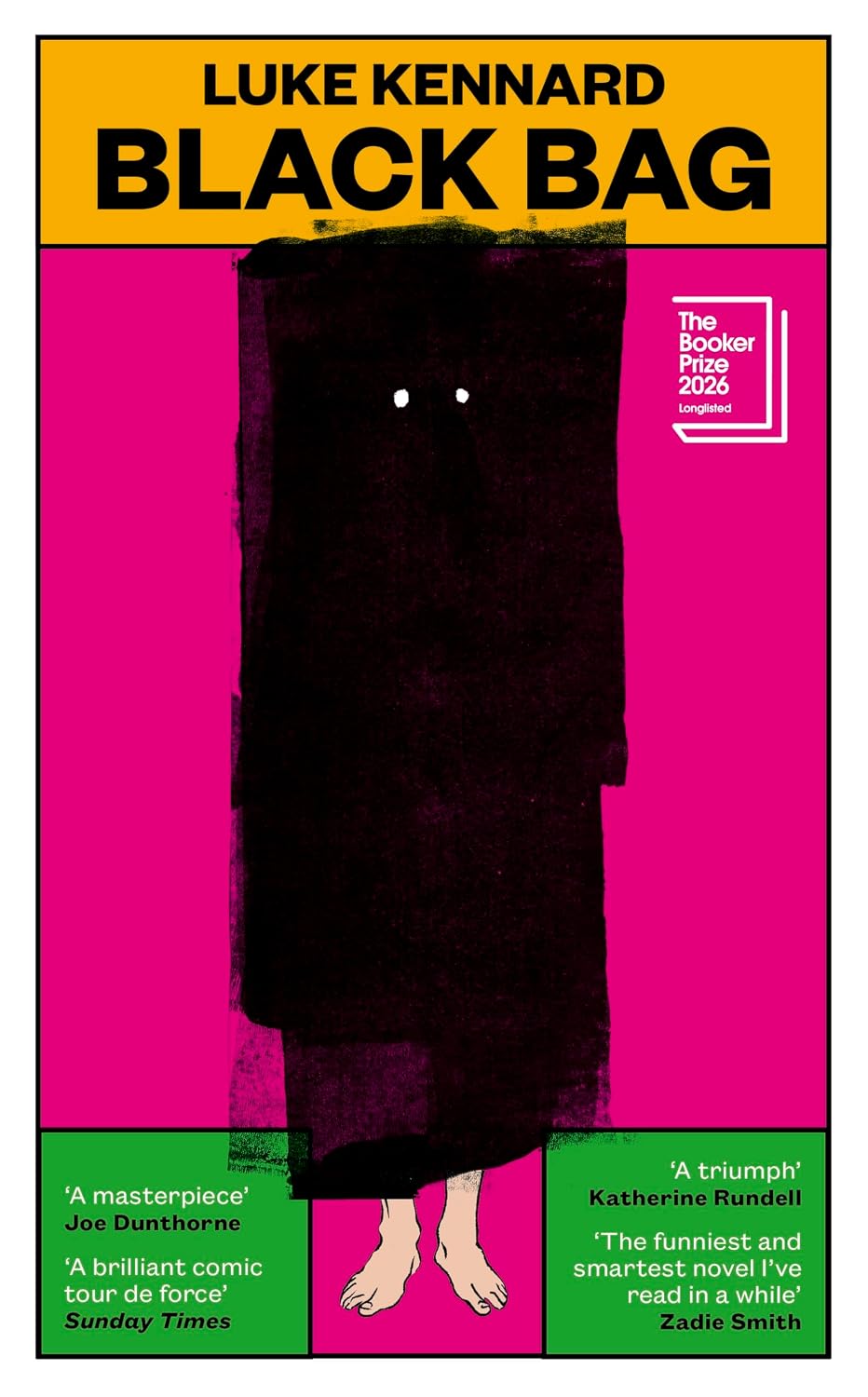
I read an original experiment in a psychology essay about attraction theory, about why we love the people we love or are friends with the people we’re friends with. And the original experiment from 1967 was mentioned in a footnote. I was just reading this essay sort of out of interest, really, but Black Bag really captured my attention straight away. And it just struck me as something that had potential to talk about, I suppose, to talk about the artist, the writer, the actor, any kind of artist really, in the 21st century and what your status is, what the frustrations of that are, how you can try and still be committed to your art at a time when it doesn’t feel particularly valued and you’re not really encouraged to pursue it. So I liked the idea of, rather than what the experiment was supposed to test, which was other people’s reaction to Black Bag, I was more interested in the out-of-work actor who had to portray Black Bag. And that just struck me as a good way in to write about some things that bothered me, that interested me.
Is your novel also a kind of experiment?
Yes, it was. And in a way the novel is just one long monologue, one long theatrical monologue, from a frustrated writer, a frustrated actor, who also has a lot in common with a frustrated writer, I guess, who just sort of feels like they’ve not really achieved what they wanted to achieve when they had a dream of being an artist or an actor or a writer. So, it was a sort of experiment, and it was quite different to things I’d written in the past. And the setup of a psychology experiment kind of meant that the writing process itself could feel like running through an experiment, could feel like setting something up and seeing what happens and writing down the results. So even though that was just going on in my head, it felt like using the model of the psychology experiment, of a case study, to try and come up with a story.
The book has many monologues on the purpose of life from the perspective of a struggling artist. Do these monologues reflect the loneliness of our times?
Yes, that’s true. That’s a significant part of it. We’re all more connected than we’ve ever been through the digital, but we’re also quite lonely. We’re more cut off from our immediate communities than we used to be. And it’s beautiful that we’re more globally connected. It’s beautiful that we can talk across cultures and across countries. And that’s a really extraordinary thing. But the way that things like social media have developed is that we’re all, kind of, isolated performers. We all see ourselves as complete individuals who are trying to be special, who are trying to stand out more than the next person. We’ve lost some idea of the communal and the collective. Some of that has been lost in the way, and we’ve been encouraged because we are less powerful when we’re separated. So I wanted one of the characters in the novel to be an influencer, to be a sort of moderately successful influencer who is connected to a million people every day through his video streams, but he also feels completely alone. He feels lonelier than the narrator does. He’s sort of isolated even though he has hundreds of thousands of people who he’s communicating with and talking to.
The narrator says, “academics could be as bad as actors”. Did you intend to bring out the gritty truths of academia?
Yes, I did, and not in a way that would offend my university. But the tradition of the campus novel is quite an important one, and it’s becoming a bit more popular again. It was back in the sort of 1950s onwards. So you have Kingsley Amis and, famously, David Lodge, who was an academic at Birmingham, the same university that I teach at. And I didn’t want to make it a kind of satire of management necessarily. I wasn’t so interested in that. Whatever is done to universities, they kind of survive in one way or another, down to who’s teaching at them and who sort of makes it feel worthwhile. But, yes, the narrator sort of realizes that academics might be just as competitive and unpleasant as actors are. They might be just as driven. They might be just as happy to do each other down in order to get ahead.
Because, to a certain extent, a lot of jobs are a kind of performance. You want to instil confidence in your audience, and that’s whether you’re giving a lecture or whether you’re acting a soliloquy. You want people to be convinced by your performance. And the other lecturers that he meets, even if they’re quite committed to their jobs, they’d be the first to admit that they’re working in quite a strange profession. I do think academia is a strange job. Every day you go from sort of teaching 18-year-olds in a big room to talking to a PhD student one-to-one for an hour, line-editing their work with them, to a sort of three-hour-long committee where you’re talking about long-term strategies and key performance indicators and business speak like that. In academia, you have to go from being a business person to a mentor to a clown to a sort of teacher. You’re having to do that kind of every few hours, basically switch to another role.
You once used the expression “the suburbanisation of the soul”. Please talk about that.
Yes, that’s an important moment. If we lose any belief in the magical or in the metaphysical or the spiritual, whichever way you want to see it, if we reduce life to kind of either a biological or an economic process, that to me is the suburbanization of the soul. It’s kind of the death of art in a way. If there is no art anymore. And one of the things that the narrator is so upset about throughout the novel and the kind of work that he can get is that it doesn’t feel like art to him. Until I was about 10 years old, I lived in a place called Luton in the UK, which is a fairly bleak town outside London. That’s a boring place, a dull place. I was happy as a child, but it’s a place where nothing much happens. So, it’s about a kind creative and spiritual reduction that the novel is trying to write against in some way. And that includes kind of writing against artificial intelligence and things like that.
Sometimes the narrative turns anachronistic when the narrator recalls his life in Sweden. What was your intention there?
It is almost like a past life. One of the things that I believe about art is that if you describe a dream within a novel, the dream is no more real and no less real than the real-life scenes described within the novel. It’s actually just on an equal plane. So, any level of fantasy or improvisation, it’s all just text. So actually, it’s the same. And as a reader, I enter into — I’m always interested in dream sequences in films and novels and how they work. It’s equally real. So, I wanted to play around with that a little bit. I wanted to see if I could make his daydream about Sweden into something quite poignant, something where he actually finds a meaningful connection and then feels sad when Birgitta passes away towards the end of the novel.
The novel is an interesting inquiry into marital relationships. Justine’s relationship with her husband symbolises deep indifference. Has it become a normal phenomenon of our contemporary times that you wanted to explore?
It’s sort of the beginning of exploring that, in a way. If we think of the tradition of the novel, it’s quite dependent on the family unit and the life story that depends on a kind of fixed address, a household with parents and children, extended family. A lot of the kind of logical progression of plot comes from that. That’s less the case now than it used to be. And some of the reasons for that are financial, but some of the reasons for that are people exploring alternative relationships and sexualities. But what that does to narrative, to plot, is really interesting. In some ways this goes back a long way. There’s a tradition of this even in the Victorian novel, where it was on the surface very strait-laced, but underneath a lot of strange things were happening. But I sort of wanted Justine, and her relationship with her husband, to be something quite liberating in a way, from expectation and from society. But I haven’t come to any conclusions on that. I think it’s just the beginning of something.
Your writing frequently finds humour in uncomfortable situations. How important is that to you?
It doesn’t have to be this sort of separate thing. You can write quite a serious novel that has moments of levity or moments of humour within it. Whether people find it funny or not is sort of outside of me as a writer. I think occasionally I’ll try to construct something that’s a joke. Like even the mistaken identity bit goes back to Shakespearean comedies, where Claudio borrows Black Bag and goes around pretending to be the narrator for a day. So there are situations, and there’s also an element of slapstick, of physical comedy, when the narrator is in the black bag. He has to use his head to open doors, and he has to have his bank card taped to the inside of it so he can pay for things. And personally, most conversations I have with people, one of the ways in which we try to connect is through making each other laugh, through finding what is funny in a given situation. And so, if that gets left out of a novel, it lacks realism for me. If something is just not funny at all, because even in the worst situations there’s usually something that is — even if it’s painfully funny, it’s still funny.
What aspects of the present moment most trouble or fascinate you as a writer?
Sometimes, as a writer, you’re like a barometer. You just absorb what’s going on. You absorb things from the discourse around you and you filter them in some way, and there are things that you decide you want to comment on. You do that without even thinking about it. If you’re writing an account of anything set in the present day, you’re going to be encountering the ideas that are around you. You’re going to be commenting on them somehow. But there are things that you sort of want to satirize and things that you think are kind of better handled in a documentary. But inevitably certain issues come through, and in the case of Black Bag, that includes: what does it mean to be a man in the 2020s, and what are the kind of tensions and contradictions of that? What does it mean to see yourself as an artist in the 2020s? What are the kind of contradictions of that? And then to be a male artist as well. I like talking to people in real life. I like talking to people in a café or in the seminar room. I like the kind of human conversations that we can have. But I’ve never found it very edifying to argue with people online because it doesn’t bring out the best in any of us. But it’s also what surrounds us. And we read more of that stuff. We read more comments and arguments between strangers than we read of literature and considered journalism. And that’s a real shame. That’s part of why we’re isolated, because we get stuck in the digital version of communication that is semi-real but very distorted as well, and it divides us.
So, that’s part of what any novel can do -- give you as a writer, and the reader as the reader, the sort of time to really think about something, a less extreme version of something.
Mohd. Farhan teaches English at Jamia Millia Islamia, a Central University in New Delhi.


