
 E-Paper



One Indian Girl book review: Chetan Bhagat’s novel fizzles out
The new Chetan Bhagat novel has a female narrator but despite its bold variations, One Indian Girl largely sticks to the script.


Author: Chetan Bhagat
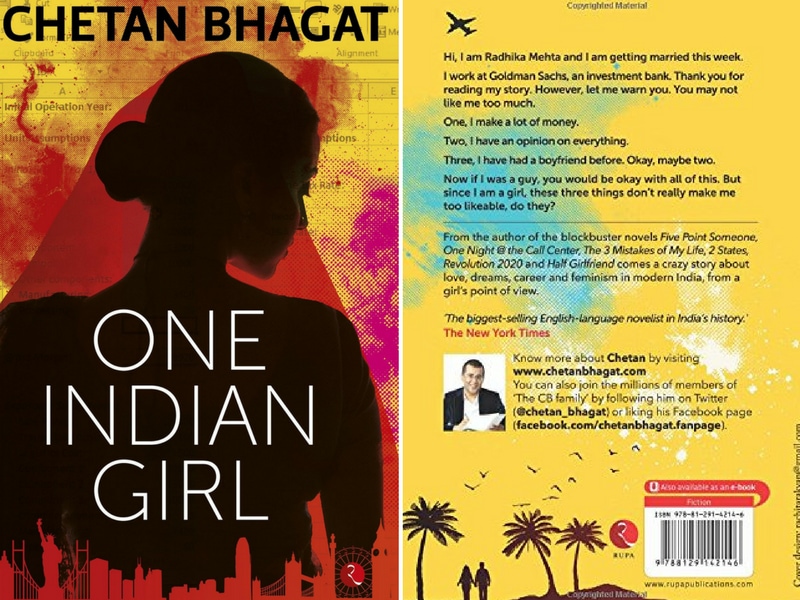
Price: Rs 176
One Indian Girl begins with a Punjabi family. Check. Obviously, there is a wedding. Check. You can’t possibly forget a dramatic mother coupled with a relatively sober father and a troupe of aunties. Check. Chetan Bhagat could probably come up with a code for what entertains the Indian masses, for Punjabis plus a wedding seems to be his favourite algorithm. And One Indian Girl is not too different.
In a first, a Chetan Bhagat novel has a female narrator but despite its bold variations, it largely sticks to the script. That doesn’t mean it has to be admonished because, after all, there is comfort in pattern and traditions.
One Indian Girl’s only motif, apart from putting up a spectacle loved by readers, is an inquiry into the mind of an Indian woman -- not a girl, but a woman. It delves into the wonderfully weird narrator, Radhika, whose internal monologue is as comical as it is relatable. Through conversations with herself, she tells the story of being born in a family that always wanted a boy but settled for an overachieving, nerdy career woman who can’t find a groom for herself because she isn’t a “girl anymore”.
Through the narrator, One Indian Girl explains why patriarchy thrives in India; not just because it is imposed by the men, but because these societal rules and restrictions are internalised by women. It is when Radhika seeks validation from her insecure boyfriend, who earns less than her, that the ugly scars of gender discrimination are visible. The realisation strikes again when the Goldman Sachs vice-president is told by her lover/married boss he did not see her as a “maternal” figure. Eventually, her past asks her to make a choice a lot of women would be familiar with: Pursuing a glittering career or living a fulfilling, homely life. Neither of her lovers recognize that a woman could want, and have, both.
But there are bigger chinks in the protagonist that stream in darker shadows of the society. In the opening chapters, the narrator thinks to herself, “This is how we girls are. At times, we want to be wanted even when we deny it.” Although the statement merely refers to the popular belief that women seek attention, it is a far cry from the lesson taught by Amitabh Bachchan’s resounding “She said No” in the movie Pink. It serves to tell us that stereotypes are dangerous, that all women may not enjoy shopping and not everyone wants a man to fawn over as she spurns him. To categorise a woman as attention-seeking is a lot like claiming all men are sexual predators. It is as nearly as ridiculous as Chetan Bhagat attempting to understand women’s psyche by getting himself waxed...
Like the indication that the society needs to change, Radhika too evolves from an under-confident geek to a decisive character living on her own terms. Her metamorphosis throws in another emerging pattern. Like Kangana Ranaut-starrer Queen, the woman has to move out of the confines of her country and out of the watchful gaze of the Indian society to discover herself. On the contrary, Radhika’s mother and sister -- who remain in India -- are deeply rooted to tradition, often justifying the system’s claustrophobic walls and following its rules mechanically.
There are, however, glaring misses in the story. While Radhika’s love life soars and topples, her professional growth only sees a straight upward trend without any blips. By zooming in on just one element of the character’s life, the author inadvertently simplifies her and relegates her issues to merely her personal life.
Read | Daddy’s Girl review: Swati Chaturvedi’s novel is the quintessential metro read
Alas! All good things must come to an end. After an intelligent first half, One Indian Girl turns into a standard Chetan Bhagat bestseller (or a future box office hit?). The plot comes to a full circle as the scene once again turns to the Goan wedding and melodrama ensues as the oblivious family dances to ‘chittiya kaliya’.
The larger question is: Is it worth spending time over? The novel can be best described as a slight anomaly from the ordinary. By the end, it’s like an advertisement theme song you don’t care about, but one that you can’t stop humming. But Bhagat’s status as a bestselling author may compel his huge readership base to spark a dialogue on feminism and equal rights. Even though it falls short of making real impact, it may just be a beginning.


