
 E-Paper



Report: Shillong Literary Festival
The fourth edition of the festival, held at the city’s famous Ward’s Lake from 18 to 20 November 2024, celebrated regional voices from north east India

 Prefer HTon Google


Shillong, having recovered from a rather frantic musical weekend of grooving to Akon and Bonnie M, is just about waking up. It’s a Monday morning and street hawkers are setting up shop for the day as I trudge up the city’s famous Ward’s Lake road.
This year, the cherry blossoms are sparse, but refreshingly beautiful nevertheless. On one side is a row of shops prepping to showcase and sell Meghalaya’s finest food, handicrafts, and beer. On the other, is an impressive set up of the fourth edition of the Shillong Literary Festival, all decked up to showcase the best of northeastern literature and arts for the next three days.
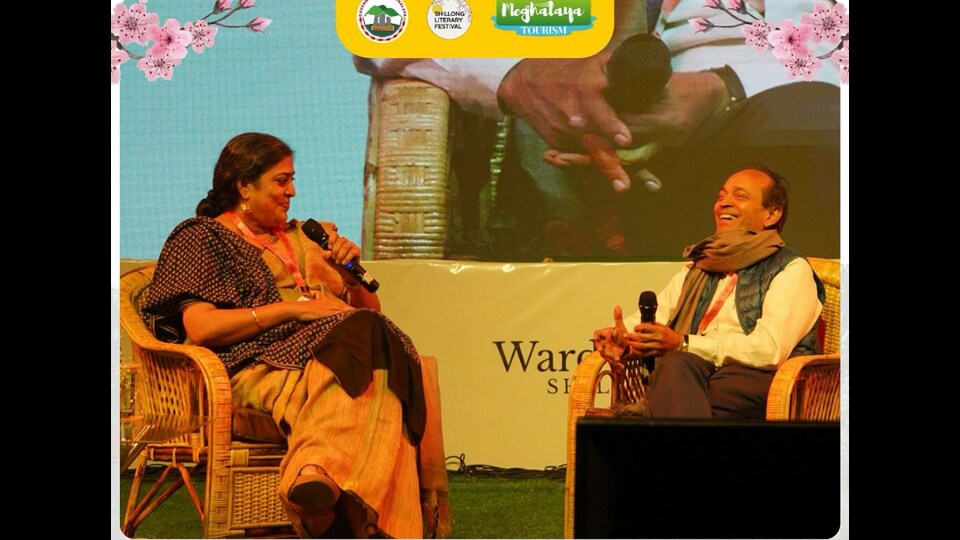
It is day one of the festival and the winter sun is gloriously shining upon us. Novelist Vikram Seth, fresh from travelling across the northeast in his red Maruti Jimny, delivered the keynote address. Accompanying him was journalist and writer Shobhaa De, along with the chief minister of Meghalaya, Conrad Sangma, and the tourism minister of Meghalaya, Paul Lyngdoh.
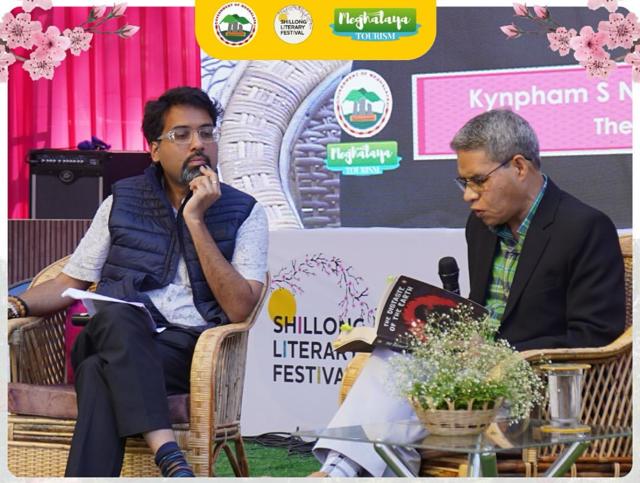
Winner of the 2024 Shakti Bhatt Literary Prize, Khasi author Kynpham S Nongkynrih, kicked off the first official session of the day. He spoke to literary agent Kanishka Gupta about how the tragic love story of Manik Raitong and Lieng Makaw inspired him to write his book, The Distaste of the Earth. His fascination with the archetypal lover Manik Raitong’s life led him to explore and use Khasi folklore to create a fictional world of kings and queens, princes and princesses, warriors and lovers.
Amabel Susngi’s sensational session on preserving Khasi lullabies had the PhD scholar singing one of her grandmother’s folk songs. Next, Vikram Seth dramatically recited his poem Fire from The Revered Earth, along with Jerry Pinto’s theatrical performance around his book, The Education of Yuri.
Day Two began with a sumptuous meal of Wak Kappa, a traditional pork dish of the Garos of Meghalaya, and rice beer. Khasi poet, dramatist, and scholar Streamlet Dkhar, Bikash Rai Debbarma, a litterateur and composer from Tripura, Anil Kumar Boro, an academic and folklorist known for his contributions to Bodo literature, and Basan Marak, a Garo writer of songs and fiction conducted an enlightening session on indigenous voices of the north east. With opening remarks about Thomas Jones, the founding father of written Khasi literature, the conversation moved on to the advent and evolution of Khasi texts during the nineteenth century. Dkhar emphasized the works of figures like Rabon Sing Kharsuka, Jeebon Roy Mairom, and Radhon Sing Berry who played an imperative role in documenting Khasi culture and folklore in response to the rise of Christianity during that time. This proved to be an imperative literary foundation that preserved indigenous Khasi beliefs and traditions. In the early twentieth century, the poetry of figures like SoSo Tham, Father Elias and Victor Bareh flourished. While their work featured themes like nature, patriotism and cultural pride, contemporary Khasi voices, Dkhar explained, focus on critical perspectives like gender, social justice and environmental issues. She spoke about the global influence on Khasi literature and explained how she too has incorporated forms like the Japanese Tanka and Haiku into her own poetry.
Day Three kicked off with a morning session on the representation and inclusivity of actors from the northeast in mainstream Bollywood cinema. Filmmaker Nicholas Kharkongor (best known for his Netflix film Axone) who is from Shillong and film producer Nancy Nisa Beso (whose latest short film Ade, won the best film at MAMI 2024) from Nagaland who both now live in Mumbai spoke about their journeys. Nicholas revealed that he stumbled into films after working in theatre in Delhi for a decade. Nancy who was inspired to tell stories after watching Notting Hill has now worked with John Abraham, Priyanka Chopra, Farhan Akhtar and Vidya Balan, among others. With the third of season of The Family Man and the second season of Paatal Lok being set and filmed in Nagaland, the panellists concluded that setting commercially viable series in the region is perhaps the first step towards sensitizing the general Indian public towards the culture and people of north east India.
The festival ended with legendary Khasi folklorist Desmond Kharmawphlang’s enlightening session on unwritten oral traditions. An enthralled full house listened to his experience of recording epic songs directly from the lips of a singer in a remote village in the Garo Hills and of meeting Gesar epic singers in Mongolia. He spoke too of songs about the family village system and of clan migration that are sung only when there is a death in the family, and of how, in the Balkans, epics are sung only during weddings.
All in all, the Shillong Literature Festival exuded much warmth, charm and originality.
Arunima Mazumdar is an independent writer. She is @sermoninstone on Twitter and @sermonsinstone on Instagram.


