
 E-Paper



Review: Contingency Plans for the Apocalypse and other Possible Situations by SB Divya
Speculative scenarios that showcase the changing relationships between the natural world and the human body


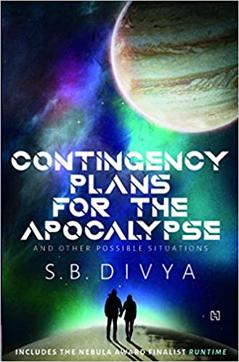
In author Vandana Singh’s essay on SF as a genre, A Speculative Manifesto, she remarks on how, in her words, “modern realist fiction is divorced from the physical universe,” so much so that it appears as if human beings “exist in a vacuum devoid of animals, rocks, and trees.” Therefore, what becomes immediately apparent in some of the stories that make up SB Divya’s collection of speculative short fiction is how nature itself is a protagonist driving or, in important ways, adding to all the narratives. Contingency Plans for the Apocalypse and other Possible Situations presents its readers with visions of possible worlds through the eyes of different characters who redefine what humanity comes to signify during times of change; technological, climate based or changes in the very make up of the human body. Her speculative scenarios straddle different times and spaces and showcase the changing relationships between the natural world and the human body in addition to dealing with themes of migration, women’s rights, economic inequalities, familial bonds in all their complexities, without ever becoming overly didactic. From this collection, which includes Divya’s Nebula award-nominated novella Runtime, the stories that particularly stand out are Microbiota and the Masses: A Love Story, An Unexpected Boon and the titular Contingency Plans for the Apocalypse.
In An Unexpected Boon, the relationship between the natural world and humans is finely etched. Here, the protagonist Kalyani, who sees and experiences the world very differently, is delighted when she is offered a beetle as a companion who helps her in navigating the world outside. Taking on mental health and societal expectations, the story, written in a simple and controlled prose, makes it apparent that this collection even with its varied speculative worlds set in different times, is also a commentary on the present.
The author plays on language in interesting ways so the stories resonate with the particular time and space in which they are set. What makes Microbiota, which can be seen as an exercise in cli-fi (climate fiction), stand out is that with an ailing biologist at the centre of the narrative, all the figures of speech used come to be deeply mired in natural terms. Whether it is fingers that “curled away, like the leaves of a Mimosa pudica: touch-me-not” or a palm that “felt warm and smooth, like eucalyptus bark in sunlight” or even subtle analogies such as “Problems tangled her thoughts faster than she could prune them away,” the language used reflects the natural world.
In the titular story for instance, which has a non-binary character as the narrator, Divya’s use of language can also be seen as a way in which she not only points to the limitations of language itself in painting visions of alternative realities, but also by challenging the reader and set notions of the use of the written word, she also points to the revolutionary capabilities of the genre itself, much like Singh does in her essay. The story begins in an Arizona at a time when abortion clinics are not only illegal but the cost for running such operations means death. The narrative touches upon the dangers of a totalitarian state’s need for control over women’s bodies in a nuanced manner while at the same time it can also be seen as offering a critique of an able-ist society.
One of the few voices of South Asian origin in the speculative genre, Divya’s short fiction collection marks her out as an important figure in this burgeoning space. Her stories, which are about the human condition, reflect in form and content the CJ Cherryh quote that the author includes as an epigraph before the contents page: “Nothing’s hopeless except never trying.”
Simar Bhasin is an independent journalist. She lives in New Delhi.


