
 E-Paper



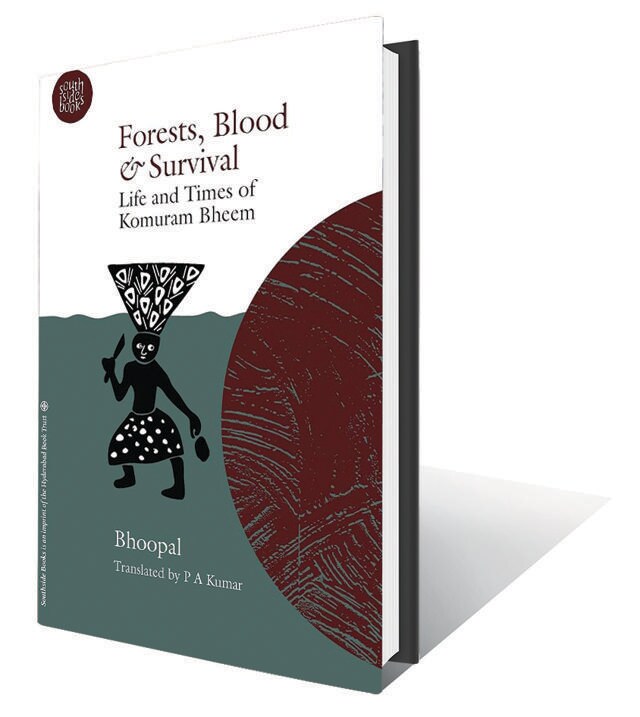
Review: Forests, Blood & Survival by Bhoopal
Actor-writer Bhoopal reimagines the life of Komuram Bheem, a legendary Gond tribal leader, and his fight against the exploitation of the tribals by the rich and powerful.

 Prefer HTon Google


In this thrilling novella, actor-writer Bhoopal reimagines the life and times of legendary Gond tribal leader Komuram Bheem, the ruthless exploitation of the tribals by the rich and the powerful, and how the tribe learns to stand up to these forces.

Bheem was born in 1901 in a hamlet in Sankenapelli in the erstwhile Hyderabad state. His family was extremely poor, often surviving on vippa flowers. As a child, Bheem could not fathom why their rich harvest of jowar, red gram, gingelly, green gram and ragi was taken away by forest officials – often in exchange for a handful of salt. Not just his Gond tribe, even others like the Kolam, Pardhan, Koya, Andh, Chenchu, and Bhil living in the forests of Adilabad met with the same fate. They had to pay goat tax, cow tax, ox tax, plot tax, hut tax and grass tax, among many others, or face severe punishment.
Bheem’s family collected vippa flowers during the season and this was their staple food throughout the year. Collecting them at the crack of dawn was not easy as wild bears also fed on them. The family had to literally fight the bears to collect the blossoms.
Despite being mercilessly plundered, the tribal people continued to live their lives, pretending like nothing had happened. “The chill of winter did not bite them, the rain did not soak them, and the light of the sun did not scorch them. Nothing bothered them. They lived happily together – playing and singing, and harvesting their crops,” writes Bhoopal.
Bheem’s grandfather, Motiram Gond, distracted the children who went to bed hungry each night with stories of Gond ancestors who were kings of the forest.
While the other children slept through the stories, Bheem didn’t. He had many questions for his grandfather: Why did the officials hate them so much? What was their fault? Who owned the forests?
“This water is ours; this air is ours; the sunlight is ours, the sky is ours; the rains are ours. Then why is the forest not ours? How did this forest and land become theirs?” he would ask his grandfather.
Motiram Gond would tell Bheem that they are the kings of the forests, and that the forests belonged to them alone – not to the money lenders or the nawabs.
On one occasion, when Bheem was playing with other boys in the forest, forest officials caught Pyku, one of his friends, cutting twigs. Despite everyone’s pleas, the officials decided to punish Pyku.
“The sergeants held Pyku’s right hand down on a teak log on the ground. Even though he squirmed, crying loudly, and tried to push them away, they cut off his fingers. The whole forest shivered with the echoes of Pyku’s screams.”
Bheem’s concern about the state of his tribe deepened after his friend’s fingers were cut off, and his father and grandmother died in quick succession – the former of a gangrenous wound on his leg and the latter of hunger.
A few seasons later, at Bheem’s insistence the Gond tribe decided to stand up to the forest officials, and he ended up killing a man who worked for the Nizam. The tribe is forced to flee and Bheem lands himself a job in a printing press. Vitoba, the owner of the press, teaches him to read and write in Telugu, Hindi and English and indirectly shapes his future.
Bheem’s circumstances force him to traverse various parts of the country, and he eventually finds himself in a tea garden in Assam. Labourers here are made to pluck tea leaves without lifting their backs. They are lashed if they even lift their backs to wipe off sweat. If a labourer dies he is quickly replaced by another as there is no dearth of labour.
Stories of Ramji Gond and other rebels start playing in Bheem’s mind and he is convinced that the tribe should take back the forests which were snatched from them in 1918 by “thieves”.
Bheem returns to his village and reunites with his family. Since he can speak chaste Urdu, and read and write, the village head employs him. He becomes a star overnight when he convinces a policeman to re-allot a piece of disputed land to his employer. Taking advantage of his rising popularity, he assembles the people of 12 villages, and tells them to protect their lands against officials and the Nizam’s men as they would against wild animals.
“The establishment of the kingdom of the Gonds is our aim. Our flag will bear the emblem of the burning torch,” he says.
Seeing the rebellion gain momentum, the Nizam tries to bribe Bheem by offering him land. When Bheem does not relent and ups the ante against the Nizam, the latter crushes the rebellion. Bheem, who created the famous slogan, “Jal, Jungle, Jameen” (Water, Forest, Land), was killed on September 1, 1940, at the age of 39. However, Gonds commemorate his death on April 8, 1940. A symbol of Gond rebellion, he is eulogised in Adivasi and Telugu folk songs. In 2014, after the creation of Telangana, the state government allocated ₹25 crore for the construction of the Komuram Bheem memorial, in the form of a tribal museum at Jodeghat and another at the Jodeghat hill rock.
Based on scant anecdotal evidence, Bhoopal reimagines Bheem’s rebellion in a way that’s far more powerful and poignant than the myths that surround the larger-than-life icon.
One of the founders of the Jana Natya Mandali, a famous cultural troupe in the Telugu states of Telengana and Andhra Pradesh, he is also a noted actor. PA Kumar’s translation from the original Telugu is lucid, and the accompanying illustrations by Aelay Laxman lend depth to the story.
Lamat R Hasan is an independent journalist. She lives in New Delhi.


