
 E-Paper



Review: Unfolding by Rahul Singh
A novel that presents two very different couples brought together by the need to feel less alone in the world, this is a study of love as a journey into the self

 Prefer HTon Google


Rahul Singh’s debut novel may, at first glance, be perceived as a queer romance centred on two male protagonists. However, within the first few pages, the novel soon unfolds (wordplay intended) into a philosophical treatise on love and the ways in which it manifests as a driving force behind some of our most important and often life-defining choices. Unfolding has two love stories at its centre: one features Ojas and Ralph, who are navigating the complexities of being in an open homosexual relationship in the midst of societal pressures and familial interventions, and the other has Ralph’s house help Zubina and her husband Aadil, both shaped by traumatic family histories, going about their hard lives taking care of each other and their two daughters as best they can. As the narrative progresses, Zubina and Aadil and their heteronormative existence turn out to be more than just a foil to Ralph and Ojas even as the latter couple are constantly in search of a concrete vision of a shared future. In the novel’s fictional universe, though Ralph and Zubina occupy widely disparate worlds, they are brought together by their inherent human need to feel less alone in the world.

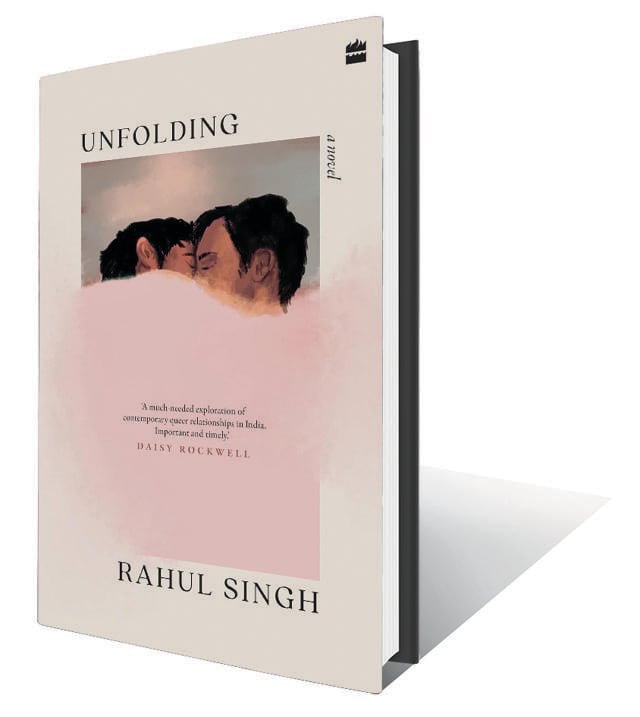
With an ostensibly simple narrative structure and a linearly progressive storyline spanning from the summer of 2019 till late autumn in Kolkata, Unfolding culminates in the annual Durga Puja celebrations. There are no dramatic plot shifts or, as the reader might expect from a story set in Kolkata, a climax being built up to align with the days of the Puja. True to its title, the novel is a slow excavation of love and a study of how it can bring out the best and the worst in people. Both Ojas and Ralph belong to affluent families that don’t fully accept their sexual orientations and by extension, their relationship. While Ojas’s parents constantly inundate him with marriage proposals, Ralph is still processing the grief of losing his mother. Not only had she shown him what love felt like but had also passed on her passion for baking resulting in his own thriving career as a pastry chef.
It is on the insistence of Ojas that the couple open up their relationship despite Ralph’s evident apprehensions. Meanwhile, Zubina, who works at Ralph’s and often encounters the intimacy he shares with Ojas (though never explicitly), thinks about what their partnership means. This train of thought leads her to confront her own experience of love. This, in turn, makes her think of her now-estranged elder sister Zeenat, who had sacrificed her own childhood to put food on the family table after their father was killed in a road accident. Through these two parallel narratives, Singh presents an exposition on love as an emotion, one that is perceived as a universal feeling of transcendence, and one that envelops all humans across class, culture, sexuality and religious background.

Throughout the novel’s 265 pages, it attempts to confront many pertinent questions primarily through the internal landscapes of Ralph and Zubina. One is the question of how we contend with fears unlocked in moments of intimacy that threaten our foundational beliefs about life. With accessible prose and sensitive characterisation, Singh’s novel is an exploration of the human need to belong to a person or a home or even to the self that can never be contained in neat social categorizations. Rahul Singh’s Unfolding leads the reader to the realization that it is precisely this truth that is revealed through the relationships we enter into, making love the ultimate catalyst for self-discovery.
Simar Bhasin is a literary critic and research scholar who lives in Delhi.


