
 E-Paper



Govt okays 15th Finance Commission proposal for non-lapsable security fund
Major recommendations of the 15th FC that were incorporated into the Union budget presented on Monday include boost in health spending, higher borrowing limits for states and a consolidation of Centrally-sponsored schemes implemented by states but largely funded by the Union government


Key recommendations of the 15th Finance Commission (FC) -- the constitutional body that decides the shares of the Centre and states in all taxes and revenues -- found their way into the Union budget 2021-22. Separately, HT has learnt the government has, in its action-taken report on the 15th FC’s report, accepted the recommendation to create a non-lapsable defence and security fund for the first time, which was not part of the Budget announcements because its implementation will likely be taken up later.
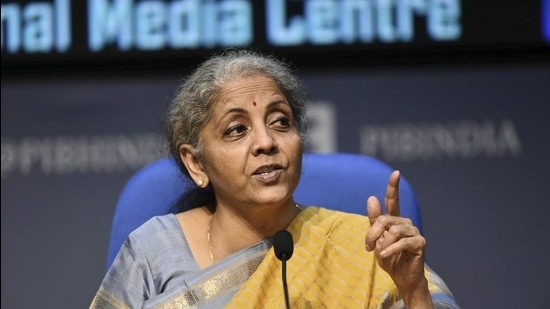
The FC had proposed a dedicated non-lapsable fund called the “modernisation fund for defence and internal security (MFDIS)”. The total indicative size of the proposed fund over the period 2021-26 is ₹238,354 crore. The NK Singh-headed 15th FC had presented its final report to President Ram Nath Kovind on November 9.
Major recommendations of the 15th FC that were incorporated into the Union budget presented on Monday include boost in health spending, higher borrowing limits for states and a consolidation of Centrally-sponsored schemes or public programmes implemented by states but largely funded by the Union government, even as the commission made its recommendation public for the first time.
The commission has suggested that 41% of the net proceeds of the Centre’s taxes be devolved to states in FY21. This is nearly the same as the commission’s report for 2020-21. The previous FC had increased the devolution to states by 10 percentage points to 42%.
The one percentage point downward adjustment had to be done on account of the erstwhile state of Jammu & Kashmir being carved into two new Union Territories—Jammu & Kashmir, and Ladakh.
The commission said it “re-calibrated the relative shares of union and states in gross revenue receipts” by cutting the grants component by 1% to allow the Centre to find the resources for the defence fund.
To meet long-term expenses for defence infrastructure, the 15th FC recommended creation of a non-lapsable defence and internal security fund either through allocation from the divisible pool of funds shared by the Centre and states or through a cess. With its acceptance, a permanent defence fund for the country is set to be created for the first time.
“No recommendation of the 15th FC has been overtly rejected,” an official said, requesting not to be quoted.
Based on the recommendations of the 15th Finance Commission, the Union government will converge and cut down the number of Centrally-sponsored schemes to rationalise them, finance minister Nirmala Sitharaman said in her budget speech.
Also read | India to borrow big for nearly half-trillion dollar budget
“On the recommendation of the 15th Finance Commission, we have undertaken a detailed exercise to rationalise and bring down the number of Centrally-sponsored schemes. This will enable consolidation of outlays for better impact,” Sitharaman said.
Boosting state governments’ finances, which have been hit both by the pandemic and poor realisation of the Goods and Services Taxes (GST), the budget has provisioned to allow states a normal ceiling of net borrowing at 4% of gross state domestic product (GSDP) for the year 2021-2022.
“A portion of this ceiling will be earmarked to be spent on incremental capital expenditure. Additional borrowing ceiling of 0.5% of GSDP will also be provided subject to conditions. States will be expected to reach a fiscal deficit of 3% of GSDP by 2023-24, as recommended by the 15th Finance Commission,” the finance minister said.
The 15 FC had recommended, based on uniform norms of assessing revenues and expenditure of the states and the Union, total revenue deficit grants of ₹294,514 crore over the award period for 17 states.
Accepting this proposal with slightly lower allocation, Sitharaman said, “I have also provided, on the commission’s recommendation, ₹118,452 crore as Revenue Deficit Grant to 17 states in 2021-2022, as against ₹74,340 crore to 14 states in 2020-2021.”


