
 E-Paper



ONGC’s once cash-rich reserves have shrunk by over 90% on govt demands
ONGC’s largest shareholder, the Indian government, has been tapping state-run companies including the country’s biggest energy explorer to bridge its fiscal deficit.


India’s Oil and Natural Gas Corp., which once had $4.3 billion of funds, is now bleeding cash.

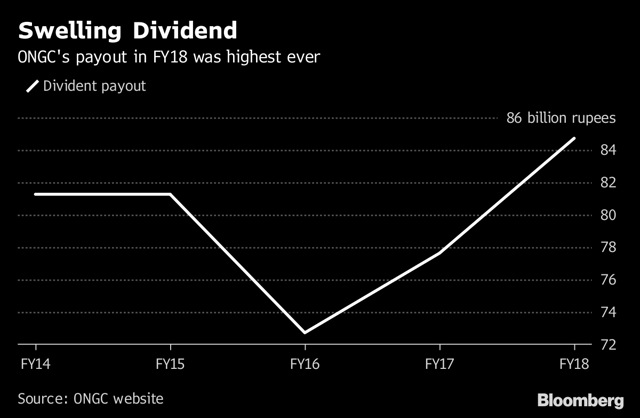
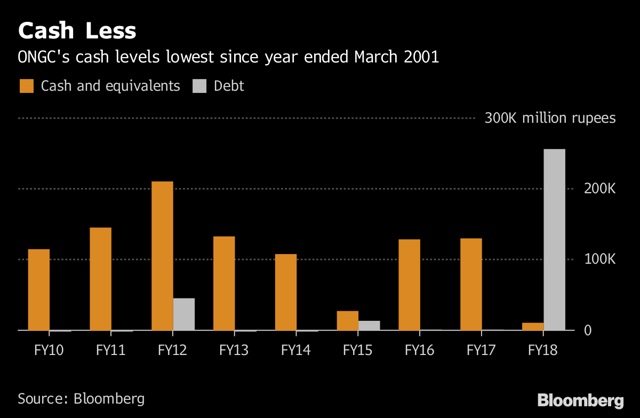
The state-run company’s cash reserves have shrunk by more than 90% in the past year, after it was ordered to purchase the administration’s stake in a refiner and it paid a record dividend. ONGC’s reserves dropped to about ₹10 billion($148 million) as on March 31 from nearly ₹130 billion a year earlier, according to data complied by Bloomberg.
ONGC’s largest shareholder, the Indian government, has been tapping state-run companies including the country’s biggest energy explorer to bridge its fiscal deficit. That’s left the company with depleting cash at a time when it has been ordered to boost investment to help cut the nation’s crude imports. ONGC paid ₹426 billion last fiscal year as dividend to the government and to buy its stake in the refiner.
“ONGC is heavily leveraged now,” Aloke Kumar Banerjee, the company’s former finance head, said in an interview. “It’s important for exploration companies to have sizable cash balance as buffer. It’s a high-risk business.”
The energy explorer’s shares have fallen 17% from a January high. They dropped as much as 0.40% on the National Stock Exchange at 11.09 am, while the benchmark S&P BSE Sensex gained 0.4%. The company’s spokesman declined to comment on its falling cash levels.
ONGC aims to spend ₹860 billion on 31 big projects to boost oil and gas production, according to its website. The company has started work on its largest-ever exploration project that will require investments of more than $5 billion over about four years.
Earlier this year, ONGC sold debt for the first time to pay for the ₹369.2 billion acquisition of the government’s holding in refiner Hindustan Petroleum Corp. Its capital expenditure swelled to a record ₹729 billion in the year ended March as it also invested ₹283.5 billion on exploration and production, and ₹74.8 billion to buy a stake in a block operated by Gujarat State Petroleum Corp, according to the company’s website.
ONGC has about ₹250 billion of one-year loans maturing in January, according to company officials, who asked not to be identified as they are not allowed to speak to the media. It used up cash it had for capital expenditure and the acquisitions and needs about ₹21 billion rupees more for the final dividend payout for the year ended March, the officials said.
The company officials said that ONGC has no plans to raise more debt to fund its capital expenditure of 320 billion rupees in the current fiscal that started April 1. Cash flows through the year will suffice, they said.
In the past, ONGC has been asked to share fuel subsidies by selling oil to refiners at a discount, a burden that was taken entirely off its back only in the year ended March 2017.
Despite these pressures ONGC ’s credit rating remains good, primarily because it is majority owned by the government, which means a sovereign assurance and easier access to the domestic banking system.
Moody’s Investors Service has a very high investment grade rating on ONGC, Vikas Halan, senior vice president at the ratings company said in an interview. “In terms of financial ability, they have access to the banking sector in India unlike anybody else.”


