
 E-Paper



Havells and the art of generating profits
According to estimates of Axis Capital, with a considerable amount of capital stuck in Sylvania, Havells was seeing returns of around 33% in 2014-15. Now with Sylvania out of its portfolio, the company’s returns are expected to go up by over 50% in 2016-17. Havells currently has a cash pile of ₹1,500 crore. It needs ₹150-300 crore for annual capital expenditure.


Voices filter through the closed bathroom door next to Anil Rai Gupta’s office. A few minutes later, the 47-year-old Gupta enters his office, with an intricate line sketch of Ganesha behind his leather chair, and says: “I met one of my senior managers in the bathroom, and wanted to bring him to this office to finish our conversation. Then I saw you people sitting here and thought we will finish the conversation in the bathroom itself.”

What does that tell you? Of course, it means Gupta, the chairman and MD of the ₹6,000-crore electrical equipment giant Havells, has a large bathroom attached to his cabin. It also means that Gupta is extremely comfortable in the QRG building in Noida, its name taken from the initials of his father, Qimat Rai — so comfortable he can take decisions even in the bathroom!
That would be expected of a man who joined the company in 1992, when he was just 23 and the company made only ₹25 crore a year in revenues.
So it should not come as a surprise that Gupta took the very unemotional decision of selling Sylvania, the European lighting company Havells acquired in 2007, though Sylvania was one-and-a-half times the size of Havells.
Gupta sensed Sylvania would put Havells on the global map, and it did. “We realised if we go out of India, we require a similar network. But to create deeply rooted distribution channels in every other global market will take huge investment and time,” says Gupta. “We did not buy Sylvania out of euphoria. It was a strategic decision as the company had distribution channels in 50 countries.”
However, as the global financial crisis set in the very next year after the acquisition, businesses coming from the European markets plunged. Experts feared that the sinking Sylvania would drag Havells down with it.
With enormous restructuring, Gupta turned Sylvania into a profitable venture within three years. The company recorded a turnover of ₹3,300 crore, before Havells decided to exit it in December last year with a profit of over ₹300 crore. It sold 80% of Sylvania to Chinese firm Shanghai Feilo Acoustics for ₹1,090 crore.
Sylvania was presenting too many challenges for Havells — changes in product categories, weak demand and currency risks. “We expected 15% to 20% return on investment. But the returns were not great. We don’t want to tuck into the aspirations of keeping a brand that is not earning money,” says Gupta.
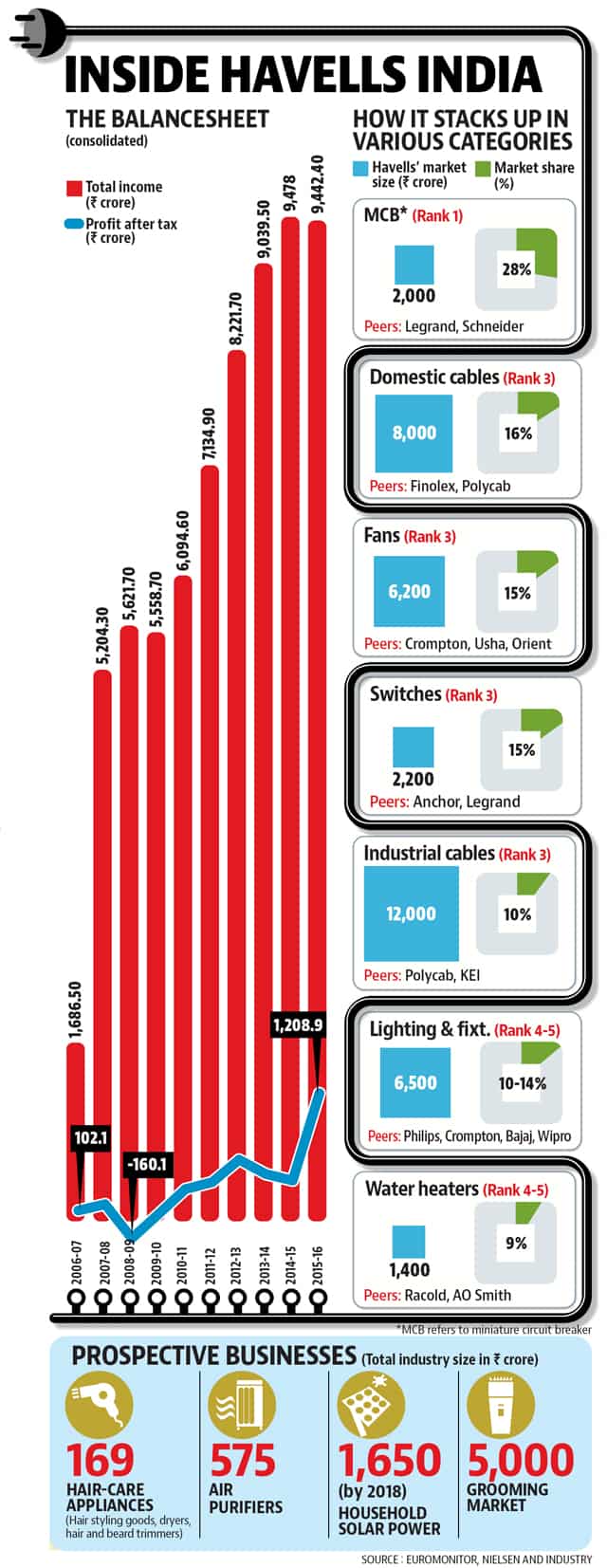
In 2014-15, Sylvania’s losses eroded 19% of the consolidated entity’s net worth. Gupta estimated that for the next two to three years, Havells needed to invest continuously in restructuring the plants to keep Sylvania’s business profitable.
According to estimates of Axis Capital, with a considerable amount of capital stuck in Sylvania, Havells was seeing returns of around 33% in 2014-15. Now with Sylvania out of its portfolio, the company’s returns are expected to go up by over 50% in 2016-17.
Havells currently has a cash pile of ₹1,500 crore. It needs ₹150-300 crore for annual capital expenditure. That leaves plenty for Gupta to play with.
Havells’s global business has shrunk to 5% of the company’s turnover, from 35% to 40% in the Sylvania years. “Now the idea is to look for growth within India. But we also have a strong product innovation, so the possibility for us to go back to the international market in a big way remains,” says Gupta. He is hunting for acquisition opportunities in emerging markets in the ₹300-crore cash bracket. The real game will be in India though.
“The management of Havells leveraged on its conventional switch gear business to add more offerings,” said Amit Mahawar, assistant director, Edelweiss Securities. “The next five to seven years would be complemented by its new focus on home automation products.”
Havells is getting into new businesses — solar lighting (it will soon install solar panels on house tops), grooming gadgets (electric razors and hair straighteners), home automation (so that your cellphone will be able to control most of your sockets). It has also set up a team to explore the option of making water purifiers.
All the areas are connected to Havells core business of lighting, switches, wires, and electrical equipment. And the focus remains largely on India, which befits the company Qimat Rai Gupta started in 1958 in a shop in Old Delhi’s famous electrical market Bhagirath Palace.
The shop, incidentally, is still there.


